
10 Law Firm Video Marketing Strategies That Win Clients

May 6, 2026

Discover 10 law firm video marketing strategies that drive real client inquiries, from awareness-stage explainers to compliance-first publishing across APAC.

10 Law Firm Video Marketing Strategies That Win Clients

May 6, 2026

Discover 10 law firm video marketing strategies that drive real client inquiries, from awareness-stage explainers to compliance-first publishing across APAC.

Law firm video marketing has shifted from a tactical experiment into a full-funnel client acquisition channel, and the gap between firms that have embraced it and those that haven't is widening fast.


Many law firms still rely heavily on referrals, static web pages, and the occasional directory listing. Meanwhile, competitors are showing up in YouTube search results, LinkedIn feeds, and Instagram reels before a prospect has even decided which firm to call. According to industry data from sources like Good2bSocial and Clio's annual legal trends reports, firms with greater visibility and early-stage credibility consistently capture more inbound inquiries, regardless of how long they've been in practice.

Video works because it answers the question a prospect is already asking, in a format they'll actually consume. This guide breaks down 10 law firm video marketing strategies organized by where they sit in the prospect's decision journey, from the moment someone searches "what happens after a DUI arrest" to the moment they click "book a consultation." This is systematic, content-infrastructure thinking. It separates firms with a real growth engine from firms that just post and hope. It's also the strategic approach we build for professional service firms across APAC at DesignBff.

Awareness-stage law firm video marketing: get your firm discovered first

Top-of-funnel video has one job: make sure your firm exists in the prospect's world before they start comparing options. The goal at this stage is visibility and initial credibility, not conversion. Three formats do this better than anything else.
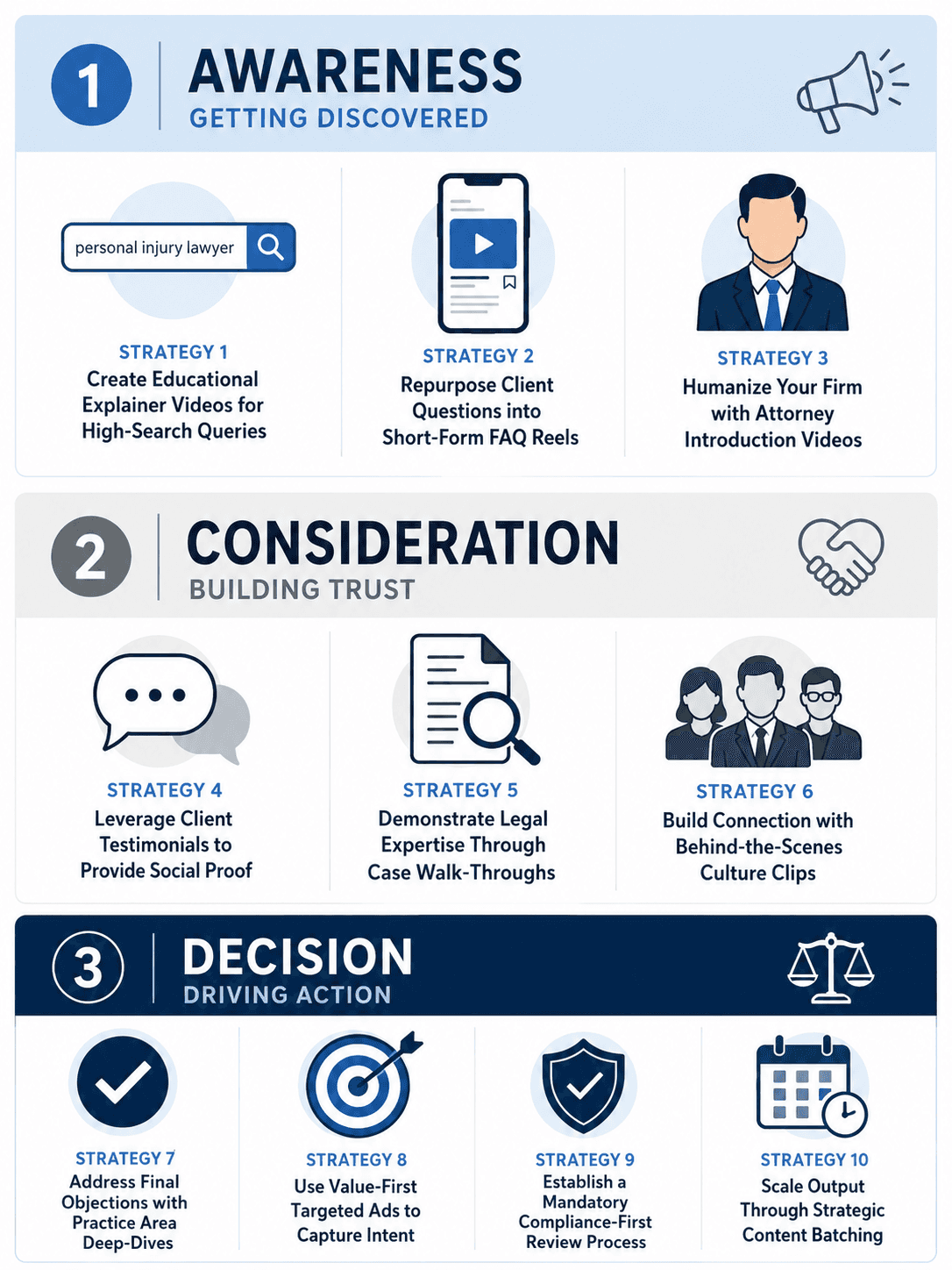
Infographic of 10 Law Firm Video Marketing Strategies That Win Clients

Strategy 1: Educational explainer videos on high-search legal questions

A 60-to-90-second video titled "What to do if you're involved in a workplace accident" is not a promotional asset. It's a search-intent asset. It works because the viewer has a specific problem and you're answering it directly. Industry research from Good2bSocial and Lead Science consistently shows that FAQ and educational short-form content generates the highest engagement lift of any video content for attorneys, with bite-sized legal tips driving up to 50% higher engagement on short-form platforms compared to general promotional content.

Keep explainers under 90 seconds for social distribution and 2, 3 minutes for YouTube, where longer watch time improves ranking. Location-specific titles ("Singapore employment law: what you need to know after a wrongful termination") consistently outperform generic ones. Always close with a direct CTA: "Book a free consultation" is enough. Don't bury it at the end.

credit: https://www.tiktok.com/@irene_thelawyer/video/7529809733188848904

Strategy 2: Short-form FAQ reels for Instagram, LinkedIn, and TikTok

A single practice area can often fuel 20 or more reels by breaking down individual client questions into standalone 15-to-60-second clips. Guidance on repurposing long-form content into multiple short clips, widely discussed in content strategy literature, supports this approach as one of the fastest ways to build consistent reach without a high production budget. The format also creates a content library that compounds over time, since each reel targets a different search query or audience interest.

Captions are non-negotiable. A significant portion of short-form video is watched without sound, and captioned content performs measurably better across all platforms. For platform strategy, LinkedIn is the primary channel for corporate and B2B practice areas, while Instagram and TikTok serve consumer-facing practices like family law, criminal defense, and personal injury more effectively.

credit: https://www.tiktok.com/@caldicottisaacslawyers/video/7421003332682009863?q=lawyer%20australia&t=1778424639257

Strategy 3: Attorney introduction videos that humanize your firm before first contact

Before a prospect books a call, they want to know who they're calling. A 60-to-120-second attorney introduction video, professionally framed and simply shot, often outperforms a written bio on engagement and can meaningfully improve conversion when optimized. Research on attorney video marketing notes retention rates 20, 40% higher for video versus text-only profiles at this stage. The video should include three things: the attorney's focus area, a brief "why I do this work" moment, and a direct invitation to connect.

These videos perform best when pinned to the homepage and embedded on the attorney's LinkedIn profile. They are the first impression for prospects who have already found your firm but haven't yet decided to reach out.

Trust-building content for prospects already evaluating your firm

Once a prospect knows you exist, the next job is proof. This is where you shift from being discovered to being chosen. Three video formats carry this weight.

Strategy 4: Client testimonial videos that do the selling for you

Testimonials are one of the most powerful trust signals in legal video marketing because they shift the voice from the attorney to a real client. Research on video content for attorneys ranks educational content and testimonials as the two highest-impact formats for lead generation, with testimonials excelling at the trust stage. A strong testimonial has a specific outcome, an emotional arc (concern before, relief after), and a client who appears comfortable and credible on camera. Keep them under two minutes and pair each one with a CTA for the relevant practice area.

Compliance is mandatory here. Obtain written client consent before publishing any testimonial. Across APAC jurisdictions including Singapore, Australia, and Hong Kong, testimonials require documented consent and claims about outcomes must be substantiated. Disclosed sponsorships or incentives must be clearly labeled per FTC guidelines and local consumer protection rules. For region-specific guidance on endorsements and influencer-type rules, see influencer marketing regulation across the Asia-Pacific.

Strategy 5: Case walk-through content that demonstrates how you think

A hypothetical or anonymized scenario breakdown lets attorneys demonstrate their reasoning without revealing client details. Structure it as: situation, complication, strategy, outcome. No client names, no identifying information. This format runs best at 2, 4 minutes and targets decision-ready prospects who are comparing multiple firms and want evidence of capability, not just credentials.

This type of content builds credibility with the prospect who has already shortlisted two or three firms and is looking for a reason to choose one. A well-executed case walk-through gives them that reason.

Strategy 6: Behind-the-scenes and culture clips that build firm identity

Short, informal clips, a team moment at a client event, a quick look at your workspace, a 30-second "day in the life" with a junior attorney, don't generate direct leads. What they do is keep warm prospects engaged during the consideration phase, which often lasts weeks. Prospects frequently follow a firm across platforms before they ever reach out.

These clips signal stability, personality, and culture. The soft factors that determine which firm gets the call are more powerful than most attorneys expect, especially in competitive markets where technical credentials look similar across multiple options.

credit: https://www.tiktok.com/@husbandandwifelaw_/video/7544130780843314445?q=lawyer%20australia&t=1778424639257

Decision-stage law firm video marketing: push prospects to take action

By this point, the prospect knows your firm and trusts you. Decision-stage content removes the last friction before they book.

Strategy 7: Practice area deep-dives that address final objections

A 3-to-5-minute video that walks through exactly what a client can expect when they engage your firm for a specific matter, the process, the timeline, the key questions, the cost structure, handles the objections that stall most prospects at the decision stage. Frame it as educational and it will convert better than most paid ads. Prospects book consultations with attorneys who have already made them feel informed and prepared.

Strategy 8: Targeted video ads on YouTube and LinkedIn

Paid legal video advertising works when it leads with value rather than promotion. The ad must answer a question or provide reassurance before it ever mentions the firm. YouTube pre-roll targeting against legal question searches reaches prospects at the exact moment of need. LinkedIn video ads work best for corporate and B2B practice areas, where professional targeting by industry, title, or company size is available.

Value-first hooks consistently outperform direct promotional ads in attorney video marketing. A 15-second answer to a common question followed by a firm introduction will outperform a 15-second brand announcement every time.

Compliance rules every attorney video must follow before publishing

Publishing non-compliant video content can trigger bar complaints, disciplinary action, and public credibility damage. Across APAC jurisdictions, including Singapore, Australia, and Hong Kong, and under global FTC standards, three rules apply to every format: content must be truthful and non-misleading; it must carry appropriate disclaimers clarifying it is general information rather than legal advice; and client consent and confidentiality must be documented and protected. Local rules vary, so always verify requirements with your jurisdiction's governing body.

Outcome guarantees are widely prohibited across many jurisdictions. Phrases like "we'll win your case" or "90% success rate" run afoul of ABA Model Rules and similar state and regional standards, as well as APAC local bar rules. Every video must carry a disclaimer stating that content is general information and does not constitute legal advice, and that viewing does not create an attorney-client relationship. For sponsored or paid content, FTC Endorsement Guide requirements apply: per FTC guidance on conspicuous disclosure, the disclosure should appear on-screen, be stated verbally, and appear in the video description. For examples of on-screen and description language you can adapt, see this guide to YouTube disclaimers. Burying a disclaimer at the end is not sufficient.

Strategy 9: Build a compliance-first review process before any video goes live

Run every video through a short pre-publish checklist before it goes live. Does the video contain any implied outcome guarantees? Is the disclaimer visible and audible? Has client consent been obtained and documented in writing? Is the attorney identified and the firm's contact information included? Is any sponsored or paid relationship disclosed upfront?

This is not a bureaucratic step. It's a brand protection system. One non-compliant video can undo months of trust-building content and expose the firm to regulatory risk that no marketing result justifies.

Law firm video production: budgets and building content that lasts

The best law firm video strategy is one your firm can execute consistently. Production budgets and distribution systems determine whether your content works long after it's published.

Choosing the right production model for your stage and budget

Three production tiers serve different needs. DIY production using a smartphone and basic editing software runs approximately $0, $250 per finished minute and works well for short-form reels and FAQ content where speed and frequency matter more than polish. Hybrid production, in-house recording combined with professional editing, typically runs $250, $2,000 per finished minute and suits attorney introductions and testimonials. Full agency production generally runs $4,000, $17,500 per finished minute and is appropriate for flagship brand films and paid ad campaigns where production quality directly affects credibility and conversion. These ranges reflect 2026 market benchmarks and will vary by market, project complexity, and geography. For a practical breakdown of typical production rates and what to expect at each level, consult this video production rates guide.

Most firms benefit from a hybrid model for ongoing content and agency production for high-stakes brand assets. Consistency of output matters more than production value for awareness-stage content. One polished brand video and twenty consistent FAQ reels will outperform twenty polished brand videos with nothing else in the mix.

Strategy 10: Build a content calendar that turns one shoot into 12 pieces of content

This is where most firms leave significant value on the table. A single 20-minute agency shoot can produce one long-form YouTube video, three to five short-form reels, two client-facing FAQ clips, and a LinkedIn thought leadership piece. A quarterly content batching session, planning topics in advance and shooting multiple formats in a single session, allows staggered distribution across platforms over 6, 8 weeks from a single production investment.

Content batching is the difference between a video campaign and a content infrastructure. This kind of planning, integrating video into a firm's broader SEO, website, and digital presence so every piece of content works harder and longer, is exactly where a strategic partner like DesignBff helps APAC firms get more from every shoot they invest in. For a deeper look at what brand strategy should deliver alongside tactical content systems, see what your law firm's brand strategy should actually deliver.

Measuring performance and refining your law firm video strategy over time

Publishing videos without tracking performance is the fastest way to waste a production budget. Three measurement tiers connect video activity to real business outcomes.

Engagement metrics, views, watch time, completion rate, signal content quality. As a practical rule of thumb, many video teams treat 50, 70%+ average completion on a 2-minute video as a strong signal that content is resonating; completion rates well below that range often indicate a weak hook or content that loses focus before it can convert. Intent signals (clicks to the consultation booking page, calls from video CTAs) measure conversion potential. Business outcomes (consultations booked, matters opened) measure actual ROI.

Use the data from each quarter to prioritize the next. Which formats generated consultation requests? Which practice areas had the highest watch time? Which platforms drove the most CTA clicks? Firms that treat video as a system, produce, publish, measure, iterate, consistently outperform firms that treat each video as a one-off project.

Start building your video strategy before your competitors do

Law firm video marketing is not about production budgets or follower counts. It's about showing up with the right format, at the right stage of the prospect's journey, with content that answers the question they're already asking. Explainer videos and FAQ reels drive awareness. Testimonials and case walk-throughs build trust. Deep-dives and targeted ads convert. A compliance-first publishing process protects everything you build. Recent coverage in the LA Times on video marketing for lawyers highlights how early adopters are capturing disproportionate visibility.

The firms winning clients through video aren't the ones with the biggest budgets. They're the ones with the clearest law firm video strategy and the discipline to execute it consistently. If your firm is ready to build a video content system that integrates with your website, SEO, and digital presence across APAC, the next step is mapping out your strategy; for tactical next steps you can implement now, see 8 Proven Ways to Strengthen Your Law Firm's Media Presence. The firms that start now will be the ones your prospects find first.


Frequently Asked Questions

What types of videos work best for law firm marketing in Australia?

Educational explainer videos and client testimonials consistently deliver the strongest results for Australian law firms. Short-form FAQ reels (15 to 60 seconds) targeting specific legal questions drive awareness on LinkedIn and Instagram, while two to four minute case walk-through videos and practice area deep-dives convert prospects who are already evaluating firms. Attorney introduction videos improve homepage engagement and consultation bookings. The best-performing firms combine all three formats into a content calendar rather than treating each video as a standalone project.

How much does law firm video production cost in Australia?

Law firm video production in Australia typically ranges from zero to $250 per finished minute for DIY smartphone-based content, $250 to $2,000 per finished minute for hybrid production (in-house recording with professional editing), and $4,000 to $17,500 per finished minute for full agency production. Most small to mid-sized firms benefit from a hybrid model for ongoing FAQ and explainer content, reserving full agency production for flagship brand films and paid advertising campaigns where production quality directly influences credibility and conversion rates.

Are there compliance rules Australian law firms must follow for video marketing?

Yes. Australian law firms must ensure all video content is truthful and non-misleading, includes a visible disclaimer stating the content is general information and does not constitute legal advice, and that viewing does not create a solicitor-client relationship. Outcome guarantees such as win rate claims or success percentages are prohibited under applicable professional conduct rules. Client testimonials require documented written consent before publication. Any sponsored or paid content must carry a clear, upfront disclosure in line with both Australian Consumer Law and FTC Endorsement Guide standards where applicable.

How do I measure whether my law firm's video marketing is working?

Start with three measurement tiers. Engagement metrics, including views, average watch time, and completion rate, indicate whether your content is resonating with the right audience. A completion rate of 50 to 70 percent or above on a two-minute video is a strong signal of relevance. Intent signals, such as clicks to your consultation booking page and calls originating from video CTAs, measure conversion potential. The final tier is business outcomes: consultations booked and new matters opened, which is the true ROI measure. Review these quarterly and use the data to prioritize the next content cycle.

How often should a law firm post video content to see results?

Consistency matters more than frequency or production quality at the awareness stage. A practical baseline for most small to mid-sized law firms is one to two short-form videos per week on LinkedIn and Instagram, supplemented by one longer YouTube video per month. Quarterly content batching sessions, where multiple formats are recorded in a single shoot, allow staggered distribution over six to eight weeks from one production investment. Firms that maintain this cadence for six or more months consistently outperform those that post sporadically, even when individual video quality is lower.

Law firm video marketing has shifted from a tactical experiment into a full-funnel client acquisition channel, and the gap between firms that have embraced it and those that haven't is widening fast.


Many law firms still rely heavily on referrals, static web pages, and the occasional directory listing. Meanwhile, competitors are showing up in YouTube search results, LinkedIn feeds, and Instagram reels before a prospect has even decided which firm to call. According to industry data from sources like Good2bSocial and Clio's annual legal trends reports, firms with greater visibility and early-stage credibility consistently capture more inbound inquiries, regardless of how long they've been in practice.

Video works because it answers the question a prospect is already asking, in a format they'll actually consume. This guide breaks down 10 law firm video marketing strategies organized by where they sit in the prospect's decision journey, from the moment someone searches "what happens after a DUI arrest" to the moment they click "book a consultation." This is systematic, content-infrastructure thinking. It separates firms with a real growth engine from firms that just post and hope. It's also the strategic approach we build for professional service firms across APAC at DesignBff.

Awareness-stage law firm video marketing: get your firm discovered first

Top-of-funnel video has one job: make sure your firm exists in the prospect's world before they start comparing options. The goal at this stage is visibility and initial credibility, not conversion. Three formats do this better than anything else.

Infographic of 10 Law Firm Video Marketing Strategies That Win Clients

Strategy 1: Educational explainer videos on high-search legal questions

A 60-to-90-second video titled "What to do if you're involved in a workplace accident" is not a promotional asset. It's a search-intent asset. It works because the viewer has a specific problem and you're answering it directly. Industry research from Good2bSocial and Lead Science consistently shows that FAQ and educational short-form content generates the highest engagement lift of any video content for attorneys, with bite-sized legal tips driving up to 50% higher engagement on short-form platforms compared to general promotional content.

Keep explainers under 90 seconds for social distribution and 2, 3 minutes for YouTube, where longer watch time improves ranking. Location-specific titles ("Singapore employment law: what you need to know after a wrongful termination") consistently outperform generic ones. Always close with a direct CTA: "Book a free consultation" is enough. Don't bury it at the end.

credit: https://www.tiktok.com/@irene_thelawyer/video/7529809733188848904

Strategy 2: Short-form FAQ reels for Instagram, LinkedIn, and TikTok

A single practice area can often fuel 20 or more reels by breaking down individual client questions into standalone 15-to-60-second clips. Guidance on repurposing long-form content into multiple short clips, widely discussed in content strategy literature, supports this approach as one of the fastest ways to build consistent reach without a high production budget. The format also creates a content library that compounds over time, since each reel targets a different search query or audience interest.

Captions are non-negotiable. A significant portion of short-form video is watched without sound, and captioned content performs measurably better across all platforms. For platform strategy, LinkedIn is the primary channel for corporate and B2B practice areas, while Instagram and TikTok serve consumer-facing practices like family law, criminal defense, and personal injury more effectively.

credit: https://www.tiktok.com/@caldicottisaacslawyers/video/7421003332682009863?q=lawyer%20australia&t=1778424639257

Strategy 3: Attorney introduction videos that humanize your firm before first contact

Before a prospect books a call, they want to know who they're calling. A 60-to-120-second attorney introduction video, professionally framed and simply shot, often outperforms a written bio on engagement and can meaningfully improve conversion when optimized. Research on attorney video marketing notes retention rates 20, 40% higher for video versus text-only profiles at this stage. The video should include three things: the attorney's focus area, a brief "why I do this work" moment, and a direct invitation to connect.

These videos perform best when pinned to the homepage and embedded on the attorney's LinkedIn profile. They are the first impression for prospects who have already found your firm but haven't yet decided to reach out.

Trust-building content for prospects already evaluating your firm

Once a prospect knows you exist, the next job is proof. This is where you shift from being discovered to being chosen. Three video formats carry this weight.

Strategy 4: Client testimonial videos that do the selling for you

Testimonials are one of the most powerful trust signals in legal video marketing because they shift the voice from the attorney to a real client. Research on video content for attorneys ranks educational content and testimonials as the two highest-impact formats for lead generation, with testimonials excelling at the trust stage. A strong testimonial has a specific outcome, an emotional arc (concern before, relief after), and a client who appears comfortable and credible on camera. Keep them under two minutes and pair each one with a CTA for the relevant practice area.

Compliance is mandatory here. Obtain written client consent before publishing any testimonial. Across APAC jurisdictions including Singapore, Australia, and Hong Kong, testimonials require documented consent and claims about outcomes must be substantiated. Disclosed sponsorships or incentives must be clearly labeled per FTC guidelines and local consumer protection rules. For region-specific guidance on endorsements and influencer-type rules, see influencer marketing regulation across the Asia-Pacific.

Strategy 5: Case walk-through content that demonstrates how you think

A hypothetical or anonymized scenario breakdown lets attorneys demonstrate their reasoning without revealing client details. Structure it as: situation, complication, strategy, outcome. No client names, no identifying information. This format runs best at 2, 4 minutes and targets decision-ready prospects who are comparing multiple firms and want evidence of capability, not just credentials.

This type of content builds credibility with the prospect who has already shortlisted two or three firms and is looking for a reason to choose one. A well-executed case walk-through gives them that reason.

Strategy 6: Behind-the-scenes and culture clips that build firm identity

Short, informal clips, a team moment at a client event, a quick look at your workspace, a 30-second "day in the life" with a junior attorney, don't generate direct leads. What they do is keep warm prospects engaged during the consideration phase, which often lasts weeks. Prospects frequently follow a firm across platforms before they ever reach out.

These clips signal stability, personality, and culture. The soft factors that determine which firm gets the call are more powerful than most attorneys expect, especially in competitive markets where technical credentials look similar across multiple options.

credit: https://www.tiktok.com/@husbandandwifelaw_/video/7544130780843314445?q=lawyer%20australia&t=1778424639257

Decision-stage law firm video marketing: push prospects to take action

By this point, the prospect knows your firm and trusts you. Decision-stage content removes the last friction before they book.

Strategy 7: Practice area deep-dives that address final objections

A 3-to-5-minute video that walks through exactly what a client can expect when they engage your firm for a specific matter, the process, the timeline, the key questions, the cost structure, handles the objections that stall most prospects at the decision stage. Frame it as educational and it will convert better than most paid ads. Prospects book consultations with attorneys who have already made them feel informed and prepared.

Strategy 8: Targeted video ads on YouTube and LinkedIn

Paid legal video advertising works when it leads with value rather than promotion. The ad must answer a question or provide reassurance before it ever mentions the firm. YouTube pre-roll targeting against legal question searches reaches prospects at the exact moment of need. LinkedIn video ads work best for corporate and B2B practice areas, where professional targeting by industry, title, or company size is available.

Value-first hooks consistently outperform direct promotional ads in attorney video marketing. A 15-second answer to a common question followed by a firm introduction will outperform a 15-second brand announcement every time.

Compliance rules every attorney video must follow before publishing

Publishing non-compliant video content can trigger bar complaints, disciplinary action, and public credibility damage. Across APAC jurisdictions, including Singapore, Australia, and Hong Kong, and under global FTC standards, three rules apply to every format: content must be truthful and non-misleading; it must carry appropriate disclaimers clarifying it is general information rather than legal advice; and client consent and confidentiality must be documented and protected. Local rules vary, so always verify requirements with your jurisdiction's governing body.

Outcome guarantees are widely prohibited across many jurisdictions. Phrases like "we'll win your case" or "90% success rate" run afoul of ABA Model Rules and similar state and regional standards, as well as APAC local bar rules. Every video must carry a disclaimer stating that content is general information and does not constitute legal advice, and that viewing does not create an attorney-client relationship. For sponsored or paid content, FTC Endorsement Guide requirements apply: per FTC guidance on conspicuous disclosure, the disclosure should appear on-screen, be stated verbally, and appear in the video description. For examples of on-screen and description language you can adapt, see this guide to YouTube disclaimers. Burying a disclaimer at the end is not sufficient.

Strategy 9: Build a compliance-first review process before any video goes live

Run every video through a short pre-publish checklist before it goes live. Does the video contain any implied outcome guarantees? Is the disclaimer visible and audible? Has client consent been obtained and documented in writing? Is the attorney identified and the firm's contact information included? Is any sponsored or paid relationship disclosed upfront?

This is not a bureaucratic step. It's a brand protection system. One non-compliant video can undo months of trust-building content and expose the firm to regulatory risk that no marketing result justifies.

Law firm video production: budgets and building content that lasts

The best law firm video strategy is one your firm can execute consistently. Production budgets and distribution systems determine whether your content works long after it's published.

Choosing the right production model for your stage and budget

Three production tiers serve different needs. DIY production using a smartphone and basic editing software runs approximately $0, $250 per finished minute and works well for short-form reels and FAQ content where speed and frequency matter more than polish. Hybrid production, in-house recording combined with professional editing, typically runs $250, $2,000 per finished minute and suits attorney introductions and testimonials. Full agency production generally runs $4,000, $17,500 per finished minute and is appropriate for flagship brand films and paid ad campaigns where production quality directly affects credibility and conversion. These ranges reflect 2026 market benchmarks and will vary by market, project complexity, and geography. For a practical breakdown of typical production rates and what to expect at each level, consult this video production rates guide.

Most firms benefit from a hybrid model for ongoing content and agency production for high-stakes brand assets. Consistency of output matters more than production value for awareness-stage content. One polished brand video and twenty consistent FAQ reels will outperform twenty polished brand videos with nothing else in the mix.

Strategy 10: Build a content calendar that turns one shoot into 12 pieces of content

This is where most firms leave significant value on the table. A single 20-minute agency shoot can produce one long-form YouTube video, three to five short-form reels, two client-facing FAQ clips, and a LinkedIn thought leadership piece. A quarterly content batching session, planning topics in advance and shooting multiple formats in a single session, allows staggered distribution across platforms over 6, 8 weeks from a single production investment.

Content batching is the difference between a video campaign and a content infrastructure. This kind of planning, integrating video into a firm's broader SEO, website, and digital presence so every piece of content works harder and longer, is exactly where a strategic partner like DesignBff helps APAC firms get more from every shoot they invest in. For a deeper look at what brand strategy should deliver alongside tactical content systems, see what your law firm's brand strategy should actually deliver.

Measuring performance and refining your law firm video strategy over time

Publishing videos without tracking performance is the fastest way to waste a production budget. Three measurement tiers connect video activity to real business outcomes.

Engagement metrics, views, watch time, completion rate, signal content quality. As a practical rule of thumb, many video teams treat 50, 70%+ average completion on a 2-minute video as a strong signal that content is resonating; completion rates well below that range often indicate a weak hook or content that loses focus before it can convert. Intent signals (clicks to the consultation booking page, calls from video CTAs) measure conversion potential. Business outcomes (consultations booked, matters opened) measure actual ROI.

Use the data from each quarter to prioritize the next. Which formats generated consultation requests? Which practice areas had the highest watch time? Which platforms drove the most CTA clicks? Firms that treat video as a system, produce, publish, measure, iterate, consistently outperform firms that treat each video as a one-off project.

Start building your video strategy before your competitors do

Law firm video marketing is not about production budgets or follower counts. It's about showing up with the right format, at the right stage of the prospect's journey, with content that answers the question they're already asking. Explainer videos and FAQ reels drive awareness. Testimonials and case walk-throughs build trust. Deep-dives and targeted ads convert. A compliance-first publishing process protects everything you build. Recent coverage in the LA Times on video marketing for lawyers highlights how early adopters are capturing disproportionate visibility.

The firms winning clients through video aren't the ones with the biggest budgets. They're the ones with the clearest law firm video strategy and the discipline to execute it consistently. If your firm is ready to build a video content system that integrates with your website, SEO, and digital presence across APAC, the next step is mapping out your strategy; for tactical next steps you can implement now, see 8 Proven Ways to Strengthen Your Law Firm's Media Presence. The firms that start now will be the ones your prospects find first.


Frequently Asked Questions

What types of videos work best for law firm marketing in Australia?

Educational explainer videos and client testimonials consistently deliver the strongest results for Australian law firms. Short-form FAQ reels (15 to 60 seconds) targeting specific legal questions drive awareness on LinkedIn and Instagram, while two to four minute case walk-through videos and practice area deep-dives convert prospects who are already evaluating firms. Attorney introduction videos improve homepage engagement and consultation bookings. The best-performing firms combine all three formats into a content calendar rather than treating each video as a standalone project.

How much does law firm video production cost in Australia?

Law firm video production in Australia typically ranges from zero to $250 per finished minute for DIY smartphone-based content, $250 to $2,000 per finished minute for hybrid production (in-house recording with professional editing), and $4,000 to $17,500 per finished minute for full agency production. Most small to mid-sized firms benefit from a hybrid model for ongoing FAQ and explainer content, reserving full agency production for flagship brand films and paid advertising campaigns where production quality directly influences credibility and conversion rates.

Are there compliance rules Australian law firms must follow for video marketing?

Yes. Australian law firms must ensure all video content is truthful and non-misleading, includes a visible disclaimer stating the content is general information and does not constitute legal advice, and that viewing does not create a solicitor-client relationship. Outcome guarantees such as win rate claims or success percentages are prohibited under applicable professional conduct rules. Client testimonials require documented written consent before publication. Any sponsored or paid content must carry a clear, upfront disclosure in line with both Australian Consumer Law and FTC Endorsement Guide standards where applicable.

How do I measure whether my law firm's video marketing is working?

Start with three measurement tiers. Engagement metrics, including views, average watch time, and completion rate, indicate whether your content is resonating with the right audience. A completion rate of 50 to 70 percent or above on a two-minute video is a strong signal of relevance. Intent signals, such as clicks to your consultation booking page and calls originating from video CTAs, measure conversion potential. The final tier is business outcomes: consultations booked and new matters opened, which is the true ROI measure. Review these quarterly and use the data to prioritize the next content cycle.

How often should a law firm post video content to see results?

Consistency matters more than frequency or production quality at the awareness stage. A practical baseline for most small to mid-sized law firms is one to two short-form videos per week on LinkedIn and Instagram, supplemented by one longer YouTube video per month. Quarterly content batching sessions, where multiple formats are recorded in a single shoot, allow staggered distribution over six to eight weeks from one production investment. Firms that maintain this cadence for six or more months consistently outperform those that post sporadically, even when individual video quality is lower.

Let’s tackle your marketing challenge and show you the roadmap to success.

Extreme close-up black and white photograph of a human eye

Let’s tackle your marketing challenge and show you the roadmap to success.

Extreme close-up black and white photograph of a human eye

Let’s tackle your marketing challenge and show you the roadmap to success.

Extreme close-up black and white photograph of a human eye

Day Job