
Hong Kong law firms targeting high-profile clients from Mainland China and cross-border markets need a fundamentally different PR approach from general market visibility tactics.
The most effective strategy positions a firm not as a full-service legal provider, but as a trusted cross-border risk navigator operating at the intersection of common law and China's commercial system.

This requires a deliberate combination of differentiated positioning, business-oriented thought leadership, third-party validation through legal rankings, Mainland-native distribution channels, and relationship ecosystems that convert professional trust into actual client introductions.
Why Is Hong Kong Law Firm PR Different for China-Facing Markets?
The context any managing partner must understand is that the Hong Kong legal market has undergone a structural shift. According to the Law Society of Hong Kong as reported by China Business Law Journal, as of August 2025, there are 82 foreign law firms in Hong Kong, 39 of which are headquartered in Mainland China, with 26 of the 36 registered association law firms paired with Mainland Chinese counterparts. This influx of PRC-headquartered firms means that competing on the basis of "China capability" alone is no longer a differentiator. The competitive question a prospective client is really asking is this: why this Hong Kong firm, rather than a PRC firm, a Magic Circle office, or a cross-border alliance?
Answering that question visibly, repeatedly, and with external validation is the central challenge that makes law firm marketing for Hong Kong firms targeting China mandates its own discipline. The stakes are also rising on the upside: between January and September 2025, there were 68 Hong Kong IPO listings representing a 45% year-on-year increase, with total funds raised reaching HKD 187.7 billion, 2.4 times the amount of the same period in the prior year. Growing deal activity means growing competition for mandates, and a firm without a coherent PR strategy is invisible at the exact moment that high-profile clients are selecting advisers.
What Makes the Hong Kong Legal Market Unique for Cross-Border Work?
Hong Kong's distinctive advantage is structural: it is a common law jurisdiction operating within China's economic system, bilingual by professional culture, and recognised by government and industry bodies as the preferred platform for commercial dispute resolution and Greater Bay Area integration. That structural position is a genuine PR asset, but only if a firm translates it into specific, credible messaging around practice areas and client outcomes. Premium legal buyers do not respond to generic claims of "Hong Kong expertise" any more than investors respond to generic fund pitches. They respond to proof of cross-border execution in situations that mirror their own risk environment.
How Should a Hong Kong Law Firm Position for High-Profile China Mandates?
Effective positioning for this market is narrow and capability-led. The most credible themes include cross-border disputes and arbitration, outbound investment structuring, sanctions and supply-chain risk, GBA data transfer and privacy, private wealth and family office matters, and sector-led positioning in finance, technology, infrastructure, and real estate. A useful frame is to present the firm as a bridge across legal systems, not merely across geographies, because that directly addresses the core concern of a sophisticated Mainland client navigating a common law environment.
Brand language should emphasize outcomes rather than credentials: regulatory confidence, board-level risk management, dispute readiness, reputation protection, enforceability across jurisdictions, and coordinated multi-jurisdiction execution. This style of messaging is what senior founders, CFOs, and general counsel actually weigh when deciding which firm to invite into a sensitive situation. Overgeneralized claims such as "full-service" or "one-stop shop" without visible proof of cross-border depth are among the fastest ways to signal generic positioning in a market where buyers have become sophisticated at distinguishing genuine capability from marketing copy.
Why Is Thought Leadership the Core PR Engine for Law Firms?
Thought leadership is the single highest-leverage PR asset a Hong Kong law firm can build, but it must go well beyond routine legal briefings to function as a client acquisition tool. The 2024 Edelman-LinkedIn B2B Thought Leadership Impact Report, which surveyed nearly 3,500 management-level professionals across seven countries, found that high-quality thought leadership directly influences which firms are invited into RFP processes, shortlisted for mandates, and trusted with premium pricing. Separately, research published by B2B International noted that the ability to display active thought leadership in a sector rose to third place among factors influencing B2B buying decisions in 2024, up from twentieth place in 2023.
For Hong Kong firms targeting China-linked work, the most effective themes are business-critical and time-sensitive: outbound investment structuring, sanctions and supply-chain risk management, GBA data transfer rules, arbitration strategy, private wealth migration, and market-entry or restructuring issues. Content should be written in plain commercial language, not for a legal audience, but for a founder, chairman, CFO, or general counsel who needs to act on legal developments quickly. Selectivity matters enormously: publishing less often with stronger positioning is more credible for premium legal brands than flooding distribution channels with undifferentiated legal alerts. A practical editorial rhythm would include a signature quarterly cross-border report backed by interviews or data, short bilingual executive briefings, and invitation-only client roundtables co-hosted with chambers, banks, or arbitration institutions.
How Often Should a Hong Kong Law Firm Publish Thought Leadership?
A law firm targeting high-profile China and cross-border clients should publish substantive thought leadership at least quarterly, with more frequent short-form commentary around active deal, dispute, or regulatory moments. Frequency matters less than consistency and quality: one rigorously researched quarterly report that earns a media pickup and generates three private roundtable invitations delivers more mandate-pipeline value than twelve generic monthly briefings that are immediately archived. The best-performing firms align their publication calendar to major regulatory moments, deal cycles, and ranking submission deadlines so that every piece of content serves multiple PR objectives simultaneously.
How Do Legal Rankings and Awards Build Trust with High-Profile Clients?
Independent legal rankings are among the few PR assets that directly transfer trust with sophisticated buyers in the way that no self-promotional marketing material can replicate. Chambers, Legal 500, asialaw, Benchmark Litigation, and ALB function as external validators that corporate decision-makers, general counsel, and referral intermediaries rely on even when rankings are not the sole basis for firm selection. The operational insight most managing partners miss is that rankings should be treated as a year-round PR program, not an annual submissions exercise. Partner bios, website practice pages, speaking pitches, media outreach, new business proposals, and client alerts should all consistently reflect third-party validation so that a prospective client encounters it at every touchpoint, not just at the ranking publication date.
Which Legal Rankings Matter Most in the Hong Kong Market?
Chambers Asia-Pacific, Legal 500 Asia-Pacific, asialaw, and Benchmark Litigation are the four most influential independent rankings for Hong Kong firms targeting corporate and high-profile clients. ALB Hong Kong Law Awards carry weight with local business audiences, and sector-specific recognition in areas like arbitration, family office, and capital markets can be more persuasive than generalist rankings for niche practice development. Firms should build structured internal PR calendars around submission timetables, client referee management programs, and post-publication amplification plans so that each ranking cycle generates maximum visibility across the full 12-month window between cycles.
What Role Do Events and Speaking Platforms Play in Law Firm PR?
High-profile client acquisition is regularly accelerated through credibility-dense events rather than open-market promotion. Hong Kong and GBA institutions continue to host legal and business forums focused on cross-border dispute resolution, commercial legal services, and Hong Kong's gateway role to Mainland China, and these forums create direct access to the narrow set of business leaders, state-linked entities, in-house counsel, investors, and cross-border advisers who represent the actual target client pool. The PR value of a speaking slot at a university arbitration centre, a chamber of commerce seminar, or an ACC event is typically higher than a general conference sponsorship, because the audience is more specific and the relationship ecosystem that surrounds the event is more actionable.
A three-layer event strategy tends to work well: flagship visibility at a small number of premium conferences with strategic audiences, owned events such as breakfast briefings and cross-border webinars co-hosted with chambers or banks, and a deliberate follow-on conversion program of private dinners and one-to-one introductions after the main event. For elite client development, the real PR value is frequently in that follow-up ecosystem, not in the speech itself. To learn how to strengthen your law firm's media presence beyond events alone, the same principle applies: sustained visibility across the right rooms, repeated to the same narrow audience, compounds into trust over time.
How Should Hong Kong Law Firms Reach Mainland Chinese Decision-Makers?
A Hong Kong law firm cannot rely on LinkedIn or English-language media placement alone to reach serious Mainland decision-makers. WeChat functions as the central channel for professional communication, authority building, lead nurturing, and relationship-based engagement in China, and Zhihu provides a separate but valuable platform for searchable expert knowledge visibility among sophisticated business audiences actively researching cross-border legal questions. If the target audience includes Mainland entrepreneurs, executives, or private wealth decision-makers, English-language media presence must be localized and redistributed through Chinese-native channels to have any material impact.
A practical China-channel stack for a Hong Kong law firm would include a WeChat Service Account as the primary owned-media hub for thought leadership and client engagement, WeChat Channels for short expert commentary and event amplification, Zhihu for expert answers on cross-border legal questions, and localized Chinese landing pages with clear sector and matter credentials. Content should be transcreated rather than merely translated, because local platform behavior, Chinese-language framing, and cultural context each require substantive adjustment from global or English-language originals. This is not a digital marketing detail, it is a client acquisition imperative in this specific market. Finding the right marketing partner for professional service firms with genuine China-channel capability is often the difference between a PR program that reaches the right people and one that simply signals sophistication to the wrong audience.
How Does a Referral and Alliance Network Support Cross-Border Client Acquisition?
For high-profile cross-border mandates, referral architecture is often as important as public visibility. Complex matters across China-related markets typically require coordinated execution across PRC and common law systems, which means sophisticated clients are looking for firms that already have trusted operational relationships with Mainland counsel, corporate finance advisers, family-office intermediaries, chambers, and arbitration institutions. PR strategy should therefore include structured alliance-building with these counterpart networks, because complex mandates are frequently won through trusted introductions before a public tender or beauty parade begins.
The most credible way to publicize alliances is through joint insight publications, co-branded events, and visible collaboration on practical client problems, rather than through vague memoranda or generic partnership announcements that signal no operational substance. A firm that co-authors a bilingual cross-border regulatory briefing with a Mainland counterpart, or co-hosts a roundtable with a major chamber and an arbitration institution, is demonstrating collaborative capability in exactly the format that sophisticated buyers find credible. Using the right CRM for your law firm to track referral relationships, follow-up timelines, and alliance touchpoints is also an underappreciated operational layer that turns relationship PR into a systematic business development function rather than an ad-hoc activity.
What PR Mistakes Are Most Harmful for Hong Kong Law Firms in This Market?
The most damaging PR mistakes in this specific market are clear and consistent. Overgeneralized positioning such as "full-service" or "one-stop shop" without visible proof of cross-border execution depth signals generic competence to buyers who are looking for specialized confidence. English-only communications when the target audience includes Mainland executives or founders effectively removes the firm from the consideration set of its most valuable prospective clients. Excessive legalese in thought leadership that fails to connect legal developments to business risk loses the C-suite audience that makes final buying decisions. Chasing large numbers of low-quality speaking events instead of selective high-trust rooms produces vanity visibility without relationship yield. Allowing untrained partners to speak reactively to media on sensitive matters in a market where reputational risk travels quickly across jurisdictions, languages, and platforms is a crisis-readiness failure with potentially significant mandate consequences.
Your 12-Month PR Action Plan for a Hong Kong Law Firm
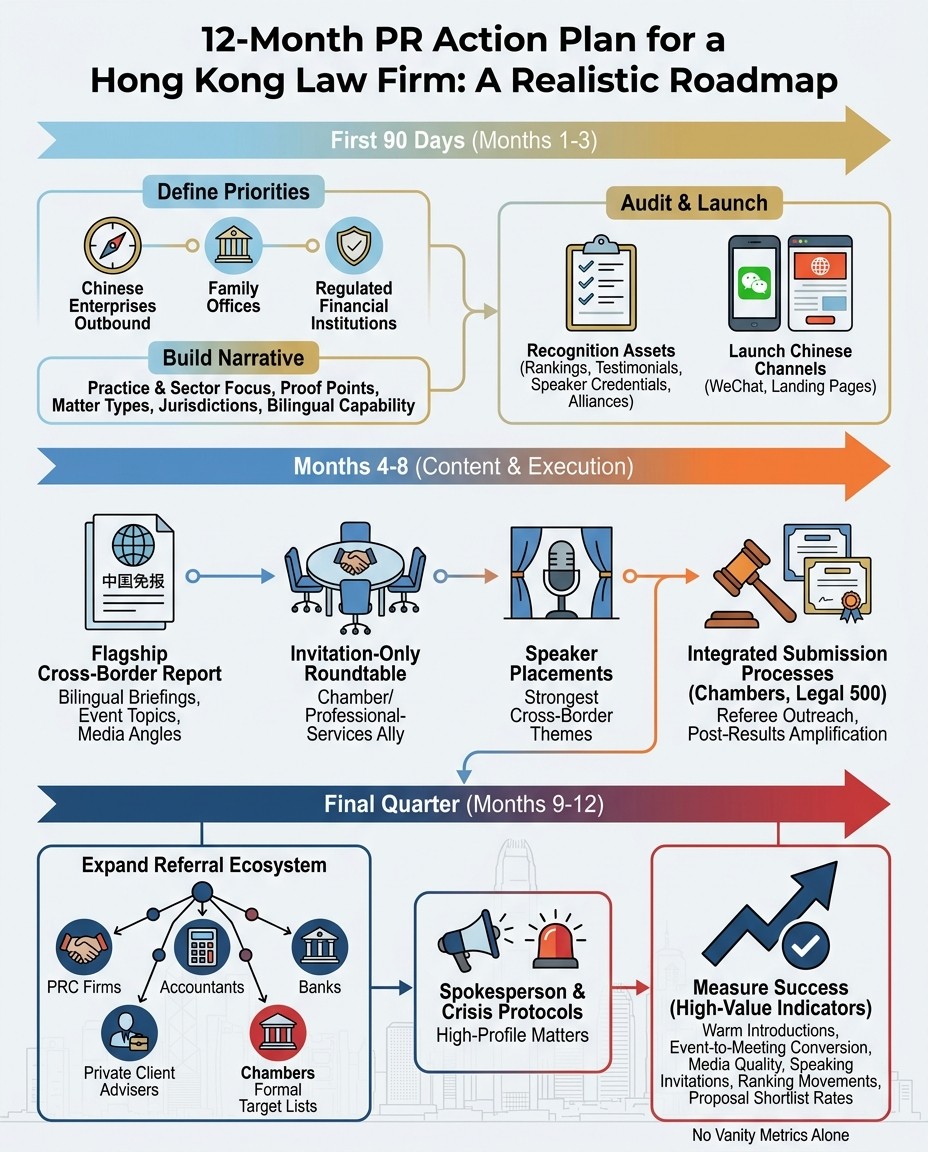
A realistic 12-month roadmap begins in the first 90 days with defining two or three priority client segments, such as Chinese enterprises going outbound, family offices, or regulated financial institutions, and building a clear narrative by practice and sector that includes proof points, matter types, jurisdictions covered, and bilingual capability. This foundation phase should also include an audit of existing recognition assets across rankings, testimonials, speaker credentials, and alliance relationships, and the launch or rebuild of Chinese-language owned channels, particularly WeChat and Chinese landing pages.
From months four to eight, the focus shifts to content and event execution: publishing one flagship cross-border report and distributing it as bilingual briefings, event topics, and media angles; hosting one invitation-only roundtable with a chamber or professional-services ally; pursuing selective speaker placements linked to the firm's strongest cross-border themes; and treating Chambers and Legal 500 submission processes as integrated PR milestones with referee outreach and post-results amplification built in. In the final quarter, the priority is expanding the referral ecosystem with formal target lists for PRC firms, accountants, banks, private client advisers, and chambers, introducing spokesperson and crisis protocols for high-profile matters, and measuring success through high-value indicators: warm introductions, event-to-meeting conversion, media quality, speaking invitations, ranking movements, and proposal shortlist rates rather than vanity metrics alone.
Conclusion
The most effective PR strategy for a Hong Kong law firm seeking high-profile China and cross-border mandates is not mass visibility. It is elite-market reputation building built on differentiated cross-border positioning, third-party validation, business-oriented thought leadership, China-native channel distribution, and relationship ecosystems that convert professional trust into actual client introductions. Firms that consistently appear credible in respected rankings and forums, speak fluently to the commercial concerns of Chinese and international decision-makers, and demonstrate operational readiness for complex multi-jurisdiction matters are the firms that win in this segment. If you are ready to build a PR strategy that attracts the clients your firm is actually capable of serving, request a free marketing audit with DesignBff today. Only 5 firms are accepted each month, and each audit is a direct conversation about the specific PR and marketing strategy your firm needs to compete for high-profile clients in China and cross-border markets.
Frequently Asked Questions
What is a PR strategy for a Hong Kong law firm targeting China clients?
A PR strategy for a Hong Kong law firm targeting China clients is a structured program that builds elite-market reputation through differentiated positioning, thought leadership, legal rankings, China-native digital channels such as WeChat and Zhihu, speaking at credibility-dense events, and referral alliance networks. It is not a mass-visibility or advertising approach. High-profile legal buying decisions are low-volume and high-trust, so the strategy focuses on repeated visibility to a narrow set of corporate decision-makers and intermediaries who influence mandate selection in cross-border markets.
How do legal rankings like Chambers help Hong Kong law firms win China mandates?
Legal rankings from Chambers, Legal 500, asialaw, and Benchmark Litigation directly transfer trust to sophisticated buyers in a way self-promotional marketing materials cannot. Corporate decision-makers, general counsel, and referral intermediaries use rankings as independent validators when shortlisting firms for high-profile mandates. To maximize their PR value, rankings should be integrated into a year-round program that includes partner bios, practice page updates, speaking pitches, media outreach, and proposal credentials, so that third-party validation appears at every client touchpoint rather than only at publication time.
Why is WeChat important for Hong Kong law firm marketing to Mainland clients?
WeChat is the central channel for professional communication, authority building, lead nurturing, and relationship-based engagement among Mainland Chinese business audiences. A Hong Kong law firm cannot rely on LinkedIn or English-language media placement alone to reach serious Mainland decision-makers, because these platforms have limited penetration and credibility among the founders, executives, and private wealth clients the firm is targeting. A WeChat Service Account functions as a firm's primary owned-media hub in this market, distributing bilingual thought leadership and capturing engagement from clients who will never encounter the firm through Western digital channels.
How much should a Hong Kong law firm invest in thought leadership content?
A Hong Kong law firm targeting high-profile China and cross-border clients should prioritize quality over volume, investing in at least one substantial flagship report per quarter supplemented by short bilingual executive briefings, issue-led webinars, and one or two invitation-only client roundtables per year. The investment required depends on firm size, but the benchmark should be content that earns genuine media pickups, generates speaking invitations, and moves rankings submissions forward simultaneously. Research published in the 2024 Edelman-LinkedIn B2B Thought Leadership Impact Report confirms that high-quality thought leadership directly influences whether firms are invited into RFP processes and shortlisted for premium mandates.
How do Hong Kong law firms build a cross-border referral network for China-related mandates?
Hong Kong law firms build effective cross-border referral networks by establishing structured alliance relationships with PRC counterpart firms, corporate finance advisers, accountants, family-office intermediaries, arbitration institutions, and chambers of commerce active in Greater Bay Area and outbound investment markets. The most credible way to activate these alliances is through joint thought leadership, co-branded events, and visible collaboration on practical client problems rather than vague memoranda or generic partnership announcements. Maintaining this network requires deliberate tracking of referral relationships, follow-up activities, and joint pipeline through a structured client relationship management system that treats referral development as a systematic business development function.