
Claude AI for Lawyers: The No-Brainer Skills in 2026

Jun 1, 2026

Claude AI is transforming how law firms work in 2026. Discover the no-brainer skills boutique law firms can deploy today to cut costs and win more clients.

Claude AI for Lawyers: The No-Brainer Skills in 2026

Jun 1, 2026

Claude AI is transforming how law firms work in 2026. Discover the no-brainer skills boutique law firms can deploy today to cut costs and win more clients.

Claude AI for lawyers is no longer a pilot experiment.

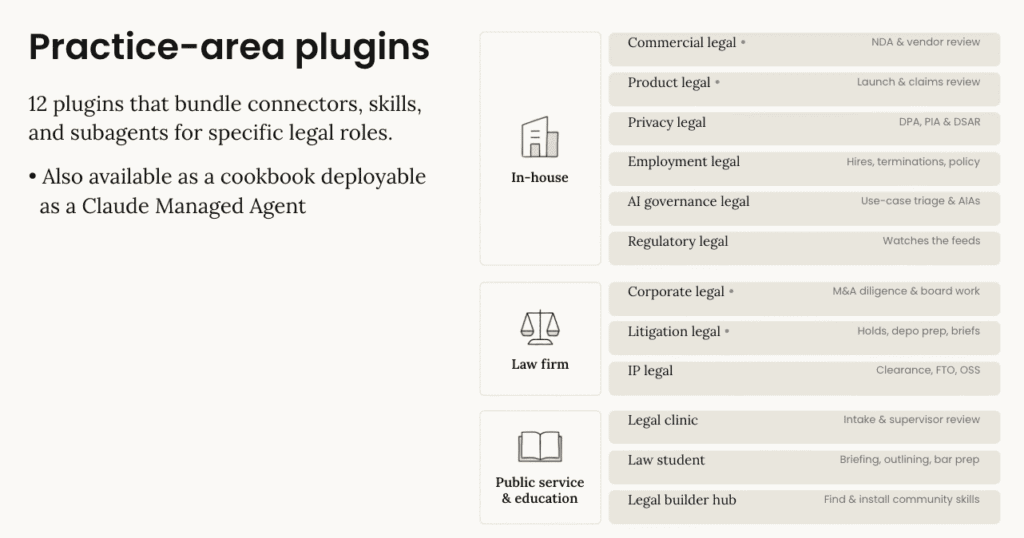
In 2026, it is operational infrastructure for firms that want to stay competitive. Anthropic's May 2026 release of 20+ MCP connectors and 12 practice-area plugins has established Claude as end-to-end legal infrastructure, not just a chat assistant.
Attorneys spend only 40–50% of their day on true expert-level legal judgment; the other 50–60% is research, document review, analysis, and administrative work that Claude is purpose-built to absorb. Law firms deploying Claude report 35–50% efficiency gains in high-volume work while maintaining or improving quality outcomes. This article breaks down the specific skills delivering immediate, measurable ROI for boutique law firms, along with the guardrails every firm must have in place before deploying them. If you are also thinking about how to position these capabilities to win clients, our boutique law firm marketing strategy guide is a practical starting point.

What Is Agentic Claude and Why Does It Matter for Law Firms in 2026?

Agentic Claude is the shift from answering questions to completing multi-step tasks end-to-end. Instead of asking "what are the risks in this contract?", you give Claude a goal: review three vendor contracts, build a prioritised risk comparison spreadsheet, flag critical clauses, request human approval at defined checkpoints, and return a final document ready for attorney sign-off. All of this completes in under 10 minutes, with a full audit trail.
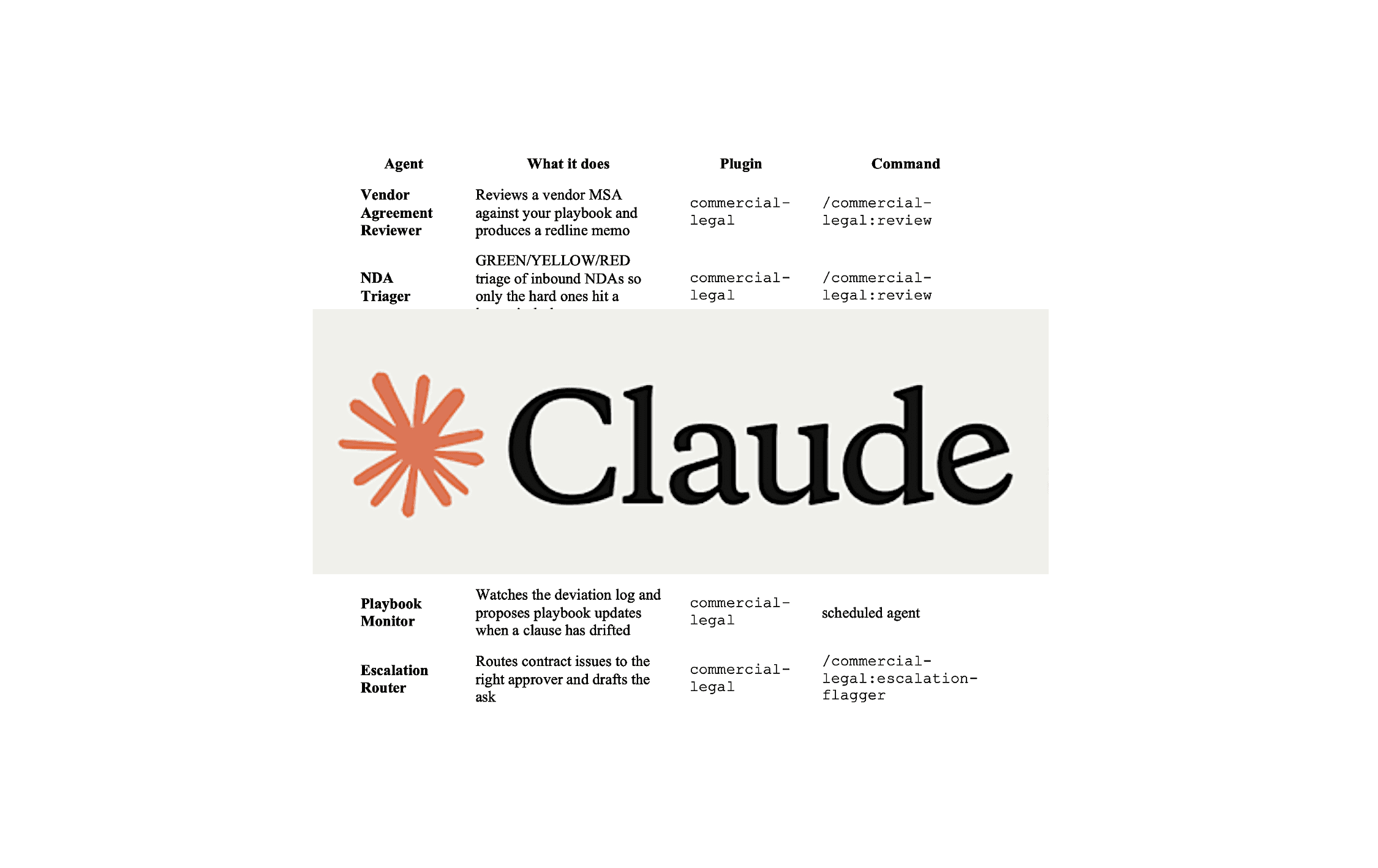
Claude Cowork receives goals, not prompts, and executes workflows across local files, applications, and connected third-party systems, with human approval checkpoints at each critical decision node. Scheduled and recurring tasks are also supported: a weekly regulatory update sweep against the firm's policy library, a daily triage of incoming contracts, and batch privilege log generation running on schedule without a human triggering each run.

3 categories of legal work are unlocked by agentic Claude: long-context work, where agents read and reason across an entire matter file rather than a single document; end-to-end work, where agents complete multi-step tasks from intake through to final document using research tools, DMS connectors, and drafting tools with human checkpoints; and memory-driven work, where agents retain prior positions, preferred styles, and client-specific preferences across sessions.

Corporate legal AI adoption more than doubled in one year, jumping from 23% to 52%, and the ACC/Everlaw survey found that 64% of in-house teams now expect to depend less on outside counsel because of AI capabilities being built internally. Understanding how to respond to that dynamic is exactly what we explore in how law firms are turning AI pilots into measurable client value.

Can Claude Review and Draft Contracts Faster Than Your Associates?

Yes, and it is Claude's highest-ROI legal skill. A 100-contract due diligence package that previously required 40–60 attorney hours is reduced to 12–20 hours with Claude handling the first-pass extraction, risk matrix, and redlines in a single workflow. Attorney review is still required, but Claude absorbs the volume work that was consuming associate billing capacity.

The workflow in practice: load the firm's standard playbook and non-negotiables into a Claude Project, upload the incoming contract, and prompt Claude to produce a risk matrix sorted by priority from critical to moderate to low. Claude extracts and categorises clauses including indemnification, limitation of liability, IP ownership, payment terms, termination, confidentiality, and dispute resolution. It flags deviations from market practice, identifies missing standard provisions such as an absent force majeure clause, checks cross-references and defined-term consistency, and surfaces contradictions between sections.

The Definely MCP connector adds a live structural analysis layer, resolving definitions and showing exactly how an edit in one clause propagates throughout the document. DocuSign and Ironclad connectors extend the workflow end-to-end, from drafting through to signature and post-signature obligation tracking.

Contract types well-suited for high-automation include NDAs, master service agreements, standard employment agreements, vendor contracts, and lease agreements. Complex M&A transaction documents, bespoke IP licensing, and high-stakes litigation settlement terms require a hybrid approach where Claude handles the analytical first pass and attorneys apply strategic judgment.

How Does Claude Process 2,500 Pages of Legal Text Without Losing Context?

Claude Opus 4.7 and Sonnet 4.6 handle up to 1 million tokens (roughly 2,500 pages of legal text) in a single conversation. An entire M&A data room, a full deposition transcript, or a 300-page commercial agreement can be reviewed in one pass, without chunking, summarising, or losing thread continuity anywhere in the document.

This eliminates the cognitive fatigue that causes attorneys to miss defined-term conflicts or factual contradictions buried deep in a lengthy document, a structural limitation of human review that Claude removes entirely. A 50-attorney litigation boutique that ran a pilot on a 500,000-document production reduced review time by 62%, from an estimated 3,200 attorney hours to 1,200. Legal research requiring 8–12 attorney hours takes 2–3 hours with Claude assisting, and the quality of the parallel analysis, not just the speed, drives the gain. Claude can also run comparative analysis across multiple contracts simultaneously, such as comparing three vendor agreements against a master playbook in a single session.

Cross-application context persistence multiplies the value further. Claude carries full context across Word, Outlook, Excel, and PowerPoint simultaneously. A redline finished in Word does not need to be re-explained when it becomes a cover note in Outlook, a closing checklist in Excel, or a board summary in PowerPoint. For boutique firms managing end-to-end transactions without dedicated legal operations teams, this removes the re-prompting overhead that fragments most AI-assisted legal work.

It is worth noting that the long-context capability applies only to documents uploaded directly into the conversation; Claude does not independently access case law databases without a connected legal database MCP connector, a distinction we cover in the research section below. For a perspective on how structured service delivery translates to client loyalty, see how small law firms build scalable client service systems.

Can Claude Help With Legal Research Without Hallucinating?

Yes, with the right connectors active, and not reliably without them. Without a connected legal database, Claude's accuracy on citation-dependent research can be as low as 10%. With Anthropic's May 2026 MCP connector ecosystem linking Claude to Westlaw, Midpage, CourtListener, Trellis, and Descrybe, every research output is grounded in verified, traceable source material and the hallucination risk specific to citations is substantially reduced.

Over 729 documented cases worldwide involve AI-fabricated citations in court filings. More than 700 attracted sanctions; some penalties exceeded $100,000. Several state bars have issued standing orders requiring hyperlinked citations or explicit AI disclosure on all filings. This is not a theoretical risk; it has already reached the sanctions stage across multiple jurisdictions. The solution is not to avoid Claude for research but to connect Claude to verified legal databases before any citation-dependent work begins. The Thomson Reuters CoCounsel MCP provides primary law, court records, KeyCite citator, and Practical Law practice manuals directly inside Claude. For Australian firms handling cross-border matters, Legal Data Hunter covers 31M+ documents across 160+ jurisdictions.

Where Claude adds genuine research value with or without database connectors is in the front end of research: framing the question into sub-issues before deeper database work, summarising uploaded case law, statutes, and regulations, producing a preliminary issue-spotting memo from uploaded materials, and identifying which jurisdictions or bodies of law are most relevant to a cross-border matter. ABA Formal Opinion 512 and most state bars expect attorneys to have a reasonable understanding of any AI tool used in service delivery, and including AI disclosure in engagement letters is best practice regardless of whether your bar has yet mandated it. For firms building their digital authority alongside these operational improvements, our guide on how law firms build digital authority through content applies directly to this space.
How Does Claude Draft Legal Documents at Partner-Ready Quality?

Claude produces structured legal prose naturally organised in IRAC format (Issue, Rule, Analysis, Conclusion) without being prompted to do so. It holds consistent tone and defined-term usage across long documents, and in head-to-head testing across 100 legal writing tasks, attorneys preferred Claude's output 64% of the time. Edit time on motions and briefs drops from 45–60 minutes to 20–30 minutes.

The document types where Claude performs at the highest tier include demand letters aligned to facts and jurisdiction, motions and briefs in structured IRAC format, research memos synthesised from uploaded sources with organised headings, NDAs and standard contracts drafted against firm playbooks loaded into Projects, engagement letters auto-drafted with matter-specific terms pulled from intake documents, client update letters in plain language, privilege logs structured consistently across large document sets, and closing checklists generated from transaction documents and updated in real time. The breadth of document types at the top performance tier is what makes Claude operationally valuable for a boutique firm managing varied matter types simultaneously.

The 5-Part Prompt Formula, tested across legal teams, reliably elevates output quality:

(1) Context: who you are, what matter this is, what jurisdiction applies;

(2) Task: exactly what document you need produced;

(3) Standards: cite the firm's playbook or relevant rules;

(4) Tone: formal brief, plain-language client letter, or negotiation memo;

(5) Format: output structure, section headings, and length preference.

Senior partners who complete this formula once per matter type and save it as a Project instruction find that every subsequent conversation delivers partner-ready output by default. Claude Opus 4.7 is identified by Anthropic as its most capable publicly available model for legal reasoning and is the highest-scoring model on Harvey's BigLaw Bench at 90.9%.

Can Claude Handle Client Communications Without Losing the Personal Touch?

Yes. Claude handles the volume communication layer of legal practice, covering drafting status updates, explaining complex legal developments in plain language, generating matter intake summaries, and triaging incoming work. Via the Microsoft Outlook MCP connector, Claude reads incoming emails, classifies them by matter and urgency, drafts responses, and schedules follow-ups automatically, without losing the firm's tone or relationship context.

For boutique firms where partners personally manage client relationships, this is time reclaimed at the highest-value level. Claude drafts engagement letter language specific to the matter and client type, writes client update memos from deposition transcripts or hearing notes, produces FAQ-style explainers for clients navigating standard legal processes in plain, non-legal English, and drafts anonymised case studies for business development use.

Document management system connectors to iManage, NetDocuments, and Box mean Claude can answer plain-language queries against the firm's actual precedent library rather than a generic training dataset, with all access permission-bound and auditable at all times, satisfying confidentiality obligations while giving Claude full matter context. Litigation teams using Claude complete discovery in 50% less time while maintaining responsiveness, freeing attorneys for the client-facing advisory work that drives retention and referrals.

For firms thinking about how to complement this operational efficiency with a stronger client acquisition strategy, our piece on how boutique law firms are winning clients through content marketing is worth reading alongside this one.

What Are the Rules for Using Claude Responsibly in Legal Practice?

Use Claude as a first-pass assistant, not a final reviewer. Always upload firm playbooks into Projects, connect to verified legal databases for any citation work, specify jurisdiction in every research prompt, and use Claude Enterprise with a Business Associate Agreement for privileged client data. Never file Claude-generated citations without independent verification.

The ABA's Model Rule 5.3 and the non-delegable duty doctrine mean attorneys cannot delegate client strategy, ethical decisions, or professional risk assessment to Claude.

The 5 non-negotiable rules are:

  1. upload firm playbooks into Projects

  2. use the 5-part prompt formula

  3. require citations in every research prompt

  4. connect to verified legal databases for citation-dependent work

  5. operate on Claude Enterprise with data training opt-outs for any matter involving privileged client information.

The EU AI Act (full application August 2026) and the Colorado AI Act (June 2026) impose mandatory risk management and human oversight mechanisms on high-risk AI in legal services, with penalties reaching €35M or 7% of global revenue. ABA guidance explicitly requires managerial lawyers to document which tools are approved, what data may be uploaded, and who is responsible for quality control. Gartner projects 80% of organisations will formalise AI governance policies by end of 2026.

The critical don'ts:

  1. never submit Claude-generated citations to courts without independent verification

  2. never upload raw, identifiable client data into standard Claude Pro

  3. never use Claude for fully autonomous legal judgment decisions

  4. never skip verification because Claude sounds confident.


Scott Milner, Partner and eData Practice Leader at Morgan Lewis, identified the defining risk of 2026: "The risk continues to shift from obviously wrong answers to confidently delivered, plausibly incorrect ones that evade surface-level review." If you are evaluating how to communicate your firm's responsible AI approach as a competitive differentiator, see how DesignBff helps law firms communicate their AI capabilities to clients.

Conclusion

All 6 skills covered in this article are production-ready and delivering measurable efficiency gains for law firms deploying them today: agentic multi-step workflows, contract review and drafting, long-document analysis, grounded legal research, structured document drafting, and client communication management.

The firms that will struggle are not those that move too fast, but those that deploy without a governance framework, clean precedents, and defined workflows. If you are leading a boutique law firm in Australia and want a clear-eyed view of where Agentic AI fits your specific practice, book a free consultation with DesignBff to map your AI adaptation timeline and framework for 2026.

Ready to Map Your Firm's Agentic AI Timeline?

DesignBff works with boutique law firms across APAC to build governance-ready Agentic AI adoption frameworks, so you capture the competitive gains without the compliance exposure. Book a free consultation and we will walk through your firm's readiness, quick wins, and 90-day roadmap together.

Book Your Free Consultation


Frequently Asked Questions

What can Claude AI actually do for lawyers in 2026?

Claude AI for lawyers covers contract review and drafting, long-document analysis up to 1 million tokens (roughly 2,500 pages), legal research grounded in verified databases, agentic multi-step workflow automation, client communication drafting, and e-discovery support. Law firms deploying Claude report 35–50% efficiency gains in high-volume work. In 2026, Claude is no longer a standalone chat tool; it is infrastructure connecting to the legal software law firms already use via Anthropic's MCP connector ecosystem, including Westlaw, iManage, DocuSign, Everlaw, and Relativity.

Is Claude safe to use with confidential client information?

It depends on the plan. Standard Claude Pro is not cleared for privileged legal work. The Nevada State Bar's review confirmed it is suitable only for routine, non-confidential tasks. For matter-related work involving client data, law firms should use Claude Enterprise, which includes SOC 2 compliance, data training opt-outs, and HIPAA-eligible configurations. A Business Associate Agreement with Anthropic should be executed for highly sensitive matters. Always use DMS connectors (iManage, NetDocuments, Box) rather than bulk-exporting client files to maintain confidentiality obligations.

How do small law firms in Australia start using Claude AI without wasting money?

The highest-ROI entry point for a boutique Australian law firm is contract review. Load your firm's standard playbook and non-negotiables into a Claude Project, then deploy the Commercial Legal or Corporate Legal plugin for structured first-pass review. Start with non-privileged, high-volume contract types such as NDAs, vendor agreements, and employment agreements before expanding to more complex matters. Build a written AI governance policy before you deploy, not after. Budget for Claude Enterprise from day one if any client matter data will be involved, and connect to Thomson Reuters CoCounsel or Midpage before conducting any citation-dependent research.

What is the difference between Claude and other legal AI tools like Harvey?

Claude is general-purpose AI infrastructure with legal-specific connectors and plugins layered on top; Harvey is purpose-built for BigLaw from the ground up. Claude's advantages for boutique firms are flexibility across practice areas, breadth of integrations with tools firms already use, and a more accessible price point than Harvey. Both Claude Opus 4.7 and Harvey score at the top of Harvey's BigLaw Bench, with Claude Opus 4.7 leading at 90.9%. For boutique Australian law firms, Claude's connector ecosystem, tiered pricing, and 12 practice-area plugins make it the more practical starting point.

Will using Claude AI for legal work reduce my firm's billable hours?

Not in the near term, and the expert consensus says the concern is framed the wrong way. Harvey CEO Winston Weinberg stated directly: "We will not see large-scale AI job displacement in the legal industry" in 2026. Harvard Law's Centre on the Legal Profession confirmed none of the AmLaw 100 firms anticipate reducing headcount of practicing attorneys, even while reporting 100x productivity gains on specific tasks. What changes is where attorney time goes, shifting from high-volume document review to higher-margin advisory work. The firms that adopt AI now and document its value internally will be best positioned to control the pricing conversation as clients begin expecting fee reductions on commoditised tasks.


Claude AI for lawyers is no longer a pilot experiment.

In 2026, it is operational infrastructure for firms that want to stay competitive. Anthropic's May 2026 release of 20+ MCP connectors and 12 practice-area plugins has established Claude as end-to-end legal infrastructure, not just a chat assistant.

Attorneys spend only 40–50% of their day on true expert-level legal judgment; the other 50–60% is research, document review, analysis, and administrative work that Claude is purpose-built to absorb. Law firms deploying Claude report 35–50% efficiency gains in high-volume work while maintaining or improving quality outcomes. This article breaks down the specific skills delivering immediate, measurable ROI for boutique law firms, along with the guardrails every firm must have in place before deploying them. If you are also thinking about how to position these capabilities to win clients, our boutique law firm marketing strategy guide is a practical starting point.

What Is Agentic Claude and Why Does It Matter for Law Firms in 2026?

Agentic Claude is the shift from answering questions to completing multi-step tasks end-to-end. Instead of asking "what are the risks in this contract?", you give Claude a goal: review three vendor contracts, build a prioritised risk comparison spreadsheet, flag critical clauses, request human approval at defined checkpoints, and return a final document ready for attorney sign-off. All of this completes in under 10 minutes, with a full audit trail.

Claude Cowork receives goals, not prompts, and executes workflows across local files, applications, and connected third-party systems, with human approval checkpoints at each critical decision node. Scheduled and recurring tasks are also supported: a weekly regulatory update sweep against the firm's policy library, a daily triage of incoming contracts, and batch privilege log generation running on schedule without a human triggering each run.

3 categories of legal work are unlocked by agentic Claude: long-context work, where agents read and reason across an entire matter file rather than a single document; end-to-end work, where agents complete multi-step tasks from intake through to final document using research tools, DMS connectors, and drafting tools with human checkpoints; and memory-driven work, where agents retain prior positions, preferred styles, and client-specific preferences across sessions.

Corporate legal AI adoption more than doubled in one year, jumping from 23% to 52%, and the ACC/Everlaw survey found that 64% of in-house teams now expect to depend less on outside counsel because of AI capabilities being built internally. Understanding how to respond to that dynamic is exactly what we explore in how law firms are turning AI pilots into measurable client value.

Can Claude Review and Draft Contracts Faster Than Your Associates?

Yes, and it is Claude's highest-ROI legal skill. A 100-contract due diligence package that previously required 40–60 attorney hours is reduced to 12–20 hours with Claude handling the first-pass extraction, risk matrix, and redlines in a single workflow. Attorney review is still required, but Claude absorbs the volume work that was consuming associate billing capacity.

The workflow in practice: load the firm's standard playbook and non-negotiables into a Claude Project, upload the incoming contract, and prompt Claude to produce a risk matrix sorted by priority from critical to moderate to low. Claude extracts and categorises clauses including indemnification, limitation of liability, IP ownership, payment terms, termination, confidentiality, and dispute resolution. It flags deviations from market practice, identifies missing standard provisions such as an absent force majeure clause, checks cross-references and defined-term consistency, and surfaces contradictions between sections.

The Definely MCP connector adds a live structural analysis layer, resolving definitions and showing exactly how an edit in one clause propagates throughout the document. DocuSign and Ironclad connectors extend the workflow end-to-end, from drafting through to signature and post-signature obligation tracking.

Contract types well-suited for high-automation include NDAs, master service agreements, standard employment agreements, vendor contracts, and lease agreements. Complex M&A transaction documents, bespoke IP licensing, and high-stakes litigation settlement terms require a hybrid approach where Claude handles the analytical first pass and attorneys apply strategic judgment.

How Does Claude Process 2,500 Pages of Legal Text Without Losing Context?

Claude Opus 4.7 and Sonnet 4.6 handle up to 1 million tokens (roughly 2,500 pages of legal text) in a single conversation. An entire M&A data room, a full deposition transcript, or a 300-page commercial agreement can be reviewed in one pass, without chunking, summarising, or losing thread continuity anywhere in the document.

This eliminates the cognitive fatigue that causes attorneys to miss defined-term conflicts or factual contradictions buried deep in a lengthy document, a structural limitation of human review that Claude removes entirely. A 50-attorney litigation boutique that ran a pilot on a 500,000-document production reduced review time by 62%, from an estimated 3,200 attorney hours to 1,200. Legal research requiring 8–12 attorney hours takes 2–3 hours with Claude assisting, and the quality of the parallel analysis, not just the speed, drives the gain. Claude can also run comparative analysis across multiple contracts simultaneously, such as comparing three vendor agreements against a master playbook in a single session.

Cross-application context persistence multiplies the value further. Claude carries full context across Word, Outlook, Excel, and PowerPoint simultaneously. A redline finished in Word does not need to be re-explained when it becomes a cover note in Outlook, a closing checklist in Excel, or a board summary in PowerPoint. For boutique firms managing end-to-end transactions without dedicated legal operations teams, this removes the re-prompting overhead that fragments most AI-assisted legal work.

It is worth noting that the long-context capability applies only to documents uploaded directly into the conversation; Claude does not independently access case law databases without a connected legal database MCP connector, a distinction we cover in the research section below. For a perspective on how structured service delivery translates to client loyalty, see how small law firms build scalable client service systems.

Can Claude Help With Legal Research Without Hallucinating?

Yes, with the right connectors active, and not reliably without them. Without a connected legal database, Claude's accuracy on citation-dependent research can be as low as 10%. With Anthropic's May 2026 MCP connector ecosystem linking Claude to Westlaw, Midpage, CourtListener, Trellis, and Descrybe, every research output is grounded in verified, traceable source material and the hallucination risk specific to citations is substantially reduced.

Over 729 documented cases worldwide involve AI-fabricated citations in court filings. More than 700 attracted sanctions; some penalties exceeded $100,000. Several state bars have issued standing orders requiring hyperlinked citations or explicit AI disclosure on all filings. This is not a theoretical risk; it has already reached the sanctions stage across multiple jurisdictions. The solution is not to avoid Claude for research but to connect Claude to verified legal databases before any citation-dependent work begins. The Thomson Reuters CoCounsel MCP provides primary law, court records, KeyCite citator, and Practical Law practice manuals directly inside Claude. For Australian firms handling cross-border matters, Legal Data Hunter covers 31M+ documents across 160+ jurisdictions.

Where Claude adds genuine research value with or without database connectors is in the front end of research: framing the question into sub-issues before deeper database work, summarising uploaded case law, statutes, and regulations, producing a preliminary issue-spotting memo from uploaded materials, and identifying which jurisdictions or bodies of law are most relevant to a cross-border matter. ABA Formal Opinion 512 and most state bars expect attorneys to have a reasonable understanding of any AI tool used in service delivery, and including AI disclosure in engagement letters is best practice regardless of whether your bar has yet mandated it. For firms building their digital authority alongside these operational improvements, our guide on how law firms build digital authority through content applies directly to this space.

How Does Claude Draft Legal Documents at Partner-Ready Quality?

Claude produces structured legal prose naturally organised in IRAC format (Issue, Rule, Analysis, Conclusion) without being prompted to do so. It holds consistent tone and defined-term usage across long documents, and in head-to-head testing across 100 legal writing tasks, attorneys preferred Claude's output 64% of the time. Edit time on motions and briefs drops from 45–60 minutes to 20–30 minutes.

The document types where Claude performs at the highest tier include demand letters aligned to facts and jurisdiction, motions and briefs in structured IRAC format, research memos synthesised from uploaded sources with organised headings, NDAs and standard contracts drafted against firm playbooks loaded into Projects, engagement letters auto-drafted with matter-specific terms pulled from intake documents, client update letters in plain language, privilege logs structured consistently across large document sets, and closing checklists generated from transaction documents and updated in real time. The breadth of document types at the top performance tier is what makes Claude operationally valuable for a boutique firm managing varied matter types simultaneously.

The 5-Part Prompt Formula, tested across legal teams, reliably elevates output quality:

(1) Context: who you are, what matter this is, what jurisdiction applies;

(2) Task: exactly what document you need produced;

(3) Standards: cite the firm's playbook or relevant rules;

(4) Tone: formal brief, plain-language client letter, or negotiation memo;

(5) Format: output structure, section headings, and length preference.

Senior partners who complete this formula once per matter type and save it as a Project instruction find that every subsequent conversation delivers partner-ready output by default. Claude Opus 4.7 is identified by Anthropic as its most capable publicly available model for legal reasoning and is the highest-scoring model on Harvey's BigLaw Bench at 90.9%.

Can Claude Handle Client Communications Without Losing the Personal Touch?

Yes. Claude handles the volume communication layer of legal practice, covering drafting status updates, explaining complex legal developments in plain language, generating matter intake summaries, and triaging incoming work. Via the Microsoft Outlook MCP connector, Claude reads incoming emails, classifies them by matter and urgency, drafts responses, and schedules follow-ups automatically, without losing the firm's tone or relationship context.

For boutique firms where partners personally manage client relationships, this is time reclaimed at the highest-value level. Claude drafts engagement letter language specific to the matter and client type, writes client update memos from deposition transcripts or hearing notes, produces FAQ-style explainers for clients navigating standard legal processes in plain, non-legal English, and drafts anonymised case studies for business development use.

Document management system connectors to iManage, NetDocuments, and Box mean Claude can answer plain-language queries against the firm's actual precedent library rather than a generic training dataset, with all access permission-bound and auditable at all times, satisfying confidentiality obligations while giving Claude full matter context. Litigation teams using Claude complete discovery in 50% less time while maintaining responsiveness, freeing attorneys for the client-facing advisory work that drives retention and referrals.

For firms thinking about how to complement this operational efficiency with a stronger client acquisition strategy, our piece on how boutique law firms are winning clients through content marketing is worth reading alongside this one.

What Are the Rules for Using Claude Responsibly in Legal Practice?

Use Claude as a first-pass assistant, not a final reviewer. Always upload firm playbooks into Projects, connect to verified legal databases for any citation work, specify jurisdiction in every research prompt, and use Claude Enterprise with a Business Associate Agreement for privileged client data. Never file Claude-generated citations without independent verification.

The ABA's Model Rule 5.3 and the non-delegable duty doctrine mean attorneys cannot delegate client strategy, ethical decisions, or professional risk assessment to Claude.

The 5 non-negotiable rules are:

  1. upload firm playbooks into Projects

  2. use the 5-part prompt formula

  3. require citations in every research prompt

  4. connect to verified legal databases for citation-dependent work

  5. operate on Claude Enterprise with data training opt-outs for any matter involving privileged client information.

The EU AI Act (full application August 2026) and the Colorado AI Act (June 2026) impose mandatory risk management and human oversight mechanisms on high-risk AI in legal services, with penalties reaching €35M or 7% of global revenue. ABA guidance explicitly requires managerial lawyers to document which tools are approved, what data may be uploaded, and who is responsible for quality control. Gartner projects 80% of organisations will formalise AI governance policies by end of 2026.

The critical don'ts:

  1. never submit Claude-generated citations to courts without independent verification

  2. never upload raw, identifiable client data into standard Claude Pro

  3. never use Claude for fully autonomous legal judgment decisions

  4. never skip verification because Claude sounds confident.


Scott Milner, Partner and eData Practice Leader at Morgan Lewis, identified the defining risk of 2026: "The risk continues to shift from obviously wrong answers to confidently delivered, plausibly incorrect ones that evade surface-level review." If you are evaluating how to communicate your firm's responsible AI approach as a competitive differentiator, see how DesignBff helps law firms communicate their AI capabilities to clients.

Conclusion

All 6 skills covered in this article are production-ready and delivering measurable efficiency gains for law firms deploying them today: agentic multi-step workflows, contract review and drafting, long-document analysis, grounded legal research, structured document drafting, and client communication management.

The firms that will struggle are not those that move too fast, but those that deploy without a governance framework, clean precedents, and defined workflows. If you are leading a boutique law firm in Australia and want a clear-eyed view of where Agentic AI fits your specific practice, book a free consultation with DesignBff to map your AI adaptation timeline and framework for 2026.

Ready to Map Your Firm's Agentic AI Timeline?

DesignBff works with boutique law firms across APAC to build governance-ready Agentic AI adoption frameworks, so you capture the competitive gains without the compliance exposure. Book a free consultation and we will walk through your firm's readiness, quick wins, and 90-day roadmap together.

Book Your Free Consultation


Frequently Asked Questions

What can Claude AI actually do for lawyers in 2026?

Claude AI for lawyers covers contract review and drafting, long-document analysis up to 1 million tokens (roughly 2,500 pages), legal research grounded in verified databases, agentic multi-step workflow automation, client communication drafting, and e-discovery support. Law firms deploying Claude report 35–50% efficiency gains in high-volume work. In 2026, Claude is no longer a standalone chat tool; it is infrastructure connecting to the legal software law firms already use via Anthropic's MCP connector ecosystem, including Westlaw, iManage, DocuSign, Everlaw, and Relativity.

Is Claude safe to use with confidential client information?

It depends on the plan. Standard Claude Pro is not cleared for privileged legal work. The Nevada State Bar's review confirmed it is suitable only for routine, non-confidential tasks. For matter-related work involving client data, law firms should use Claude Enterprise, which includes SOC 2 compliance, data training opt-outs, and HIPAA-eligible configurations. A Business Associate Agreement with Anthropic should be executed for highly sensitive matters. Always use DMS connectors (iManage, NetDocuments, Box) rather than bulk-exporting client files to maintain confidentiality obligations.

How do small law firms in Australia start using Claude AI without wasting money?

The highest-ROI entry point for a boutique Australian law firm is contract review. Load your firm's standard playbook and non-negotiables into a Claude Project, then deploy the Commercial Legal or Corporate Legal plugin for structured first-pass review. Start with non-privileged, high-volume contract types such as NDAs, vendor agreements, and employment agreements before expanding to more complex matters. Build a written AI governance policy before you deploy, not after. Budget for Claude Enterprise from day one if any client matter data will be involved, and connect to Thomson Reuters CoCounsel or Midpage before conducting any citation-dependent research.

What is the difference between Claude and other legal AI tools like Harvey?

Claude is general-purpose AI infrastructure with legal-specific connectors and plugins layered on top; Harvey is purpose-built for BigLaw from the ground up. Claude's advantages for boutique firms are flexibility across practice areas, breadth of integrations with tools firms already use, and a more accessible price point than Harvey. Both Claude Opus 4.7 and Harvey score at the top of Harvey's BigLaw Bench, with Claude Opus 4.7 leading at 90.9%. For boutique Australian law firms, Claude's connector ecosystem, tiered pricing, and 12 practice-area plugins make it the more practical starting point.

Will using Claude AI for legal work reduce my firm's billable hours?

Not in the near term, and the expert consensus says the concern is framed the wrong way. Harvey CEO Winston Weinberg stated directly: "We will not see large-scale AI job displacement in the legal industry" in 2026. Harvard Law's Centre on the Legal Profession confirmed none of the AmLaw 100 firms anticipate reducing headcount of practicing attorneys, even while reporting 100x productivity gains on specific tasks. What changes is where attorney time goes, shifting from high-volume document review to higher-margin advisory work. The firms that adopt AI now and document its value internally will be best positioned to control the pricing conversation as clients begin expecting fee reductions on commoditised tasks.


Let’s tackle your marketing challenge and show you the roadmap to success.

Extreme close-up black and white photograph of a human eye

Let’s tackle your marketing challenge and show you the roadmap to success.

Extreme close-up black and white photograph of a human eye

Let’s tackle your marketing challenge and show you the roadmap to success.

Extreme close-up black and white photograph of a human eye

Day Job