
Follow These 7 Steps To Build An Effective Client Engagement Plan for Small Law Firms

Apr 30, 2026

Build a client engagement plan for your small law firm that retains more clients, reduces complaints, and grows referrals. Practical 7-step framework.

Follow These 7 Steps To Build An Effective Client Engagement Plan for Small Law Firms

Apr 30, 2026

Build a client engagement plan for your small law firm that retains more clients, reduces complaints, and grows referrals. Practical 7-step framework.

A client engagement plan for a small law firm is a structured system of communication, onboarding, content, and feedback touchpoints designed to build long-term client relationships that generate repeat work and referrals.

For boutique practices competing without the marketing budgets of large firms, this is the most cost-effective growth engine available, because research consistently shows that referred clients are on average 16% more profitable than those acquired through paid channels, yet most small firms still leave that advantage entirely to chance.

Why Do Small Law Firms Lose Clients After the First Matter?

Most small law firms lose clients not because of poor legal work, but because of poor communication and the absence of any structured post-matter follow-up. Once a matter closes, the relationship ends by default, and future legal needs quietly migrate to competitors. According to the 2025 Legal Client Experience Report published by Case Status, 80% of law firm clients feel uncared for, a statistic that reflects a widespread and correctable gap between the quality of legal advice delivered and the quality of the client experience surrounding it. For firms that want to convert good legal outcomes into loyal, referring clients, the fix is not more advertising spend. It is a deliberate, structured engagement plan that keeps the relationship alive at every stage of the client lifecycle. DesignBff's client engagement infrastructure for professional service firms is specifically built to close this gap, replacing ad hoc follow-up with a repeatable system that protects retention and grows lifetime value across every practice area.
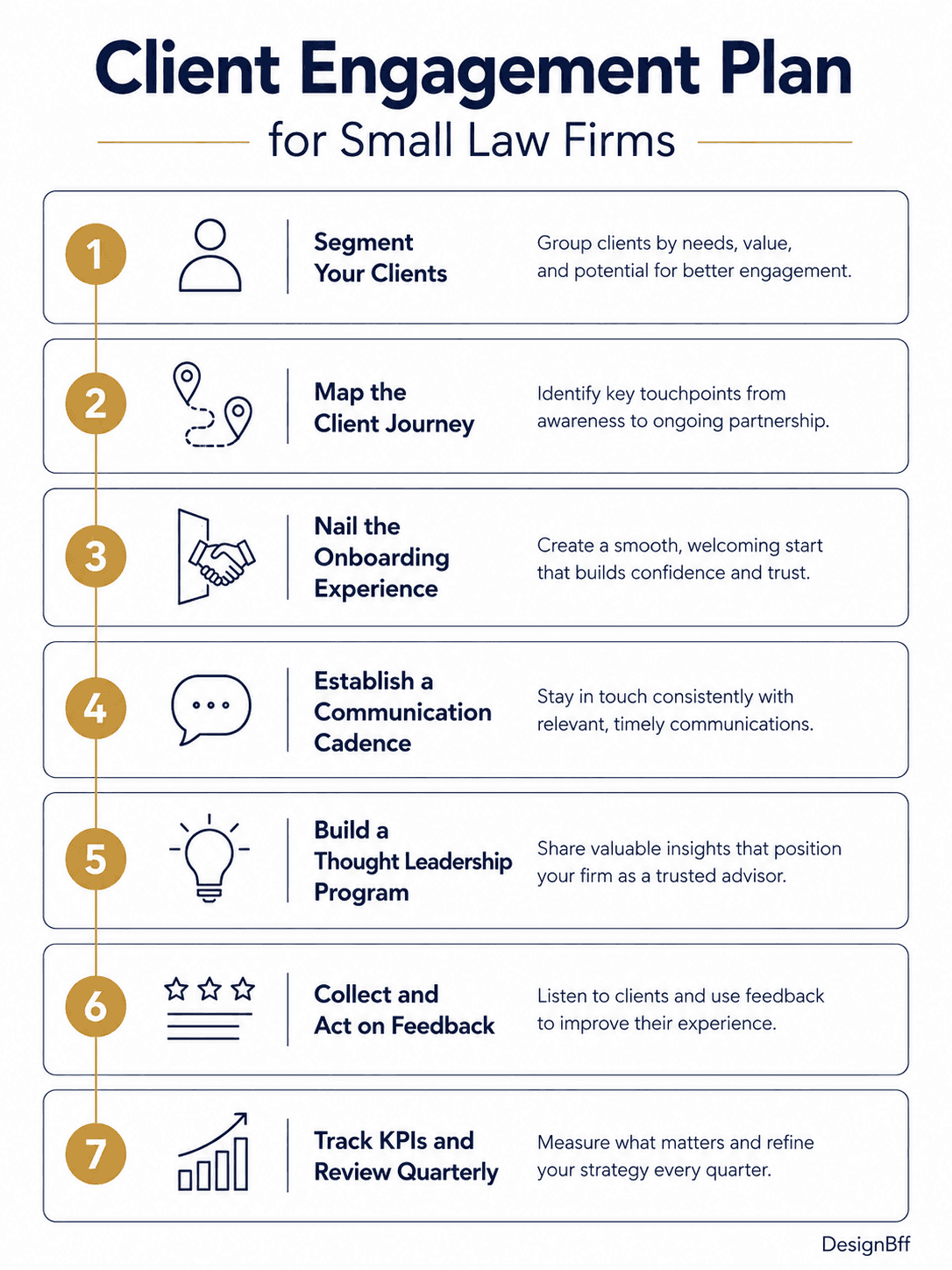
Infographic of 7 steps of creating an effective client engagement plan for small law firms

Step 1: Segment Your Client Base Before Engaging Anyone

The starting point of any effective engagement plan is knowing precisely who you are engaging. Client segmentation organises your client base by practice area, relationship stage, client type, and value tier so that every communication is relevant and well-timed rather than generic and forgettable.

A family law client navigating a property settlement has entirely different emotional and informational needs compared to a business owner seeking a commercial contract review, and sending the same newsletter to both wastes the opportunity and quietly erodes trust.

For a small firm with limited bandwidth, building three to five clear client personas creates a practical framework for all downstream communication and content decisions, and it feeds directly into how your CRM should be configured. If you are still building your client pipeline alongside your engagement infrastructure, it is worth reading how lead generation for small family law firms intersects with segmentation strategy, since the two disciplines work far better when designed together from the outset.

Step 2: How Do You Map the Client Journey for a Law Firm?

Client journey mapping is a visual representation of every touchpoint a client has with your firm, from the first online search through matter closure and beyond, and it reveals the friction points and communication gaps that silently damage satisfaction and retention.

Mapping these stages exposes exactly where clients feel uncertain, where they are left waiting without updates, and where the firm misses opportunities to exceed expectations. A typical law firm journey moves through five stages: awareness, acquisition, consideration, active matter, and loyalty, and each stage carries a distinct engagement goal that the firm must consciously design rather than leave to assumption.

DesignBff's Client Journey Auditing and Mapping service works through this process systematically, giving boutique firms a clear picture of where satisfaction breaks down and what needs to be built to repair it before clients vote with their feet.

Step 3: What Should a Law Firm Client Onboarding Experience Include?

A strong law firm onboarding experience should include a digital welcome kit, a secure client portal for document sharing, a signed engagement letter with clear communication standards, and for longer matters, a shared milestone calendar that celebrates progress and prevents the anxiety of perceived stalling. The first 30 days set the tone for the entire relationship.

Proactive communication from day one replaces client-initiated "just checking in" emails with a firm-led flow of information that builds confidence before anxiety has a chance to form. Platforms like Clio Grow, MyCase, and Lawmatics provide the secure document sharing, e-signatures, and matter visibility that reduce client anxiety during active matters, and they allow a small team to deliver a premium experience without adding administrative headcount.

An engagement letter is more than a legal formality in this context. It is the document that sets the scope, fee expectations, communication cadence, and response time commitments that clients will use to judge the firm throughout the relationship.

Step 4: How Often Should a Law Firm Communicate with Active Clients?

During an active matter, a law firm should commit to at minimum a bi-weekly summary email or monthly status call, with that commitment documented in the engagement letter rather than left to individual lawyer discretion. Poor communication is consistently identified as the leading cause of client complaints in the legal profession.

The Legal Ombudsman's 2024/25 Annual Report named it one of the top drivers of formal grievances, a pattern that Australian legal regulators and client experience researchers echo consistently across the profession. A structured cadence framework covers four distinct moments: active matter updates that replace reactive calls; a 30 to 60 day post-matter check-in that generates referrals and return business; an annual legal planning call with key clients that positions the firm as a proactive advisor rather than a reactive vendor; and personalised milestone messages for anniversaries that can be automated via a CRM while retaining a genuinely personal feel.

Establishing this cadence as a firm-wide standard is what separates firms that grow through relationships from those that rely perpetually on new client acquisition. You can also explore how 8 proven ways to strengthen your law firm's media presence supports the between-matter visibility that a communication cadence alone cannot cover.

Step 5: Does Thought Leadership Content Strengthen Client Relationships?

Yes. Thought leadership content published consistently positions a law firm as a trusted advisor between matters and keeps the firm visible without requiring direct client outreach at every touchpoint. Educational content that answers common legal questions in the firm's practice areas serves two purposes simultaneously: it demonstrates expertise to prospective clients discovering the firm through search, and it provides existing clients with genuinely useful information that reinforces the advisory relationship.

The most effective content types for small law firms include blog articles covering practice area FAQs, segmented email newsletters with updates on relevant legal changes by client type, short-form video on LinkedIn addressing common client concerns, and practical guides or templates that grow the firm's contact list over time.

The governing principle is consistency over volume. A monthly email newsletter and two blog articles per month, executed reliably over twelve months, consistently outperforms sporadic high-volume content bursts. Research into content marketing for law firms confirms that sustained, segmented content programs drive measurably higher engagement and retention outcomes than ad hoc publishing schedules.

Step 6: How Do You Collect and Act on Client Feedback?

The fastest way to improve client satisfaction in a law firm is to send Net Promoter Score surveys at defined milestones and assign clear internal ownership for acting on the results. According to ClearlyRated's 2024 Legal Industry Benchmark Study, the average NPS for law firms sits at 37%, while firms recognised as service leaders achieve scores averaging 70%. That gap represents a significant competitive advantage available to any small firm willing to build a structured feedback loop rather than relying on gut feel and informal conversations.

Australian mid-market firm Macpherson Kelley demonstrated this precisely, implementing monthly NPS surveys for all invoiced clients and improving their top loyalty drivers, "clear communication" and "practical advice," by seven percentage points year-on-year. The practical framework involves sending NPS surveys at matter closure, at 90 days post-close, and annually for ongoing relationships. High-scoring promoters should trigger an automated request for a Google review or direct referral. Low scores should alert the responsible lawyer immediately, because as the data consistently shows, most dissatisfaction stems from communication gaps rather than legal errors, which means the remedy is almost always within the firm's direct control.

Step 7: What Technology and KPIs Should a Small Law Firm Track?

A small law firm's client engagement technology stack should include a legal CRM for intake and matter tracking, a secure client portal, and an email marketing tool for segmented outreach, all chosen based on how well they support the engagement behaviors the firm has committed to rather than on feature lists alone. Tools like Clio Grow, Lawmatics, and MyCase handle the CRM and portal layer, while platforms like Levitate or Mailchimp manage segmented email campaigns at a cost accessible to boutique practices.

According to Thomson Reuters' 2024 State of the Legal Market Report, 52% of Australian law firms that aligned their automation initiatives with strategic goals saw measurable improvements in client satisfaction and retention, which confirms that implementation discipline matters more than platform sophistication. For a detailed breakdown of how to evaluate and compare your options, DesignBff's guide to choosing the right CRM for your law firm in 2026 covers the key decision criteria specific to Australian boutique practices.

On the measurement side, the six KPIs that matter most are the NPS trend over time, client retention rate expressed as the percentage of clients returning for a second matter, referral rate as a share of new client volume, average matter value as a proxy for relationship depth, email engagement rate by client segment, and response time SLA compliance. Review these metrics quarterly and conduct a full plan review with firm leadership every six months so that the engagement plan evolves with the firm rather than becoming a document that quietly goes out of date.

Conclusion

For a small law firm, a client engagement plan is not a marketing luxury. It is the operational infrastructure that determines whether strong legal work translates into lasting client relationships, consistent referrals, and a portfolio of loyal clients who return again and again. By segmenting your client base, mapping the journey, nailing onboarding, committing to a structured communication cadence, publishing thought leadership content, collecting feedback through NPS, and tracking outcomes with clear KPIs, your firm builds a compounding competitive advantage that is genuinely difficult for competitors to replicate without the same discipline and deliberate design.

Book a free consultation with DesignBff to discuss the client engagement tactics that will help your boutique law firm close more clients, build a bigger portfolio of happy loyal clients, and grow a practice built on relationships rather than constant re-acquisition.


Frequently Asked Questions

What is a client engagement plan for a law firm?

A client engagement plan for a law firm is a structured system that manages every touchpoint in the client relationship, from initial onboarding through matter delivery, post-matter follow-up, and ongoing nurture. It typically covers a documented communication cadence, client segmentation by practice area and value tier, a feedback mechanism such as NPS surveys, and a technology stack to manage it consistently. Unlike general marketing, a client engagement plan focuses on retaining and deepening relationships with clients the firm already has, which is significantly more cost-effective than relying on constant new client acquisition.

How do I improve client communication in my small law firm?

Improving client communication starts with establishing a documented communication cadence and removing the discretion from individual lawyers to decide how and when to update clients. Commit to bi-weekly matter updates during active cases and record that commitment in your engagement letter as a service standard. Use a CRM or practice management tool to trigger automated acknowledgements, status updates, and follow-up reminders so that nothing falls through the cracks between fee earners. Post-matter check-ins at 30 to 60 days and annual legal planning calls for key clients are among the highest-impact, lowest-cost communication habits a small firm can build.

What is a good NPS score for a law firm in Australia?

A good NPS score for a law firm is above 50%, which is considered strong across most industries. According to ClearlyRated's 2024 Legal Industry Benchmark Study, the average NPS for law firms globally is 37%, while firms recognised as service leaders achieve an average of 70%. For a small Australian boutique practice, tracking your NPS trend over time matters more than any single score, since consistent improvement from a baseline of 30 to a score of 50 over 18 months demonstrates that your engagement investments are translating into genuine and measurable loyalty.

How do I onboard new legal clients effectively?

Effective legal client onboarding involves four core elements: a digital welcome kit explaining what the client can expect at each stage, a client portal for secure document sharing and matter visibility, a well-crafted engagement letter setting clear scope, fees, and communication standards, and for longer matters, a shared milestone calendar that celebrates progress and reduces anxiety during slow periods. The goal of a strong onboarding experience is to replace client-initiated "just checking in" calls with a firm-led flow of information that builds confidence from the first interaction. Platforms like Clio Grow and Lawmatics are commonly used by Australian boutique firms to systematise this process without adding headcount.

How do I measure whether my law firm's client engagement plan is working?

Measure your client engagement plan against six core KPIs: your NPS trend over time, client retention rate expressed as the percentage of clients who return for a second matter, referral rate as a share of total new client volume, average matter value as a proxy for relationship depth and cross-selling success, email engagement rate by client segment, and response time SLA compliance. Review these quarterly and conduct a full plan review with firm leadership every six months. If your NPS is improving but retention remains flat, your engagement experience during the matter is likely strong, but your post-matter nurture system needs to be built or reinforced.


A client engagement plan for a small law firm is a structured system of communication, onboarding, content, and feedback touchpoints designed to build long-term client relationships that generate repeat work and referrals.

For boutique practices competing without the marketing budgets of large firms, this is the most cost-effective growth engine available, because research consistently shows that referred clients are on average 16% more profitable than those acquired through paid channels, yet most small firms still leave that advantage entirely to chance.

Why Do Small Law Firms Lose Clients After the First Matter?

Most small law firms lose clients not because of poor legal work, but because of poor communication and the absence of any structured post-matter follow-up. Once a matter closes, the relationship ends by default, and future legal needs quietly migrate to competitors. According to the 2025 Legal Client Experience Report published by Case Status, 80% of law firm clients feel uncared for, a statistic that reflects a widespread and correctable gap between the quality of legal advice delivered and the quality of the client experience surrounding it. For firms that want to convert good legal outcomes into loyal, referring clients, the fix is not more advertising spend. It is a deliberate, structured engagement plan that keeps the relationship alive at every stage of the client lifecycle. DesignBff's client engagement infrastructure for professional service firms is specifically built to close this gap, replacing ad hoc follow-up with a repeatable system that protects retention and grows lifetime value across every practice area.

Infographic of 7 steps of creating an effective client engagement plan for small law firms

Step 1: Segment Your Client Base Before Engaging Anyone

The starting point of any effective engagement plan is knowing precisely who you are engaging. Client segmentation organises your client base by practice area, relationship stage, client type, and value tier so that every communication is relevant and well-timed rather than generic and forgettable.

A family law client navigating a property settlement has entirely different emotional and informational needs compared to a business owner seeking a commercial contract review, and sending the same newsletter to both wastes the opportunity and quietly erodes trust.

For a small firm with limited bandwidth, building three to five clear client personas creates a practical framework for all downstream communication and content decisions, and it feeds directly into how your CRM should be configured. If you are still building your client pipeline alongside your engagement infrastructure, it is worth reading how lead generation for small family law firms intersects with segmentation strategy, since the two disciplines work far better when designed together from the outset.

Step 2: How Do You Map the Client Journey for a Law Firm?

Client journey mapping is a visual representation of every touchpoint a client has with your firm, from the first online search through matter closure and beyond, and it reveals the friction points and communication gaps that silently damage satisfaction and retention.

Mapping these stages exposes exactly where clients feel uncertain, where they are left waiting without updates, and where the firm misses opportunities to exceed expectations. A typical law firm journey moves through five stages: awareness, acquisition, consideration, active matter, and loyalty, and each stage carries a distinct engagement goal that the firm must consciously design rather than leave to assumption.

DesignBff's Client Journey Auditing and Mapping service works through this process systematically, giving boutique firms a clear picture of where satisfaction breaks down and what needs to be built to repair it before clients vote with their feet.

Step 3: What Should a Law Firm Client Onboarding Experience Include?

A strong law firm onboarding experience should include a digital welcome kit, a secure client portal for document sharing, a signed engagement letter with clear communication standards, and for longer matters, a shared milestone calendar that celebrates progress and prevents the anxiety of perceived stalling. The first 30 days set the tone for the entire relationship.

Proactive communication from day one replaces client-initiated "just checking in" emails with a firm-led flow of information that builds confidence before anxiety has a chance to form. Platforms like Clio Grow, MyCase, and Lawmatics provide the secure document sharing, e-signatures, and matter visibility that reduce client anxiety during active matters, and they allow a small team to deliver a premium experience without adding administrative headcount.

An engagement letter is more than a legal formality in this context. It is the document that sets the scope, fee expectations, communication cadence, and response time commitments that clients will use to judge the firm throughout the relationship.

Step 4: How Often Should a Law Firm Communicate with Active Clients?

During an active matter, a law firm should commit to at minimum a bi-weekly summary email or monthly status call, with that commitment documented in the engagement letter rather than left to individual lawyer discretion. Poor communication is consistently identified as the leading cause of client complaints in the legal profession.

The Legal Ombudsman's 2024/25 Annual Report named it one of the top drivers of formal grievances, a pattern that Australian legal regulators and client experience researchers echo consistently across the profession. A structured cadence framework covers four distinct moments: active matter updates that replace reactive calls; a 30 to 60 day post-matter check-in that generates referrals and return business; an annual legal planning call with key clients that positions the firm as a proactive advisor rather than a reactive vendor; and personalised milestone messages for anniversaries that can be automated via a CRM while retaining a genuinely personal feel.

Establishing this cadence as a firm-wide standard is what separates firms that grow through relationships from those that rely perpetually on new client acquisition. You can also explore how 8 proven ways to strengthen your law firm's media presence supports the between-matter visibility that a communication cadence alone cannot cover.

Step 5: Does Thought Leadership Content Strengthen Client Relationships?

Yes. Thought leadership content published consistently positions a law firm as a trusted advisor between matters and keeps the firm visible without requiring direct client outreach at every touchpoint. Educational content that answers common legal questions in the firm's practice areas serves two purposes simultaneously: it demonstrates expertise to prospective clients discovering the firm through search, and it provides existing clients with genuinely useful information that reinforces the advisory relationship.

The most effective content types for small law firms include blog articles covering practice area FAQs, segmented email newsletters with updates on relevant legal changes by client type, short-form video on LinkedIn addressing common client concerns, and practical guides or templates that grow the firm's contact list over time.

The governing principle is consistency over volume. A monthly email newsletter and two blog articles per month, executed reliably over twelve months, consistently outperforms sporadic high-volume content bursts. Research into content marketing for law firms confirms that sustained, segmented content programs drive measurably higher engagement and retention outcomes than ad hoc publishing schedules.

Step 6: How Do You Collect and Act on Client Feedback?

The fastest way to improve client satisfaction in a law firm is to send Net Promoter Score surveys at defined milestones and assign clear internal ownership for acting on the results. According to ClearlyRated's 2024 Legal Industry Benchmark Study, the average NPS for law firms sits at 37%, while firms recognised as service leaders achieve scores averaging 70%. That gap represents a significant competitive advantage available to any small firm willing to build a structured feedback loop rather than relying on gut feel and informal conversations.

Australian mid-market firm Macpherson Kelley demonstrated this precisely, implementing monthly NPS surveys for all invoiced clients and improving their top loyalty drivers, "clear communication" and "practical advice," by seven percentage points year-on-year. The practical framework involves sending NPS surveys at matter closure, at 90 days post-close, and annually for ongoing relationships. High-scoring promoters should trigger an automated request for a Google review or direct referral. Low scores should alert the responsible lawyer immediately, because as the data consistently shows, most dissatisfaction stems from communication gaps rather than legal errors, which means the remedy is almost always within the firm's direct control.

Step 7: What Technology and KPIs Should a Small Law Firm Track?

A small law firm's client engagement technology stack should include a legal CRM for intake and matter tracking, a secure client portal, and an email marketing tool for segmented outreach, all chosen based on how well they support the engagement behaviors the firm has committed to rather than on feature lists alone. Tools like Clio Grow, Lawmatics, and MyCase handle the CRM and portal layer, while platforms like Levitate or Mailchimp manage segmented email campaigns at a cost accessible to boutique practices.

According to Thomson Reuters' 2024 State of the Legal Market Report, 52% of Australian law firms that aligned their automation initiatives with strategic goals saw measurable improvements in client satisfaction and retention, which confirms that implementation discipline matters more than platform sophistication. For a detailed breakdown of how to evaluate and compare your options, DesignBff's guide to choosing the right CRM for your law firm in 2026 covers the key decision criteria specific to Australian boutique practices.

On the measurement side, the six KPIs that matter most are the NPS trend over time, client retention rate expressed as the percentage of clients returning for a second matter, referral rate as a share of new client volume, average matter value as a proxy for relationship depth, email engagement rate by client segment, and response time SLA compliance. Review these metrics quarterly and conduct a full plan review with firm leadership every six months so that the engagement plan evolves with the firm rather than becoming a document that quietly goes out of date.

Conclusion

For a small law firm, a client engagement plan is not a marketing luxury. It is the operational infrastructure that determines whether strong legal work translates into lasting client relationships, consistent referrals, and a portfolio of loyal clients who return again and again. By segmenting your client base, mapping the journey, nailing onboarding, committing to a structured communication cadence, publishing thought leadership content, collecting feedback through NPS, and tracking outcomes with clear KPIs, your firm builds a compounding competitive advantage that is genuinely difficult for competitors to replicate without the same discipline and deliberate design.

Book a free consultation with DesignBff to discuss the client engagement tactics that will help your boutique law firm close more clients, build a bigger portfolio of happy loyal clients, and grow a practice built on relationships rather than constant re-acquisition.


Frequently Asked Questions

What is a client engagement plan for a law firm?

A client engagement plan for a law firm is a structured system that manages every touchpoint in the client relationship, from initial onboarding through matter delivery, post-matter follow-up, and ongoing nurture. It typically covers a documented communication cadence, client segmentation by practice area and value tier, a feedback mechanism such as NPS surveys, and a technology stack to manage it consistently. Unlike general marketing, a client engagement plan focuses on retaining and deepening relationships with clients the firm already has, which is significantly more cost-effective than relying on constant new client acquisition.

How do I improve client communication in my small law firm?

Improving client communication starts with establishing a documented communication cadence and removing the discretion from individual lawyers to decide how and when to update clients. Commit to bi-weekly matter updates during active cases and record that commitment in your engagement letter as a service standard. Use a CRM or practice management tool to trigger automated acknowledgements, status updates, and follow-up reminders so that nothing falls through the cracks between fee earners. Post-matter check-ins at 30 to 60 days and annual legal planning calls for key clients are among the highest-impact, lowest-cost communication habits a small firm can build.

What is a good NPS score for a law firm in Australia?

A good NPS score for a law firm is above 50%, which is considered strong across most industries. According to ClearlyRated's 2024 Legal Industry Benchmark Study, the average NPS for law firms globally is 37%, while firms recognised as service leaders achieve an average of 70%. For a small Australian boutique practice, tracking your NPS trend over time matters more than any single score, since consistent improvement from a baseline of 30 to a score of 50 over 18 months demonstrates that your engagement investments are translating into genuine and measurable loyalty.

How do I onboard new legal clients effectively?

Effective legal client onboarding involves four core elements: a digital welcome kit explaining what the client can expect at each stage, a client portal for secure document sharing and matter visibility, a well-crafted engagement letter setting clear scope, fees, and communication standards, and for longer matters, a shared milestone calendar that celebrates progress and reduces anxiety during slow periods. The goal of a strong onboarding experience is to replace client-initiated "just checking in" calls with a firm-led flow of information that builds confidence from the first interaction. Platforms like Clio Grow and Lawmatics are commonly used by Australian boutique firms to systematise this process without adding headcount.

How do I measure whether my law firm's client engagement plan is working?

Measure your client engagement plan against six core KPIs: your NPS trend over time, client retention rate expressed as the percentage of clients who return for a second matter, referral rate as a share of total new client volume, average matter value as a proxy for relationship depth and cross-selling success, email engagement rate by client segment, and response time SLA compliance. Review these quarterly and conduct a full plan review with firm leadership every six months. If your NPS is improving but retention remains flat, your engagement experience during the matter is likely strong, but your post-matter nurture system needs to be built or reinforced.


Let’s tackle your marketing challenge and show you the roadmap to success.

Extreme close-up black and white photograph of a human eye

Let’s tackle your marketing challenge and show you the roadmap to success.

Extreme close-up black and white photograph of a human eye

Let’s tackle your marketing challenge and show you the roadmap to success.

Extreme close-up black and white photograph of a human eye

Day Job