
Singapore's intellectual property landscape is one of the most competitive legal markets in Asia-Pacific, and the firms that win new instructions today are rarely doing so on reputation alone.
A cross-channel content marketing plan gives IP law firms in Singapore a structured way to build visible authority across the channels where decision-makers actually spend their time,

whether that is Google, LinkedIn, or their email inbox, turning consistent expertise into a steady pipeline of qualified enquiries without relying solely on referrals.
Why Does Content Marketing Matter for IP Law Firms in Singapore?
Content marketing is no longer optional for professional service firms competing in Singapore's IP sector. According to research by SeoProfy, 94% of law firms now identify search engines as their top channel for brand awareness, and organic search drives as much as 66% of call conversions in the legal industry. At the same time, a three-year study on law firm SEO ROI found average returns of 526% on SEO investment, meaning that every dollar placed into well-crafted, search-optimised content compounds in value over time. For an IP law firm in Singapore, where potential clients include multinationals managing complex multi-jurisdiction portfolios, high-growth startups seeking pre-Series A IP protection, and in-house counsel benchmarking external counsel options, the stakes of digital invisibility are particularly high. A firm without a coherent content presence loses traction before a prospect ever considers picking up the phone.
What Is the ROI of Content Marketing for a Law Firm?
Content marketing delivers returns that paid advertising cannot replicate at scale. Content marketing for law firms generates three times more leads than paid search at a fraction of the long-term cost, according to Lawyerist. For email marketing specifically, revenue data compiled by RevenueMemo shows an average return of $36 for every $1 spent, making it the highest-ROI channel available to most firms. The compounding nature of quality content, where a single well-researched article continues to attract search traffic for years, makes it the most efficient long-term investment in client acquisition a Singapore IP firm can make.
What Regulatory Rules Must Singapore IP Firms Follow in Content Marketing?
Singapore's content marketing rules for law firms are non-negotiable. Under Rules 43 and 44 of the Legal Profession (Professional Conduct) Rules 2015, firms must be able to justify any claim to expertise or specialisation, and all publicity must be accurate, non-misleading and non-deceptive. In practice, this means marketing content must educate and inform rather than make comparative or superlative claims against competitors. Phrases such as "Singapore's best IP firm" are prohibited without objective substantiation. SAL Accredited Specialist status may be promoted, but only in formats specifically permitted, and firm-level accreditation claims are not allowed. Ethical, value-led content is not simply best practice in Singapore; it is the mandatory operating framework for every piece of content you publish.
Who Are Your Target Audiences and What Do They Need?
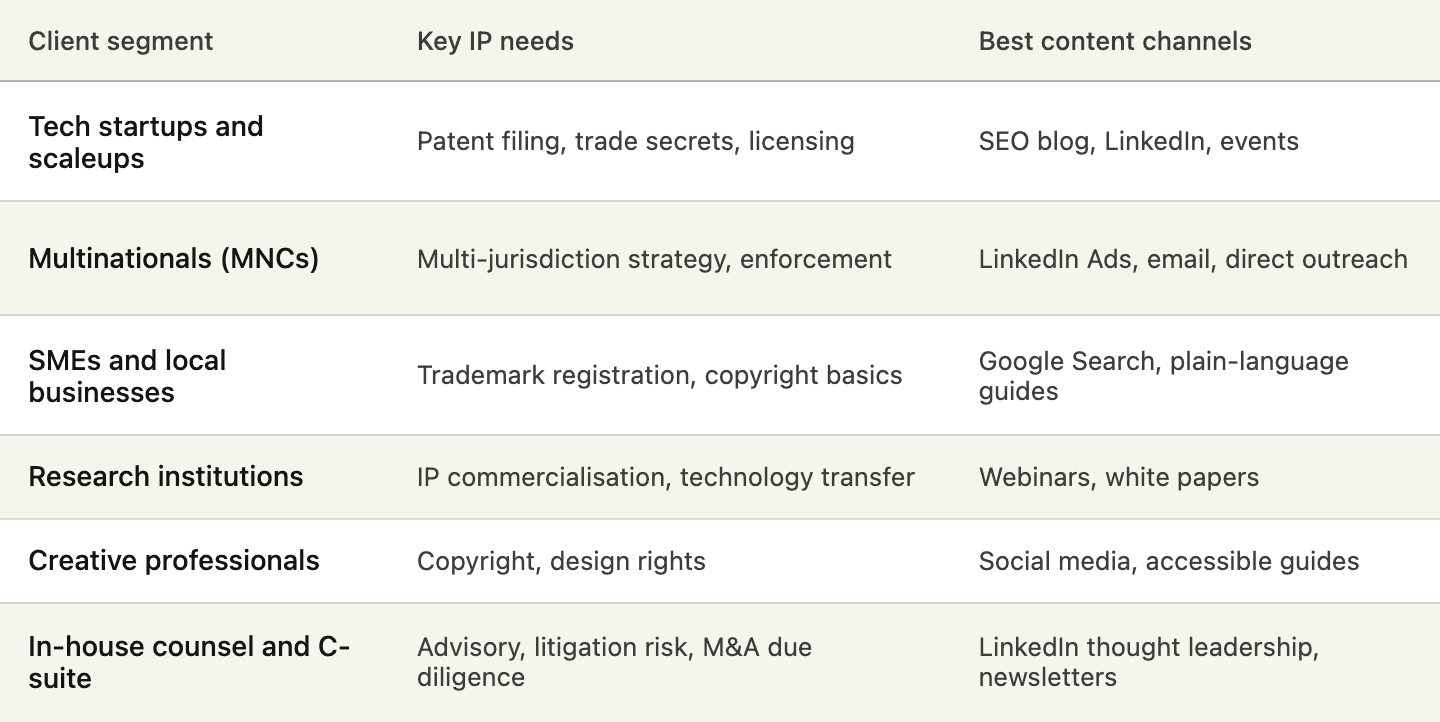
An effective cross-channel content plan starts with a precise understanding of who you are trying to reach. Singapore IP firm clients span six distinct segments, each with different IP needs, search behaviours and preferred channels.
Tech startups and scaleups typically need patent filing, trade secret protection and licensing guidance, and they are most reachable through SEO-driven blog content, LinkedIn and industry events.
Multinationals require multi-jurisdiction IP strategy and enforcement support, and they are best reached through LinkedIn outreach, targeted advertising and direct email.
SMEs and local businesses looking for trademark registration and copyright basics are most accessible through Google Search and plain-language educational content.
Research institutions and universities involved in IP commercialisation respond well to webinars and white papers.
Creative professionals in media and design are increasingly active on social platforms. And in-house counsel and C-suite decision-makers, perhaps the highest-value segment, consume LinkedIn thought leadership and curated newsletters. Mapping your content to these segments ensures every piece of content earns its place in the plan.
How Should You Structure Your IP Law Firm Content Hub?
Your firm's website should function as the central content hub, with all channel activity driving qualified traffic back to it. This hub-and-spoke architecture ensures SEO authority compounds over time rather than being fragmented across social platforms that can change their algorithms overnight. The website should contain dedicated practice area landing pages for each IP discipline, including trademarks, patents, copyright, registered designs and trade secrets, each optimised for high-intent search queries that reflect what potential clients actually type into Google.
A consistently updated blog, ideally publishing two to four articles per month, supports both organic search visibility and social media distribution. Attorney profiles with clear accreditation credentials and attributed content are equally critical, as Google's E-E-A-T framework for legal and YMYL content actively rewards identifiable human expertise behind every article. Downloadable assets such as guides, checklists and white papers complete the hub by giving visitors a reason to share their contact details and enter your nurture funnel.
What Content Pillars Work Best for a Singapore IP Law Firm?
5 evergreen content pillars give a Singapore IP firm structured coverage of the full range of client search intent. The first pillar, IP Protection Basics, covers practical guides for business owners new to IP, such as how to register a trademark in Singapore or the difference between a patent and a trade secret. These address informational queries that signal high future intent.
The second pillar, IP Strategy for Growth, serves SMEs and scaleups with content on licensing, franchising, IP valuation and R&D tax incentives.
The third pillar, IP Enforcement and Disputes, targets in-house counsel and business owners dealing with infringement, including content on the litigation versus ADR choice.
The fourth pillar, Legislative Updates and Case Commentary, positions senior lawyers as authoritative commentators, with Singapore's Copyright Act 2021 and ongoing ASEAN IP alignment providing rich ongoing material.
The fifth pillar, IP in Emerging Sectors, covers AI-generated IP, fintech patents, biotech and green technology, all high-growth areas where clients actively seek specialist guidance and where very little quality content currently exists in the Singapore market.
Which Channels Should a Singapore IP Law Firm Prioritise?
Is SEO Still Worth Investing in for IP Law Firms in Singapore?
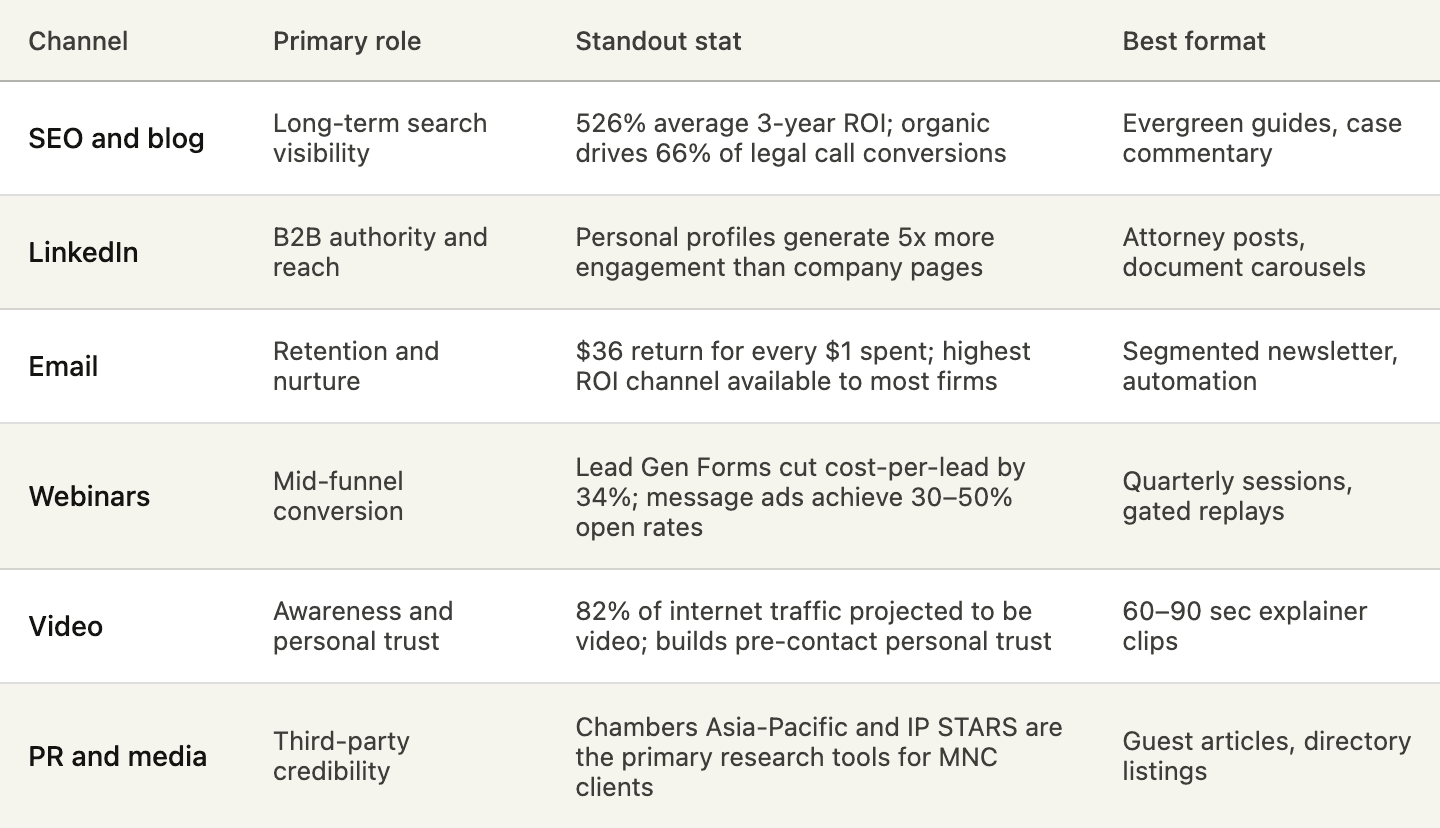
Yes, SEO remains the single highest-value long-term channel for a Singapore IP law firm. Beyond the practice area landing pages described above, keyword architecture should build around primary terms such as "IP law firm Singapore" and "trademark registration Singapore lawyer", secondary terms such as "patent attorney Singapore startups", and long-tail question queries such as "how to protect a software patent in Singapore." These question-form keywords directly mirror how potential clients phrase their searches and increasingly mirror how AI-powered search tools surface answers.
With AI Overviews, ChatGPT and Perplexity now generating significant legal research traffic, content must be jurisdiction-specific, reference Singapore statutes and case law directly, and include structured data markup to be cited by AI models. Technical foundations matter equally: implement schema markup for legal services, optimise Google Business Profile for local pack inclusion, ensure mobile performance is fast, and maintain structured internal linking between practice area pages and blog content. To understand how DesignBff approaches search visibility for law firms, see our law firm marketing services.
How Should an IP Law Firm Use LinkedIn for Business Development?
LinkedIn is the primary B2B authority channel for reaching in-house counsel, C-suite decision-makers, startup founders and MNC procurement contacts in Singapore. The single most important insight for any firm starting on LinkedIn is that personal profiles generate 2.75x more impressions and 5x more engagement than company pages, meaning partner and senior associate profiles are the firm's most powerful LinkedIn asset, not the firm page itself.
Each senior practitioner should maintain an active personal profile, sharing authored insights, commenting on IP developments, and engaging with clients' content at a cadence of at least one substantive post per week. For paid LinkedIn activity, Sponsored Content and Lead Gen Forms are the most effective formats for IP firms; Lead Gen Forms in particular reduce cost-per-lead by up to 34% by keeping users on the platform rather than requiring a click-through to a landing page. For a practical overview of how to select the right social platforms for your IP firm's specific audience, see our guide to best social media platforms for IP law firms.
Why Is Email Marketing the Highest-ROI Channel for IP Law Firms?
Email is the retention engine that most law firms underuse. A monthly or bi-weekly newsletter structured around three content types, namely key IP law developments relevant to clients' industries, one attorney-authored thought leadership piece, and relevant firm news, maintains relationships with existing clients who generate both repeat instructions and referrals at minimal cost.
The critical execution detail is segmentation: an MNC client in pharma should receive patent-heavy updates, while a creative sector prospect should receive copyright-focused insights. List growth should happen ethically through double opt-in, downloadable lead magnets and sign-up prompts in email signatures and contact forms. A welcome automation sequence introducing the firm's practice areas and pointing to key resources converts new subscribers from passive readers into active leads over time.
What Other Channels Complement SEO, LinkedIn and Email?
Webinars are the most effective consideration-stage channel for a Singapore IP firm because they convert awareness into active interest at scale. Hosting quarterly sessions on high-demand topics such as protecting startup IP before Series A, navigating cross-border trademark filing via the Madrid Protocol, or AI-generated content and copyright law positions the firm as the go-to specialist voice. Co-hosting with IPOS, Enterprise Singapore or industry associations expands audience reach while adding third-party credibility. All webinar recordings should be gated for lead capture and repurposed as podcast episodes, blog recaps and LinkedIn highlight clips, ensuring a single event fuels weeks of channel activity.
Video content, particularly short-form explainer clips of 60 to 90 seconds, is increasingly essential as 82% of internet traffic is projected to be video by 2025, and legal video that is useful, clear and attorney-fronted builds the kind of personal trust that accelerates the decision to make first contact. For tactical guidance on strengthening your firm's broader media and PR presence, our article on 8 proven ways to strengthen your law firm's media presence covers the full range of options including directory listings in Chambers Asia-Pacific and IP STARS.
How Do You Measure What Is Actually Working?
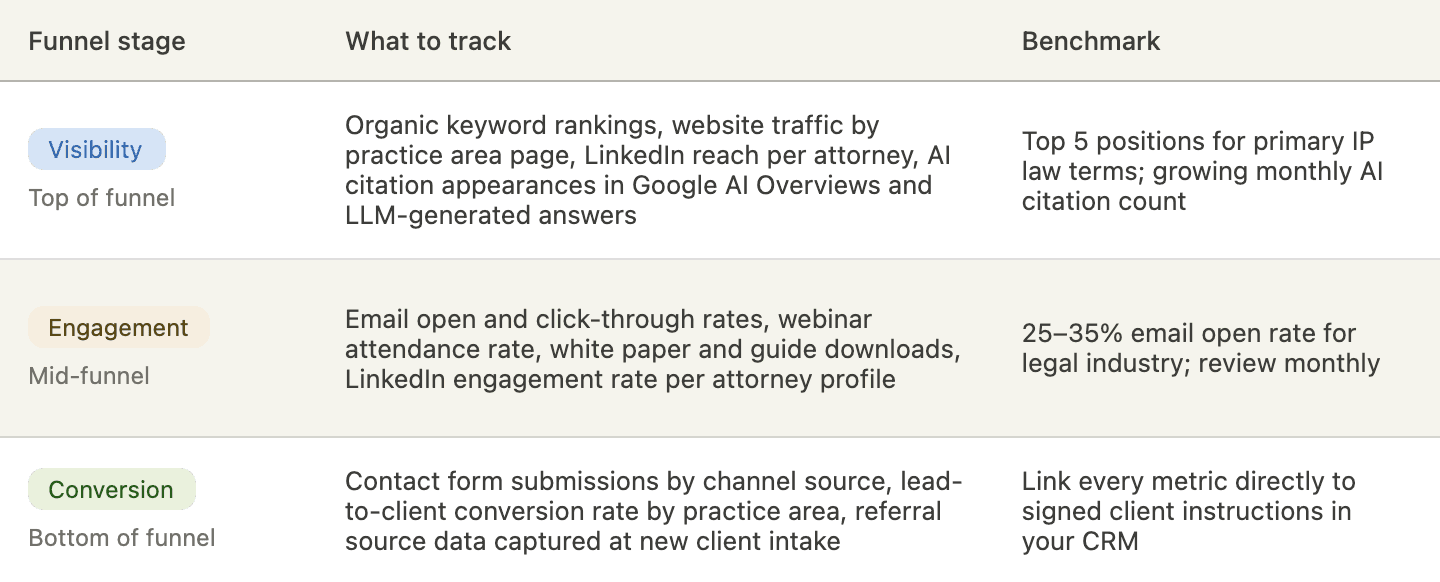
Measurement should always trace back to signed clients, not vanity metrics. Structure your analytics around three funnel stages. At the visibility stage, track organic search rankings for target keywords, website organic traffic by practice area, LinkedIn reach and, increasingly, AI search citation appearances in Google AI Overviews and LLM-generated answers. At the engagement stage, track email open rates (the legal industry benchmark is 25 to 35%), webinar attendance rates, white paper downloads and LinkedIn engagement per attorney profile. At the conversion stage, track contact form submissions by channel source, lead-to-client conversion rate by practice area, and referral source data captured at new client intake.
Install Google Analytics 4 with goal tracking, Google Search Console for keyword performance, and LinkedIn Insight Tag for website retargeting. UTM parameters on all email links and social posts ensure accurate attribution across every channel. Managing client relationships and attributing leads correctly becomes significantly easier with a CRM tailored to professional services firms; our guide to selecting the ideal CRM for law firms in 2026 walks through the key considerations. Review a consolidated marketing dashboard monthly, and link content performance data directly to new client intake figures from the firm's CRM so the conversation about marketing value is always grounded in business outcomes.
Conclusion
A cross-channel content marketing plan works for a Singapore IP law firm when it is anchored in genuine expertise, built on a technically sound website, distributed consistently across the channels where decision-makers spend their time, and measured against the only outcome that truly matters: new client instructions. The channels described here, SEO, LinkedIn, email, webinars, video and PR, are not competing alternatives but complementary layers of a unified strategy. A single well-researched white paper on AI-generated IP can fuel a webinar, a podcast episode, an email campaign, a LinkedIn series and a dozen short-form posts, giving even a small boutique firm a disproportionate market presence relative to its marketing investment. The firms in Singapore that commit to this approach consistently and patiently are the ones that become the first name prospects recall when the IP question becomes urgent.
If you are ready to build that kind of authority, book a free consultation with DesignBff to discuss a content strategy designed specifically for your IP law firm.
Frequently Asked Questions
What is cross-channel content marketing for an IP law firm?
Cross-channel content marketing for an IP law firm means creating a coordinated strategy where educational content is produced once and distributed consistently across multiple platforms, including your website, LinkedIn, email, webinars and video. Rather than treating each channel as a separate activity, a cross-channel plan ensures consistent messaging, compounding authority and measurable ROI across every touchpoint where your potential clients spend time. For Singapore IP firms, this approach is particularly effective because different client segments research legal services in very different ways.
How do Singapore's legal advertising rules affect content marketing?
Singapore's Legal Profession (Professional Conduct) Rules 2015, specifically Rules 43 and 44, require that any claim to expertise be justified and that all publicity be accurate and non-misleading. In practice, this means all content must educate and inform rather than make unsubstantiated comparative claims. Content marketing built around sharing genuine expertise, such as case commentaries, regulatory updates and practical IP guides, is fully compliant and is precisely the format that performs best in search. Ethical content and effective content marketing are aligned, not in conflict.
How many blog articles should a Singapore IP law firm publish per month?
A Singapore IP law firm should aim to publish a minimum of two to four blog articles per month to build meaningful search visibility over time. This cadence balances quality and consistency, which are both factors that search engines reward. Each article should be authored by or reviewed by a named, credentialled attorney to satisfy Google's E-E-A-T standards for legal content. Evergreen foundational guides and timely case commentaries should be balanced in the editorial calendar so the blog serves both search discovery and thought leadership goals simultaneously.
Which social media platform is most effective for an IP law firm in Singapore?
LinkedIn is the most effective social media platform for an IP law firm in Singapore because it offers direct access to in-house counsel, C-suite decision-makers, startup founders and MNC contacts, which are the exact audience segments that instruct IP counsel. Personal profiles of partners and senior associates outperform company pages significantly, generating 2.75x more impressions according to industry data. Consistent, attorney-led posting of IP insights, case commentaries and regulatory updates at a minimum frequency of once per week per senior practitioner compounds into measurable business development over time.
How do I know if my content marketing plan is working for my IP law firm?
Measure content marketing performance across three funnel stages. Visibility metrics include organic keyword rankings and website traffic by practice area. Engagement metrics include email open rates (benchmarked at 25 to 35% for legal), webinar attendance and white paper downloads. Conversion metrics are the most important: track contact form submissions by channel source, lead-to-client conversion rates by practice area, and referral source data at new client intake. All of these data points should be reviewed monthly in a consolidated dashboard and linked directly to new client instructions so the business case for content investment is always clear and evidence-based.