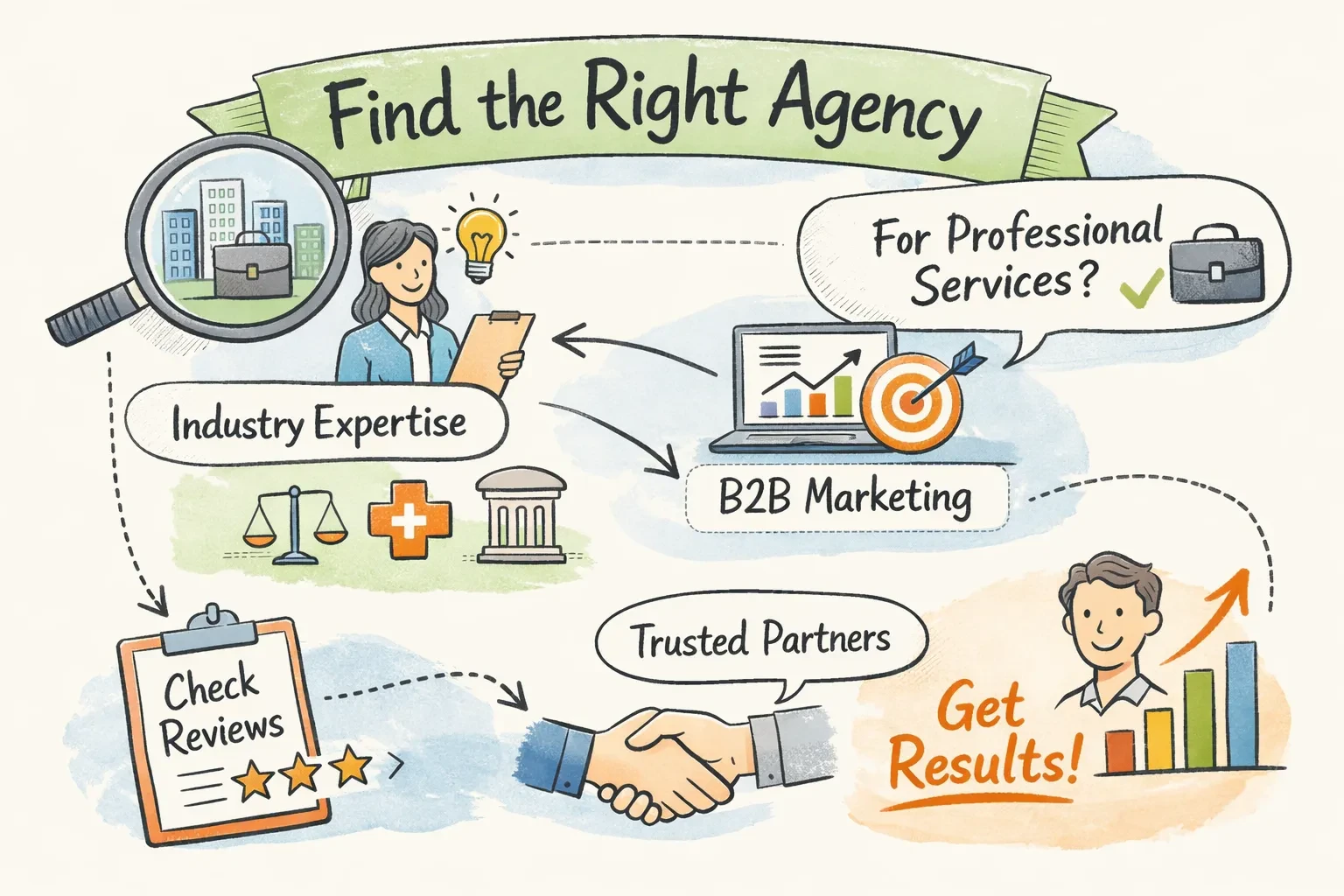
How to Find Marketing Agencies Specializing in Professional Services?

Mar 24, 2026

Where to find marketing agencies specialising in professional services: a step-by-step guide to shortlisting, vetting and hiring the right partner.

How to Find Marketing Agencies Specializing in Professional Services?

Mar 24, 2026

Where to find marketing agencies specialising in professional services: a step-by-step guide to shortlisting, vetting and hiring the right partner.

If you want to know where to find marketing agencies specializing in professional services, start by clarifying the outcomes you need.

Map your target clients, priority services, geographic focus and any compliance constraints so you attract agencies familiar with your sector rules and reputational risks.

Key takeaways

  • Map your needs: start with outcomes by naming your target client, the services to grow, geographic focus and any compliance constraints.

  • Create a one-page brief: include persona, three success metrics, budget, timeline and non-negotiables to keep proposals comparable.

  • Search specialist directories and networks: look for verified reviews, sector case studies and platform partner badges.

  • Use LinkedIn and private communities: check senior profiles, groups and referrals to validate cultural fit and thought leadership.

  • Vetting and pilot: apply a 10-point checklist, then run a scoped pilot to test responsiveness and outcomes before committing.

Start here: map what you need before you search

Before you start outreach, build an outcomes-first brief that lists who you want to win, which services you want to grow and any compliance constraints. For advisory firms, prioritize lead quality and partner-led positioning rather than raw volume, since tight briefs filter out agencies chasing traffic over credibility. Keep the brief to one page so every agency answers the same questions and you can compare proposals quickly.

  • Business snapshot: revenue band, service lines and partners involved.

  • Target client persona: role, company size and buying triggers.

  • Three success metrics: consults per month, qualified leads and revenue conversion.

  • Budget and timeline: approximate retainer or project budget and key milestones.

  • Compliance and content requirements: regulated messaging, disclosure rules and partner visibility.

Mark a couple of answers as non-negotiable. For example, confirm the agency has experience with regulated messaging and proven partner-led thought leadership before you brief them. Those criteria distinguish professional services specialists from generalist shops and help protect your brand while accelerating sales conversations. If you choose the DIY path, the sections below show the best places to look and how to evaluate agency track records.

Directories and review sites to surface specialist agencies

Start your search on marketing agency directories that let you filter by industry and service. Useful platforms include Clutch for verified reviews, Agency Spotter for curated portfolios, Credo for vetted consultants, UpCity for local SMB fit, DesignRush for creative listings and DAN for city-specific agency pages, and supplement these with G2 and the HubSpot directory to check partner badges and platform expertise.

When reviewing profiles, prioritize case studies that include measurable outcomes, the client's industry, team bios and sample deliverables. Look for dates and specific metrics such as leads generated or conversion improvements, and avoid profiles with no dates, generic testimonials or no contactable references. Use filters to narrow results quickly: set industry to legal, accounting or finance; set service to B2B content, SEO or paid acquisition; and set location to APAC or your target markets.

Run boolean searches in directories and search engines to surface tightly matched profiles, for example "law firm marketing agency" OR "legal marketing specialist" AND "SEO". Treat directory rankings as a starting point and cross-check claims by calling references, reviewing LinkedIn histories and requesting raw analytics samples or metric summaries before you sign. After you build a shortlist, compare engagement models and pricing to choose between retained and project-based partners.

LinkedIn, communities and niche networks where specialists hang out

LinkedIn is a practical research hub for professional services specialists. Search by service keywords such as SEO and thought leadership, filter for senior roles like head of growth or managing partner, and review long-form posts, case studies and client commentary. Follow hashtags like #legalmarketing, #accountingmarketing and #professionalservicesmarketing to keep relevant content in your feed.

When you ask for referrals, be explicit about the proof you need and make the request public to invite responses. Use a short template such as: "Looking for a marketing agency for our mid-market law practice. Please recommend agencies who worked with [X practice] and delivered [Y metric]." That level of specificity filters out vague referrals and speeds qualification.

Do not ignore private communities and audio channels where boutique consultants gather. Monitor specialist Slack channels, private LinkedIn groups and alumni networks for law and accounting marketers, and check podcast guest lists and industry roundtables to spot agencies that discuss sector-specific tactics. Use group-sourced leads to build a qualified shortlist, but for larger retainers request detailed case data and an outline proposal so you can compare approach and outcomes.

Associations, events and local networks that introduce you to agencies

Professional associations and local chambers often publish supplier lists and can surface vetted marketing agencies for professional services. Check marketing branches of national associations, legal and accounting institutes, and your local chamber of commerce to find firms that understand market norms and regulatory expectations. These sources cut through the noise and provide names with relevant credentials.

Conferences, workshops and speaker lists are another rich source of leads. Mine session descriptions and exhibitor directories for agency names, then review capability pages and recent presentations to judge methodology and sector fit. Session abstracts often reveal how an agency approaches compliance and measurable outcomes.

Attend local meetups, law society events and accounting forums where agencies sponsor or present to test chemistry and compliance awareness in person. When you convert contacts into a shortlist, follow a simple workflow: collect speaker bios and contact details, request a one-page capability deck, book a short discovery call and ask for a relevant case study or client reference that demonstrates compliance experience. That workflow helps you compare candidates objectively before you invite formal proposals.

Vetting checklist, red flags and KPI targets for shortlisting agencies

Use this 10-point checklist to assess shortlisted agencies and compare them on the same criteria. Below are the items you should request and verify.

  • Industry experience: client lists in law, accounting or finance and examples of sector-specific playbooks.

  • Case studies with measurable outcomes: before-and-after metrics and the attribution methodology used.

  • Named team and senior involvement: CVs for the lead strategist and the partner who will sign off on work.

  • Testing and optimization approach: examples of A/B tests, experimentation cadence and learning loops.

  • Compliance experience: evidence of regulatory-safe copy and examples of working with compliance teams.

  • Data ownership: contractual language showing you retain raw data and campaign access.

  • Reporting cadence: a sample monthly dashboard and the typical SLA for insights delivery.

  • Client references: two to three references who match your firm size and challenge.

  • Technology stack: the tools they use for CRM, automation, analytics and SEO reporting.

  • Cultural fit: how they work with in-house partners and a recent example of role handoffs.

Watch for clear red flags and be prepared to walk away if they appear. A heavy focus on vanity metrics without lead-quality evidence, one-size-fits-all packages that ignore your sales cycle, or refusal to share reference metrics are all serious concerns. Common deal-breakers include agencies that only report impressions, cannot name a senior lead for your account, or refuse to provide anonymized outcome data.

Set pragmatic KPI targets that match your ticket size and sales cycle. For mid-market engagements, expect cost per qualified lead roughly in the $50 to $200 range depending on channel, a lead-to-client conversion rate around 10 to 20 percent, an LTV to CAC ratio of 3 to 5, and organic traffic growth in the 20 to 30 percent range year-over-year. Move these benchmarks up for higher-ticket, longer-cycle services and down for more transactional offers.

Validate agency claims by requesting anonymized campaign dashboards, joining reference calls to verify before-and-after metrics, and reviewing a sample monthly report template. Test responsiveness during the proposal stage, since timely, clear replies tend to predict consistent service quality. Once you are satisfied, structure an RFP and scoring rubric to evaluate proposals objectively before negotiations.

Outreach, RFP template, pricing models and how to decide

Use focused outreach to get clear, fast responses. Send a short email with the subject "Brief RFP, [Firm name] needs a marketing partner" and attach your one-page brief. Ask for interest and availability for a discovery call within a week and request three to five client facts plus expected deliverables to reduce back-and-forth. This approach speeds qualification and makes comparisons easier.

Keep the RFP to one page so vendors can reply quickly. Include context, objectives and KPIs, a budget range and timeline, evaluation criteria and a preferred start date. A concise brief yields faster, comparable proposals and makes scoring straightforward.

  • Context: firm size, services and constraints.

  • Objectives and KPIs: lead quality, pipeline value and retention.

  • Budget range and timeline.

  • Evaluation criteria and preferred start date.

Score proposals with a weighted matrix such as 30 percent strategy and insight, 25 percent sector fit and case studies, 20 percent team and senior time, 15 percent price and commercial terms, and 10 percent chemistry and communication. Compare fees using common models: hourly rates from $100 to $300 plus, project fees from $5,000 to $50,000, retainers starting around $3,000 per month and scaling to $10,000-plus for comprehensive support, or hybrid value-based arrangements tied to outcomes. For a deeper look at modern agency fee benchmarks, consult a 2026 agency pricing guide to understand costs, models and ROI expectations.

Where to find marketing agencies specializing in professional services: next steps

Start by drafting a one-page, outcomes-first brief that names your target client, the exact outcomes you need, three core services and a budget band. Use two specialist directories to shortlist five agencies, then message three on LinkedIn and request capability decks plus a scoped pilot. Prioritize outcome alignment, compliance experience and proof of results rather than glossy portfolios so you recruit a partner who will drive partner-led growth for your practice.

For a template or a second opinion, request a brief review or diagnostic audit from DesignBff and receive a shortlist matched to APAC professional services. Alternatively, use the directories, networks and vetting checklist above to run a focused search and validate candidates before you commit to a retainer or project engagement. Finalize your one-page brief and start outreach this week to keep momentum.

Frequently Asked Questions

How do I find a marketing agency that specialises in professional services?

Start by searching specialist directories such as Clutch, DAN and DesignRush using filters for industry (legal, accounting or finance) and your target geography. Supplement directory research by searching LinkedIn for senior strategists using terms like "law firm SEO" or "accounting firm marketing," and ask for referrals through professional association networks such as legal and accounting institutes. Prioritise agencies that can share case studies with measurable outcomes, named team members and evidence of compliance-aware content, not just polished portfolio pages.

What should I look for when vetting a marketing agency for my law or accounting firm?

Look for proven sector experience backed by verifiable case studies that include before-and-after metrics, the client's industry and the attribution method used. Ask for CVs of the lead strategist, confirmation that you will retain ownership of all data and ad accounts, and two to three references from firms of similar size and challenge. Agencies that only report impressions, cannot name a senior account lead or refuse to share anonymised outcome data are clear red flags. For a structured approach, apply a 10-point vetting checklist before inviting formal proposals.

How much does a marketing agency for a professional services firm typically cost?

Marketing agency fees vary by engagement model, scope and market. Hourly rates typically range from $100 to $300 or more, project fees from $5,000 to $50,000, and monthly retainers start around $3,000 for foundational support, scaling to $10,000 or more for comprehensive strategy and execution. Hybrid or value-based arrangements tied to lead quality outcomes are also available for mid-market firms. When budgeting, factor in cost per qualified lead (typically $50 to $200 depending on channel) and a target LTV to CAC ratio of 3 to 5 to assess long-term return on your investment.

Why does my professional services firm need a specialist marketing agency rather than a generalist one?

Specialist agencies understand the compliance constraints, ethical advertising rules and reputational risks unique to regulated sectors like law, accounting and finance. A generalist shop may drive website traffic but lack the experience to produce regulatory-safe content, position partners as thought leaders or target the right buyer persona for high-ticket, relationship-driven services. For professional service firms, the quality and credibility of leads matters far more than raw volume. Agencies with sector-specific playbooks, compliance experience and a track record with similar firms protect your brand while accelerating partner-led growth and qualified pipeline.

How do I run a pilot with a marketing agency before signing a long-term retainer?

Define a scoped, time-limited project with clear KPIs before any pilot begins, such as a 90-day SEO audit and content sprint targeting three priority practice areas. Set measurable success criteria upfront: qualified consultation requests, organic traffic growth or conversion rate benchmarks aligned to your ticket size and sales cycle. Monitor responsiveness and reporting quality throughout, since timely and transparent communication during a pilot is a strong predictor of long-term service consistency. At the end of the pilot, evaluate outcomes against your agreed metrics and request a retrospective before negotiating retainer terms.

If you want to know where to find marketing agencies specializing in professional services, start by clarifying the outcomes you need.

Map your target clients, priority services, geographic focus and any compliance constraints so you attract agencies familiar with your sector rules and reputational risks.

Key takeaways

  • Map your needs: start with outcomes by naming your target client, the services to grow, geographic focus and any compliance constraints.

  • Create a one-page brief: include persona, three success metrics, budget, timeline and non-negotiables to keep proposals comparable.

  • Search specialist directories and networks: look for verified reviews, sector case studies and platform partner badges.

  • Use LinkedIn and private communities: check senior profiles, groups and referrals to validate cultural fit and thought leadership.

  • Vetting and pilot: apply a 10-point checklist, then run a scoped pilot to test responsiveness and outcomes before committing.

Start here: map what you need before you search

Before you start outreach, build an outcomes-first brief that lists who you want to win, which services you want to grow and any compliance constraints. For advisory firms, prioritize lead quality and partner-led positioning rather than raw volume, since tight briefs filter out agencies chasing traffic over credibility. Keep the brief to one page so every agency answers the same questions and you can compare proposals quickly.

  • Business snapshot: revenue band, service lines and partners involved.

  • Target client persona: role, company size and buying triggers.

  • Three success metrics: consults per month, qualified leads and revenue conversion.

  • Budget and timeline: approximate retainer or project budget and key milestones.

  • Compliance and content requirements: regulated messaging, disclosure rules and partner visibility.

Mark a couple of answers as non-negotiable. For example, confirm the agency has experience with regulated messaging and proven partner-led thought leadership before you brief them. Those criteria distinguish professional services specialists from generalist shops and help protect your brand while accelerating sales conversations. If you choose the DIY path, the sections below show the best places to look and how to evaluate agency track records.

Directories and review sites to surface specialist agencies

Start your search on marketing agency directories that let you filter by industry and service. Useful platforms include Clutch for verified reviews, Agency Spotter for curated portfolios, Credo for vetted consultants, UpCity for local SMB fit, DesignRush for creative listings and DAN for city-specific agency pages, and supplement these with G2 and the HubSpot directory to check partner badges and platform expertise.

When reviewing profiles, prioritize case studies that include measurable outcomes, the client's industry, team bios and sample deliverables. Look for dates and specific metrics such as leads generated or conversion improvements, and avoid profiles with no dates, generic testimonials or no contactable references. Use filters to narrow results quickly: set industry to legal, accounting or finance; set service to B2B content, SEO or paid acquisition; and set location to APAC or your target markets.

Run boolean searches in directories and search engines to surface tightly matched profiles, for example "law firm marketing agency" OR "legal marketing specialist" AND "SEO". Treat directory rankings as a starting point and cross-check claims by calling references, reviewing LinkedIn histories and requesting raw analytics samples or metric summaries before you sign. After you build a shortlist, compare engagement models and pricing to choose between retained and project-based partners.

LinkedIn, communities and niche networks where specialists hang out

LinkedIn is a practical research hub for professional services specialists. Search by service keywords such as SEO and thought leadership, filter for senior roles like head of growth or managing partner, and review long-form posts, case studies and client commentary. Follow hashtags like #legalmarketing, #accountingmarketing and #professionalservicesmarketing to keep relevant content in your feed.

When you ask for referrals, be explicit about the proof you need and make the request public to invite responses. Use a short template such as: "Looking for a marketing agency for our mid-market law practice. Please recommend agencies who worked with [X practice] and delivered [Y metric]." That level of specificity filters out vague referrals and speeds qualification.

Do not ignore private communities and audio channels where boutique consultants gather. Monitor specialist Slack channels, private LinkedIn groups and alumni networks for law and accounting marketers, and check podcast guest lists and industry roundtables to spot agencies that discuss sector-specific tactics. Use group-sourced leads to build a qualified shortlist, but for larger retainers request detailed case data and an outline proposal so you can compare approach and outcomes.

Associations, events and local networks that introduce you to agencies

Professional associations and local chambers often publish supplier lists and can surface vetted marketing agencies for professional services. Check marketing branches of national associations, legal and accounting institutes, and your local chamber of commerce to find firms that understand market norms and regulatory expectations. These sources cut through the noise and provide names with relevant credentials.

Conferences, workshops and speaker lists are another rich source of leads. Mine session descriptions and exhibitor directories for agency names, then review capability pages and recent presentations to judge methodology and sector fit. Session abstracts often reveal how an agency approaches compliance and measurable outcomes.

Attend local meetups, law society events and accounting forums where agencies sponsor or present to test chemistry and compliance awareness in person. When you convert contacts into a shortlist, follow a simple workflow: collect speaker bios and contact details, request a one-page capability deck, book a short discovery call and ask for a relevant case study or client reference that demonstrates compliance experience. That workflow helps you compare candidates objectively before you invite formal proposals.

Vetting checklist, red flags and KPI targets for shortlisting agencies

Use this 10-point checklist to assess shortlisted agencies and compare them on the same criteria. Below are the items you should request and verify.

  • Industry experience: client lists in law, accounting or finance and examples of sector-specific playbooks.

  • Case studies with measurable outcomes: before-and-after metrics and the attribution methodology used.

  • Named team and senior involvement: CVs for the lead strategist and the partner who will sign off on work.

  • Testing and optimization approach: examples of A/B tests, experimentation cadence and learning loops.

  • Compliance experience: evidence of regulatory-safe copy and examples of working with compliance teams.

  • Data ownership: contractual language showing you retain raw data and campaign access.

  • Reporting cadence: a sample monthly dashboard and the typical SLA for insights delivery.

  • Client references: two to three references who match your firm size and challenge.

  • Technology stack: the tools they use for CRM, automation, analytics and SEO reporting.

  • Cultural fit: how they work with in-house partners and a recent example of role handoffs.

Watch for clear red flags and be prepared to walk away if they appear. A heavy focus on vanity metrics without lead-quality evidence, one-size-fits-all packages that ignore your sales cycle, or refusal to share reference metrics are all serious concerns. Common deal-breakers include agencies that only report impressions, cannot name a senior lead for your account, or refuse to provide anonymized outcome data.

Set pragmatic KPI targets that match your ticket size and sales cycle. For mid-market engagements, expect cost per qualified lead roughly in the $50 to $200 range depending on channel, a lead-to-client conversion rate around 10 to 20 percent, an LTV to CAC ratio of 3 to 5, and organic traffic growth in the 20 to 30 percent range year-over-year. Move these benchmarks up for higher-ticket, longer-cycle services and down for more transactional offers.

Validate agency claims by requesting anonymized campaign dashboards, joining reference calls to verify before-and-after metrics, and reviewing a sample monthly report template. Test responsiveness during the proposal stage, since timely, clear replies tend to predict consistent service quality. Once you are satisfied, structure an RFP and scoring rubric to evaluate proposals objectively before negotiations.

Outreach, RFP template, pricing models and how to decide

Use focused outreach to get clear, fast responses. Send a short email with the subject "Brief RFP, [Firm name] needs a marketing partner" and attach your one-page brief. Ask for interest and availability for a discovery call within a week and request three to five client facts plus expected deliverables to reduce back-and-forth. This approach speeds qualification and makes comparisons easier.

Keep the RFP to one page so vendors can reply quickly. Include context, objectives and KPIs, a budget range and timeline, evaluation criteria and a preferred start date. A concise brief yields faster, comparable proposals and makes scoring straightforward.

  • Context: firm size, services and constraints.

  • Objectives and KPIs: lead quality, pipeline value and retention.

  • Budget range and timeline.

  • Evaluation criteria and preferred start date.

Score proposals with a weighted matrix such as 30 percent strategy and insight, 25 percent sector fit and case studies, 20 percent team and senior time, 15 percent price and commercial terms, and 10 percent chemistry and communication. Compare fees using common models: hourly rates from $100 to $300 plus, project fees from $5,000 to $50,000, retainers starting around $3,000 per month and scaling to $10,000-plus for comprehensive support, or hybrid value-based arrangements tied to outcomes. For a deeper look at modern agency fee benchmarks, consult a 2026 agency pricing guide to understand costs, models and ROI expectations.

Where to find marketing agencies specializing in professional services: next steps

Start by drafting a one-page, outcomes-first brief that names your target client, the exact outcomes you need, three core services and a budget band. Use two specialist directories to shortlist five agencies, then message three on LinkedIn and request capability decks plus a scoped pilot. Prioritize outcome alignment, compliance experience and proof of results rather than glossy portfolios so you recruit a partner who will drive partner-led growth for your practice.

For a template or a second opinion, request a brief review or diagnostic audit from DesignBff and receive a shortlist matched to APAC professional services. Alternatively, use the directories, networks and vetting checklist above to run a focused search and validate candidates before you commit to a retainer or project engagement. Finalize your one-page brief and start outreach this week to keep momentum.

Frequently Asked Questions

How do I find a marketing agency that specialises in professional services?

Start by searching specialist directories such as Clutch, DAN and DesignRush using filters for industry (legal, accounting or finance) and your target geography. Supplement directory research by searching LinkedIn for senior strategists using terms like "law firm SEO" or "accounting firm marketing," and ask for referrals through professional association networks such as legal and accounting institutes. Prioritise agencies that can share case studies with measurable outcomes, named team members and evidence of compliance-aware content, not just polished portfolio pages.

What should I look for when vetting a marketing agency for my law or accounting firm?

Look for proven sector experience backed by verifiable case studies that include before-and-after metrics, the client's industry and the attribution method used. Ask for CVs of the lead strategist, confirmation that you will retain ownership of all data and ad accounts, and two to three references from firms of similar size and challenge. Agencies that only report impressions, cannot name a senior account lead or refuse to share anonymised outcome data are clear red flags. For a structured approach, apply a 10-point vetting checklist before inviting formal proposals.

How much does a marketing agency for a professional services firm typically cost?

Marketing agency fees vary by engagement model, scope and market. Hourly rates typically range from $100 to $300 or more, project fees from $5,000 to $50,000, and monthly retainers start around $3,000 for foundational support, scaling to $10,000 or more for comprehensive strategy and execution. Hybrid or value-based arrangements tied to lead quality outcomes are also available for mid-market firms. When budgeting, factor in cost per qualified lead (typically $50 to $200 depending on channel) and a target LTV to CAC ratio of 3 to 5 to assess long-term return on your investment.

Why does my professional services firm need a specialist marketing agency rather than a generalist one?

Specialist agencies understand the compliance constraints, ethical advertising rules and reputational risks unique to regulated sectors like law, accounting and finance. A generalist shop may drive website traffic but lack the experience to produce regulatory-safe content, position partners as thought leaders or target the right buyer persona for high-ticket, relationship-driven services. For professional service firms, the quality and credibility of leads matters far more than raw volume. Agencies with sector-specific playbooks, compliance experience and a track record with similar firms protect your brand while accelerating partner-led growth and qualified pipeline.

How do I run a pilot with a marketing agency before signing a long-term retainer?

Define a scoped, time-limited project with clear KPIs before any pilot begins, such as a 90-day SEO audit and content sprint targeting three priority practice areas. Set measurable success criteria upfront: qualified consultation requests, organic traffic growth or conversion rate benchmarks aligned to your ticket size and sales cycle. Monitor responsiveness and reporting quality throughout, since timely and transparent communication during a pilot is a strong predictor of long-term service consistency. At the end of the pilot, evaluate outcomes against your agreed metrics and request a retrospective before negotiating retainer terms.

Let’s tackle your marketing challenge and show you the roadmap to success.

Extreme close-up black and white photograph of a human eye

Let’s tackle your marketing challenge and show you the roadmap to success.

Extreme close-up black and white photograph of a human eye

Let’s tackle your marketing challenge and show you the roadmap to success.

Extreme close-up black and white photograph of a human eye

Day Job