
Beyond Billables: What Your Law Firm's Brand Strategy Should Actually Deliver?

Feb 3, 2026

Most law firms confuse marketing activity with brand strategy. Learn what your 12-month brand plan should actually deliver beyond lead generation.

Law firm partners discussing brand strategy and positioning in meeting room

Beyond Billables: What Your Law Firm's Brand Strategy Should Actually Deliver?

Feb 3, 2026

Most law firms confuse marketing activity with brand strategy. Learn what your 12-month brand plan should actually deliver beyond lead generation.

Law firm partners discussing brand strategy and positioning in meeting room

When partners ask about their firm's brand strategy for the next 12 months, they're usually trying to figure out if all that marketing spend is actually building something or just creating noise. It's a fair question.

With 82% of legal clients now reviewing at least three firms online before making contact, the difference between a strategic brand and random marketing activity has never mattered more. But here's what most law firms get wrong. They confuse being busy with being strategic, and they measure success by how much they post rather than whether anyone actually remembers them when it matters.

Why Most Law Firm Brand Strategies Fail to Deliver?

Most law firms don't have brand strategies. They have marketing calendars dressed up as strategy. There's a big difference. A marketing calendar tells you what to post and when. A brand strategy tells you what market position you're building and how every activity contributes to that goal. The Australian legal market is crowded with over 20,000 private practices, and most of them sound exactly the same. They all promise excellence, client focus, and deep expertise. When everyone makes the same promise, no one stands out.

This happens because firms focus on activity instead of outcomes. They post on LinkedIn because they think they should. They send newsletters because competitors do. They update their website because it looks outdated. But none of this is connected to a clear idea of what the firm should be known for or who should know about it. Research from legal marketing specialists shows that firms often struggle because their positioning isn't specific enough. When you try to serve everyone, you become memorable to no one.

The real test of brand strength isn't how often you post. It's whether the right people think of your firm first when they have a legal problem you're built to solve. That requires strategy, not just activity.

What Is a Brand Positioning Strategy for Law Firms?

How to Position Your Brand in a Crowded Legal Market?

Brand positioning is the strategic foundation of how your law firm is perceived in the market. It defines who you serve, what specific problems you solve, and why clients should choose you instead of the dozen other firms they're comparing you to. This isn't about being better at everything. It's about being the obvious choice for something specific.

Think about it this way. A positioning statement before strategy might read like this: "We provide high-quality legal services to businesses and individuals across Australia." That could describe almost any firm. After developing real positioning, it might become: "We help service-based business owners protect their assets, grow their brand, and scale their business without legal headaches." The second version tells you exactly who benefits and what outcome they get. That specificity is what makes positioning work.

Effective law firm brand positioning identifies what makes your firm different, even if that difference is subtle. Many firms are 98% the same, competing on similar expertise and service models. Your positioning captures the 2% that sets you apart, whether that's your approach to client communication, your specific industry focus, or the way you structure your services. When you get positioning right, everything else gets easier. Your marketing has direction. Your partners know what to talk about. Your clients understand why you're different.

The Three Pillars of Strong Law Firm Brand Positioning

Strong law firm brands are built on three foundations: reputation, visibility, and relevance. Brand strength can be understood as reputation multiplied by visibility, with relevance to your target market completing the equation. You need all three working together.

Reputation is what people believe about your firm's competence and trustworthiness. It's built through delivering results, maintaining ethical standards, and creating positive client experiences. But reputation alone doesn't drive growth if nobody knows about it. Visibility makes your reputation accessible. It ensures that when potential clients face a legal challenge, they know your firm exists and understand what you do. This comes from consistent presence in the places your target clients look for information, whether that's LinkedIn, industry publications, or referral networks.

Relevance ties everything together. Your firm might be visible and well-regarded, but if you're known for the wrong expertise or talking to the wrong audience, growth stalls. Relevance means your brand connects directly to the specific needs of the clients you want to serve. A commercial litigation firm that accidentally builds a brand around family law has high visibility but low relevance for their target market. Getting all three pillars aligned is what transforms marketing activity into genuine brand strength.

How Should Partner Visibility Factor Into Your Brand Strategy?

Why Lawyer Personal Branding Matters More Than Firm Marketing?

Here's something that makes law firms different from other businesses. Clients want to work with people, not logos. When someone faces a legal challenge, they're not just hiring a firm. They're hiring a specific lawyer whose judgment and expertise they trust. This is why lawyer personal branding has become crucial to firm brand strategy.

The numbers back this up. When decision-makers research law firms, they spend as much time looking at individual lawyer profiles as they do reviewing firm credentials. They want to see evidence that the person they'll actually work with knows their stuff. A strong personal brand for lawyers demonstrates expertise through thought leadership, media commentary, and consistent visibility in industry conversations.

But here's where it gets tricky. Individual lawyer brands need to complement the firm brand, not compete with it. The best approach aligns partner visibility efforts with firm positioning. If your firm is building a brand around commercial property law, your partners should be developing personal brands that showcase specific aspects of that expertise. One partner might focus on retail leasing, another on development projects, and another on property disputes. Together, they reinforce the firm's overall positioning while building individual recognition.

For small to mid-sized firms, partner visibility often matters more than firm-level marketing. Potential clients connect with individual expertise before they connect with firm values. Your 12-month brand strategy should include concrete plans for building partner profiles, not just firm awareness.

How to Build a Personal Brand on LinkedIn as a Lawyer?

LinkedIn remains the most effective platform for professional networking and credibility-building in the Australian legal industry. But most lawyers use it poorly, either posting nothing at all or sharing generic content that does nothing to demonstrate expertise. Here's what actually works.

Start with your profile. Your LinkedIn profile should immediately communicate your specific expertise and the problems you solve. A well-optimized profile includes a professional headshot, a headline that states your specialization clearly, and a summary that explains who you help and how. Skip the generic "experienced lawyer" description and be specific about your practice focus. If you help manufacturing businesses navigate workplace disputes, say that. If you specialize in succession planning for family-owned businesses, lead with that.

Content strategy matters more than posting frequency. Publishing one substantive article monthly that demonstrates real expertise builds more value than posting daily promotional updates. The best-performing content explains complex legal concepts in plain language, offers perspectives on industry developments, or shares practical guidance that helps your target audience make better decisions. Educational content performs best because it proves competence while providing value.

Engagement amplifies your visibility. Commenting thoughtfully on industry updates, joining relevant LinkedIn groups, and sharing insights on trending legal topics keeps you visible in your network. The goal isn't to be everywhere. It's to be consistently present in conversations that matter to your target clients. For time-poor partners, this might mean focusing on LinkedIn exclusively rather than spreading effort across multiple platforms. Our 90-day LinkedIn strategy for law firm partners breaks this down into manageable actions that actually fit into a busy legal practice schedule.

How to Do PR for a Law Firm Without Wasting Budget?

What Makes PR Different From Marketing for Law Firms?

Most law firms confuse PR with advertising, but they serve completely different purposes. Law firm public relations is about strategically shaping how others perceive your firm through earned media and third-party validation. Instead of paying for ad space, you're earning coverage by providing valuable expertise to journalists, speaking at industry events, or contributing insights to publications. That third-party endorsement carries weight that paid advertising simply cannot match.

PR builds credibility in ways that marketing cannot. When a journalist quotes your partner in a news article about employment law changes, that positions your firm as the expert source. When your managing partner speaks at an industry conference, that demonstrates leadership. When your firm's analysis appears in the Australian Financial Review, that signals authority. None of this can be bought through traditional advertising.

Effective legal PR requires understanding how to translate technical legal expertise into insights that resonate with both media and potential clients. The best PR teams act as bridges, helping lawyers communicate complex concepts in accessible ways while maintaining professional credibility. For law firms specifically, PR must navigate client confidentiality, ethical advertising restrictions, and the challenge of making legal topics genuinely newsworthy.

PR Tactics That Actually Work for Small to Mid-Sized Firms

You don't need a massive budget to make PR work for your law firm. Smaller firms can compete effectively by being more focused and strategic than larger competitors. Here's what actually delivers results for boutique and mid-sized practices.

Thought leadership programs build visibility through consistent expert commentary. This means identifying partners who have genuine expertise in areas that generate media interest, then systematically positioning them as expert sources. Register for platforms like HARO (Help A Reporter Out) where journalists seek expert sources. When reporters need legal commentary on breaking news, your partners should be ready to respond quickly with quotable insights. Media relationships built over time increase your chances of being contacted directly when relevant stories develop.

Speaking engagements at industry conferences and events position partners as authorities while creating networking opportunities with potential clients and referral sources. Target events where your ideal clients gather, not just legal industry conferences. If you serve construction businesses, speak at construction industry events. If your expertise is in retail law, present at retail sector conferences. The visibility matters most when you're presenting to people who might actually need your services.

Written content in industry publications builds credibility and improves search visibility. Contributing articles to relevant trade publications, submitting op-eds to business media, and publishing insights on legal developments helps establish expertise. Research shows that lawyers who regularly publish thoughtful content are perceived as more credible and attract higher-quality client inquiries.

The question of in-house vs agency PR depends on your firm's size and expertise. Managing PR internally offers cost savings and complete control over messaging but requires dedicated time and media relationship skills most lawyers don't have. Working with a specialized legal PR agency brings established media contacts and PR expertise but costs more. Many small firms find success with a hybrid approach: using external specialists for media training and relationship-building while handling content creation and social amplification internally. You can learn more about balancing content creation with limited time through strategic approaches.

How Do You Know If Your Brand Is Getting Stronger?

Brand Metrics That Matter for Law Firms

Without measurement, you can't tell if you're building a brand or just burning budget. But most law firms track the wrong metrics. Social media follower counts and website page views tell you about activity, not brand strength. Here's what actually indicates whether your brand is getting stronger.

Brand awareness measures whether your target market knows your firm exists and understands what you do. This can be tracked through aided awareness (do they recognize your name when they hear it?) and unaided awareness (do they think of your firm spontaneously when considering legal services?). Regular brand tracking surveys help you understand how awareness changes over time. For smaller firms without survey budgets, track branded search volume (people searching specifically for your firm name) as a proxy for growing awareness.

Share of voice indicates how much of the conversation in your market belongs to your firm. Monitor your firm's presence relative to competitors through media mentions, social media engagement, and search engine visibility. Tools like SEMrush or similar platforms help track whether your share of visibility is growing or shrinking. If competitors consistently dominate industry conversations while your firm remains invisible, your brand isn't strengthening regardless of how much content you create.

Client sentiment reveals how people actually perceive your firm. Net Promoter Score asks clients how likely they are to recommend your firm. Review platform ratings show what clients say when you're not listening. Regular client satisfaction surveys provide qualitative feedback about whether your brand promise matches client experience. Strong brands deliver on the expectations they set, creating positive sentiment that drives referrals and repeat business.

Website analytics reveal brand interest through direct traffic (people typing your URL directly because they know who you are) and time on site (deeper engagement suggesting genuine interest rather than accidental visits). Increasing direct traffic typically indicates growing brand recognition. People seek you out specifically rather than discovering you through generic searches.

The Difference Between Marketing Activity and Brand Growth

Here's the brutal truth: high activity levels don't automatically translate to strong brands. A law firm posting daily on social media without strategy creates noise, not brand strength. A firm publishing one thoughtful piece monthly that generates meaningful conversations builds actual brand equity. The difference lies in quality, consistency, and strategic focus.

Strong brands maintain consistency across all touchpoints. Every interaction, whether a LinkedIn post, client meeting, or media interview, reinforces core brand attributes. They focus on depth over breadth, becoming known for specific expertise rather than trying to be everything to everyone. This requires discipline. It means saying no to opportunities that don't align with positioning, even when they seem like easy wins.

Brand growth also manifests in how people talk about your firm when you're not in the room. Monitor review platforms, social media mentions, and conduct regular client satisfaction surveys to understand whether your brand genuinely resonates or just exists. The goal is to build associations so strong that when someone in your target market faces the legal challenge you specialize in, they think of your firm first. Everything else is vanity metrics. Understanding the distinction between brand experience and client experience helps clarify what you're actually building.

Building Your 12-Month Law Firm Brand Plan

What Should Be in Your Quarterly Brand Strategy?

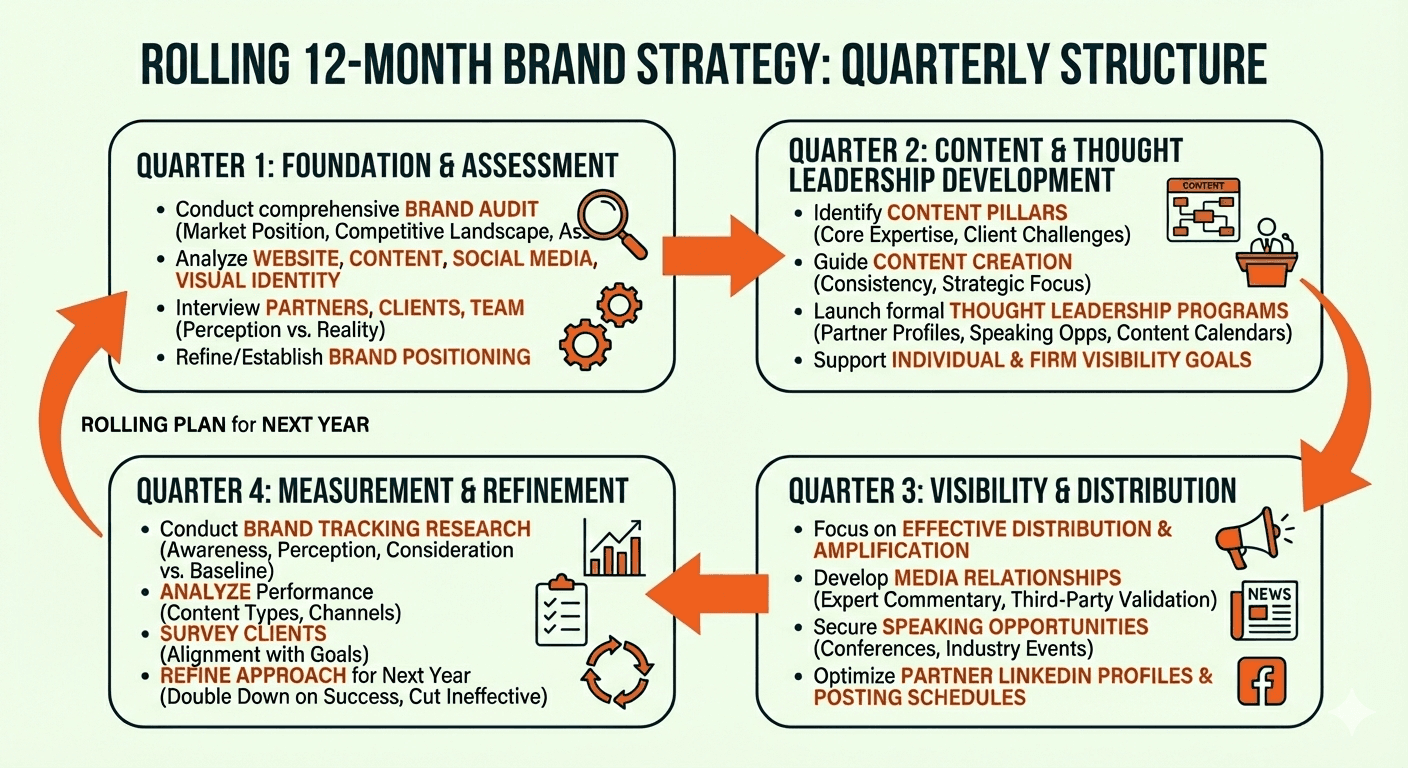
A 12-month brand strategy shouldn't be a static document you write in January and forget by March. It needs to be a rolling plan that goes into detail on near-term initiatives while maintaining direction for longer-term goals. Here's how to structure it quarter by quarter.

Q1 should focus on foundation and assessment. Conduct a comprehensive brand audit examining your current market position, competitive landscape, and brand assets. This includes analyzing your website, content, social media presence, and visual identity against competitors and best practices. Interview partners, key clients, and team members to understand how your brand is actually perceived versus how you want it to be perceived. Use these insights to refine or establish brand positioning that guides everything else.

Q2 shifts to content and thought leadership development. Identify content pillars representing your core expertise areas and the client challenges you solve best. These pillars guide all content creation, ensuring consistency and strategic focus. Launch formal thought leadership programs for partners who will become the face of your expertise. This includes developing individual partner profiles, identifying speaking opportunities, and creating content calendars that support both individual and firm visibility goals.

Q3 emphasizes visibility and distribution. Creating excellent content means nothing without effective distribution. Develop relationships with journalists covering your practice areas and offer expert commentary on industry developments. Media coverage builds credibility because third-party validation carries more weight than self-promotion. Secure speaking opportunities at relevant conferences and industry events. Optimize partner LinkedIn profiles and implement consistent posting schedules. The focus here is amplification, making sure your expertise reaches the audiences that matter.

Q4 focuses on measurement and refinement. Conduct brand tracking research to assess changes in awareness, perception, and consideration compared to your baseline from quarter one. Analyze which content types and channels delivered the strongest results. Survey clients to understand whether brand perceptions align with strategic goals. Use these insights to refine your approach for the following year, doubling down on what works and cutting what doesn't.
How to Get Partner Buy-In for Brand Investment

The biggest challenge in executing brand strategy isn't the tactics. It's getting partners to commit time and budget to something that doesn't generate leads this quarter. Partners think in billable hours and immediate return on investment. Brand building requires thinking in years, not months. Here's how to bridge that gap.

Start with the business case. Law firms with strong brands command premium pricing, attract better talent, and generate qualified referrals. They also create resilience during market downturns. When potential clients face legal challenges, they turn to firms they already know and trust, not firms they need to research from scratch. Quantify this wherever possible. If brand building reduces your cost per client acquisition by 30% over two years, that's a concrete ROI partners can evaluate.

Frame brand investment as risk mitigation, not just growth strategy. The Australian legal market is increasingly competitive, and client expectations continue to evolve. Firms that rely solely on referrals or static websites are falling behind as 73% of legal consumers begin their search online. Investing in brand isn't optional anymore. It's about maintaining market position while competitors invest in theirs.

Make partner participation manageable. Time-poor partners resist brand initiatives that require hours of their week. Structure thought leadership programs that work with their schedules, not against them. This might mean batch-recording podcast interviews quarterly rather than weekly. It might mean hiring content support to turn 15-minute partner interviews into publishable articles. The goal is to make participation sustainable, not overwhelming. When you need help developing these systems, request a marketing audit to identify gaps and create realistic implementation plans.

The firms that win in the next decade won't be the ones with the biggest marketing budgets. They'll be the ones with the clearest positioning, the most consistent execution, and the patience to build brand equity that competitors can't easily copy. That requires partners who understand the difference between marketing activity and brand strategy. Your 12-month plan should make that difference impossible to miss.

Most law firms will keep confusing posts with positioning and activity with strategy. The ones that figure out the difference will own their market while everyone else wonders why their marketing isn't working. The choice is yours. Are you building a brand or just keeping busy?

Request a marketing audit from DesignBff to identify the gaps between your current marketing activity and a genuine brand strategy that builds sustainable market position for your law firm.

Frequently Asked Questions

Q1: How long does it take for a law firm rebrand to show results?

Brand building is a long-term investment with different results appearing at different stages. You might see improvements in website traffic and social media engagement within three to six months as visibility increases. However, meaningful changes in brand awareness and market position typically require 12 to 18 months of consistent effort. The brand strategy development itself often takes six to 12 weeks, with implementation and measurement extending over the following year. For law firms specifically, the sales cycle length matters too. If your typical client takes six months from first awareness to engagement, you need to maintain brand presence for at least that long before seeing lead generation impact.

Q2: Should our law firm focus on brand building or lead generation first?

This is a false choice that keeps firms stuck. The most effective approach integrates both rather than treating them as separate activities. Content marketing and thought leadership can simultaneously build brand awareness and generate leads. A rolling marketing plan helps balance short-term lead generation tactics with longer-term brand building by planning six to 18 months ahead with quarterly reviews and adjustments. For small law firms especially, focusing only on immediate lead generation creates a constant scramble for new business. Adding brand building creates compound returns where visibility today continues generating inquiries months later.

Q3: How much should a small law firm invest in brand strategy versus marketing?

Most small law firms allocate five to ten percent of annual revenue to marketing, with a portion dedicated to brand building versus direct lead generation activities. The exact split depends on your growth objectives, competitive intensity, and current market position. Newer firms or those entering competitive markets may need to invest more heavily upfront to establish market presence. Firms in highly competitive markets or those seeking rapid growth typically invest toward the higher end of this range. The key is ensuring that whatever you invest has strategic direction behind it. Spending two percent of revenue strategically will deliver better results than spending eight percent randomly.

Q4: Can individual lawyer brands conflict with firm brand identity?

Yes, but only when they're not strategically aligned. Personal branding and firm branding should reinforce each other rather than competing. The best approach ensures individual lawyer brands represent specific aspects of the firm's overall positioning. If your firm specializes in employment law, partners should develop personal brands around different aspects of that expertise rather than building completely unrelated profiles. Problems arise when partners build personal brands that directly contradict firm values or positioning, or when they become so associated with their personal brand that clients follow them if they leave. The solution is alignment from the start, with clear guidelines about how individual and firm brands work together.

Q5: What's the minimum viable brand strategy for a boutique law firm?

Even the smallest firms need three things: clear positioning that explains who you serve and what makes you different, consistent visibility in places your target clients look for information, and one or two partners committed to thought leadership and relationship-building. You don't need a massive budget. You need clarity and consistency. Start with optimizing your website and partner LinkedIn profiles to clearly communicate your positioning. Pick one or two content channels where your target clients actually spend time and show up consistently with valuable insights. Build relationships with a handful of journalists or industry publications relevant to your practice area. For firms with limited resources, focusing deeply on a narrow niche delivers better results than spreading effort thinly across everything. The minimum viable strategy is the one you'll actually execute consistently, not the one that looks impressive in a planning document.

When partners ask about their firm's brand strategy for the next 12 months, they're usually trying to figure out if all that marketing spend is actually building something or just creating noise. It's a fair question.

With 82% of legal clients now reviewing at least three firms online before making contact, the difference between a strategic brand and random marketing activity has never mattered more. But here's what most law firms get wrong. They confuse being busy with being strategic, and they measure success by how much they post rather than whether anyone actually remembers them when it matters.

Why Most Law Firm Brand Strategies Fail to Deliver?

Most law firms don't have brand strategies. They have marketing calendars dressed up as strategy. There's a big difference. A marketing calendar tells you what to post and when. A brand strategy tells you what market position you're building and how every activity contributes to that goal. The Australian legal market is crowded with over 20,000 private practices, and most of them sound exactly the same. They all promise excellence, client focus, and deep expertise. When everyone makes the same promise, no one stands out.

This happens because firms focus on activity instead of outcomes. They post on LinkedIn because they think they should. They send newsletters because competitors do. They update their website because it looks outdated. But none of this is connected to a clear idea of what the firm should be known for or who should know about it. Research from legal marketing specialists shows that firms often struggle because their positioning isn't specific enough. When you try to serve everyone, you become memorable to no one.

The real test of brand strength isn't how often you post. It's whether the right people think of your firm first when they have a legal problem you're built to solve. That requires strategy, not just activity.

What Is a Brand Positioning Strategy for Law Firms?

How to Position Your Brand in a Crowded Legal Market?

Brand positioning is the strategic foundation of how your law firm is perceived in the market. It defines who you serve, what specific problems you solve, and why clients should choose you instead of the dozen other firms they're comparing you to. This isn't about being better at everything. It's about being the obvious choice for something specific.

Think about it this way. A positioning statement before strategy might read like this: "We provide high-quality legal services to businesses and individuals across Australia." That could describe almost any firm. After developing real positioning, it might become: "We help service-based business owners protect their assets, grow their brand, and scale their business without legal headaches." The second version tells you exactly who benefits and what outcome they get. That specificity is what makes positioning work.

Effective law firm brand positioning identifies what makes your firm different, even if that difference is subtle. Many firms are 98% the same, competing on similar expertise and service models. Your positioning captures the 2% that sets you apart, whether that's your approach to client communication, your specific industry focus, or the way you structure your services. When you get positioning right, everything else gets easier. Your marketing has direction. Your partners know what to talk about. Your clients understand why you're different.

The Three Pillars of Strong Law Firm Brand Positioning

Strong law firm brands are built on three foundations: reputation, visibility, and relevance. Brand strength can be understood as reputation multiplied by visibility, with relevance to your target market completing the equation. You need all three working together.

Reputation is what people believe about your firm's competence and trustworthiness. It's built through delivering results, maintaining ethical standards, and creating positive client experiences. But reputation alone doesn't drive growth if nobody knows about it. Visibility makes your reputation accessible. It ensures that when potential clients face a legal challenge, they know your firm exists and understand what you do. This comes from consistent presence in the places your target clients look for information, whether that's LinkedIn, industry publications, or referral networks.

Relevance ties everything together. Your firm might be visible and well-regarded, but if you're known for the wrong expertise or talking to the wrong audience, growth stalls. Relevance means your brand connects directly to the specific needs of the clients you want to serve. A commercial litigation firm that accidentally builds a brand around family law has high visibility but low relevance for their target market. Getting all three pillars aligned is what transforms marketing activity into genuine brand strength.

How Should Partner Visibility Factor Into Your Brand Strategy?

Why Lawyer Personal Branding Matters More Than Firm Marketing?

Here's something that makes law firms different from other businesses. Clients want to work with people, not logos. When someone faces a legal challenge, they're not just hiring a firm. They're hiring a specific lawyer whose judgment and expertise they trust. This is why lawyer personal branding has become crucial to firm brand strategy.

The numbers back this up. When decision-makers research law firms, they spend as much time looking at individual lawyer profiles as they do reviewing firm credentials. They want to see evidence that the person they'll actually work with knows their stuff. A strong personal brand for lawyers demonstrates expertise through thought leadership, media commentary, and consistent visibility in industry conversations.

But here's where it gets tricky. Individual lawyer brands need to complement the firm brand, not compete with it. The best approach aligns partner visibility efforts with firm positioning. If your firm is building a brand around commercial property law, your partners should be developing personal brands that showcase specific aspects of that expertise. One partner might focus on retail leasing, another on development projects, and another on property disputes. Together, they reinforce the firm's overall positioning while building individual recognition.

For small to mid-sized firms, partner visibility often matters more than firm-level marketing. Potential clients connect with individual expertise before they connect with firm values. Your 12-month brand strategy should include concrete plans for building partner profiles, not just firm awareness.

How to Build a Personal Brand on LinkedIn as a Lawyer?

LinkedIn remains the most effective platform for professional networking and credibility-building in the Australian legal industry. But most lawyers use it poorly, either posting nothing at all or sharing generic content that does nothing to demonstrate expertise. Here's what actually works.

Start with your profile. Your LinkedIn profile should immediately communicate your specific expertise and the problems you solve. A well-optimized profile includes a professional headshot, a headline that states your specialization clearly, and a summary that explains who you help and how. Skip the generic "experienced lawyer" description and be specific about your practice focus. If you help manufacturing businesses navigate workplace disputes, say that. If you specialize in succession planning for family-owned businesses, lead with that.

Content strategy matters more than posting frequency. Publishing one substantive article monthly that demonstrates real expertise builds more value than posting daily promotional updates. The best-performing content explains complex legal concepts in plain language, offers perspectives on industry developments, or shares practical guidance that helps your target audience make better decisions. Educational content performs best because it proves competence while providing value.

Engagement amplifies your visibility. Commenting thoughtfully on industry updates, joining relevant LinkedIn groups, and sharing insights on trending legal topics keeps you visible in your network. The goal isn't to be everywhere. It's to be consistently present in conversations that matter to your target clients. For time-poor partners, this might mean focusing on LinkedIn exclusively rather than spreading effort across multiple platforms. Our 90-day LinkedIn strategy for law firm partners breaks this down into manageable actions that actually fit into a busy legal practice schedule.

How to Do PR for a Law Firm Without Wasting Budget?

What Makes PR Different From Marketing for Law Firms?

Most law firms confuse PR with advertising, but they serve completely different purposes. Law firm public relations is about strategically shaping how others perceive your firm through earned media and third-party validation. Instead of paying for ad space, you're earning coverage by providing valuable expertise to journalists, speaking at industry events, or contributing insights to publications. That third-party endorsement carries weight that paid advertising simply cannot match.

PR builds credibility in ways that marketing cannot. When a journalist quotes your partner in a news article about employment law changes, that positions your firm as the expert source. When your managing partner speaks at an industry conference, that demonstrates leadership. When your firm's analysis appears in the Australian Financial Review, that signals authority. None of this can be bought through traditional advertising.

Effective legal PR requires understanding how to translate technical legal expertise into insights that resonate with both media and potential clients. The best PR teams act as bridges, helping lawyers communicate complex concepts in accessible ways while maintaining professional credibility. For law firms specifically, PR must navigate client confidentiality, ethical advertising restrictions, and the challenge of making legal topics genuinely newsworthy.

PR Tactics That Actually Work for Small to Mid-Sized Firms

You don't need a massive budget to make PR work for your law firm. Smaller firms can compete effectively by being more focused and strategic than larger competitors. Here's what actually delivers results for boutique and mid-sized practices.

Thought leadership programs build visibility through consistent expert commentary. This means identifying partners who have genuine expertise in areas that generate media interest, then systematically positioning them as expert sources. Register for platforms like HARO (Help A Reporter Out) where journalists seek expert sources. When reporters need legal commentary on breaking news, your partners should be ready to respond quickly with quotable insights. Media relationships built over time increase your chances of being contacted directly when relevant stories develop.

Speaking engagements at industry conferences and events position partners as authorities while creating networking opportunities with potential clients and referral sources. Target events where your ideal clients gather, not just legal industry conferences. If you serve construction businesses, speak at construction industry events. If your expertise is in retail law, present at retail sector conferences. The visibility matters most when you're presenting to people who might actually need your services.

Written content in industry publications builds credibility and improves search visibility. Contributing articles to relevant trade publications, submitting op-eds to business media, and publishing insights on legal developments helps establish expertise. Research shows that lawyers who regularly publish thoughtful content are perceived as more credible and attract higher-quality client inquiries.

The question of in-house vs agency PR depends on your firm's size and expertise. Managing PR internally offers cost savings and complete control over messaging but requires dedicated time and media relationship skills most lawyers don't have. Working with a specialized legal PR agency brings established media contacts and PR expertise but costs more. Many small firms find success with a hybrid approach: using external specialists for media training and relationship-building while handling content creation and social amplification internally. You can learn more about balancing content creation with limited time through strategic approaches.

How Do You Know If Your Brand Is Getting Stronger?

Brand Metrics That Matter for Law Firms

Without measurement, you can't tell if you're building a brand or just burning budget. But most law firms track the wrong metrics. Social media follower counts and website page views tell you about activity, not brand strength. Here's what actually indicates whether your brand is getting stronger.

Brand awareness measures whether your target market knows your firm exists and understands what you do. This can be tracked through aided awareness (do they recognize your name when they hear it?) and unaided awareness (do they think of your firm spontaneously when considering legal services?). Regular brand tracking surveys help you understand how awareness changes over time. For smaller firms without survey budgets, track branded search volume (people searching specifically for your firm name) as a proxy for growing awareness.

Share of voice indicates how much of the conversation in your market belongs to your firm. Monitor your firm's presence relative to competitors through media mentions, social media engagement, and search engine visibility. Tools like SEMrush or similar platforms help track whether your share of visibility is growing or shrinking. If competitors consistently dominate industry conversations while your firm remains invisible, your brand isn't strengthening regardless of how much content you create.

Client sentiment reveals how people actually perceive your firm. Net Promoter Score asks clients how likely they are to recommend your firm. Review platform ratings show what clients say when you're not listening. Regular client satisfaction surveys provide qualitative feedback about whether your brand promise matches client experience. Strong brands deliver on the expectations they set, creating positive sentiment that drives referrals and repeat business.

Website analytics reveal brand interest through direct traffic (people typing your URL directly because they know who you are) and time on site (deeper engagement suggesting genuine interest rather than accidental visits). Increasing direct traffic typically indicates growing brand recognition. People seek you out specifically rather than discovering you through generic searches.

The Difference Between Marketing Activity and Brand Growth

Here's the brutal truth: high activity levels don't automatically translate to strong brands. A law firm posting daily on social media without strategy creates noise, not brand strength. A firm publishing one thoughtful piece monthly that generates meaningful conversations builds actual brand equity. The difference lies in quality, consistency, and strategic focus.

Strong brands maintain consistency across all touchpoints. Every interaction, whether a LinkedIn post, client meeting, or media interview, reinforces core brand attributes. They focus on depth over breadth, becoming known for specific expertise rather than trying to be everything to everyone. This requires discipline. It means saying no to opportunities that don't align with positioning, even when they seem like easy wins.

Brand growth also manifests in how people talk about your firm when you're not in the room. Monitor review platforms, social media mentions, and conduct regular client satisfaction surveys to understand whether your brand genuinely resonates or just exists. The goal is to build associations so strong that when someone in your target market faces the legal challenge you specialize in, they think of your firm first. Everything else is vanity metrics. Understanding the distinction between brand experience and client experience helps clarify what you're actually building.

Building Your 12-Month Law Firm Brand Plan

What Should Be in Your Quarterly Brand Strategy?

A 12-month brand strategy shouldn't be a static document you write in January and forget by March. It needs to be a rolling plan that goes into detail on near-term initiatives while maintaining direction for longer-term goals. Here's how to structure it quarter by quarter.

Q1 should focus on foundation and assessment. Conduct a comprehensive brand audit examining your current market position, competitive landscape, and brand assets. This includes analyzing your website, content, social media presence, and visual identity against competitors and best practices. Interview partners, key clients, and team members to understand how your brand is actually perceived versus how you want it to be perceived. Use these insights to refine or establish brand positioning that guides everything else.

Q2 shifts to content and thought leadership development. Identify content pillars representing your core expertise areas and the client challenges you solve best. These pillars guide all content creation, ensuring consistency and strategic focus. Launch formal thought leadership programs for partners who will become the face of your expertise. This includes developing individual partner profiles, identifying speaking opportunities, and creating content calendars that support both individual and firm visibility goals.

Q3 emphasizes visibility and distribution. Creating excellent content means nothing without effective distribution. Develop relationships with journalists covering your practice areas and offer expert commentary on industry developments. Media coverage builds credibility because third-party validation carries more weight than self-promotion. Secure speaking opportunities at relevant conferences and industry events. Optimize partner LinkedIn profiles and implement consistent posting schedules. The focus here is amplification, making sure your expertise reaches the audiences that matter.

Q4 focuses on measurement and refinement. Conduct brand tracking research to assess changes in awareness, perception, and consideration compared to your baseline from quarter one. Analyze which content types and channels delivered the strongest results. Survey clients to understand whether brand perceptions align with strategic goals. Use these insights to refine your approach for the following year, doubling down on what works and cutting what doesn't.

How to Get Partner Buy-In for Brand Investment

The biggest challenge in executing brand strategy isn't the tactics. It's getting partners to commit time and budget to something that doesn't generate leads this quarter. Partners think in billable hours and immediate return on investment. Brand building requires thinking in years, not months. Here's how to bridge that gap.

Start with the business case. Law firms with strong brands command premium pricing, attract better talent, and generate qualified referrals. They also create resilience during market downturns. When potential clients face legal challenges, they turn to firms they already know and trust, not firms they need to research from scratch. Quantify this wherever possible. If brand building reduces your cost per client acquisition by 30% over two years, that's a concrete ROI partners can evaluate.

Frame brand investment as risk mitigation, not just growth strategy. The Australian legal market is increasingly competitive, and client expectations continue to evolve. Firms that rely solely on referrals or static websites are falling behind as 73% of legal consumers begin their search online. Investing in brand isn't optional anymore. It's about maintaining market position while competitors invest in theirs.

Make partner participation manageable. Time-poor partners resist brand initiatives that require hours of their week. Structure thought leadership programs that work with their schedules, not against them. This might mean batch-recording podcast interviews quarterly rather than weekly. It might mean hiring content support to turn 15-minute partner interviews into publishable articles. The goal is to make participation sustainable, not overwhelming. When you need help developing these systems, request a marketing audit to identify gaps and create realistic implementation plans.

The firms that win in the next decade won't be the ones with the biggest marketing budgets. They'll be the ones with the clearest positioning, the most consistent execution, and the patience to build brand equity that competitors can't easily copy. That requires partners who understand the difference between marketing activity and brand strategy. Your 12-month plan should make that difference impossible to miss.

Most law firms will keep confusing posts with positioning and activity with strategy. The ones that figure out the difference will own their market while everyone else wonders why their marketing isn't working. The choice is yours. Are you building a brand or just keeping busy?

Request a marketing audit from DesignBff to identify the gaps between your current marketing activity and a genuine brand strategy that builds sustainable market position for your law firm.

Frequently Asked Questions

Q1: How long does it take for a law firm rebrand to show results?

Brand building is a long-term investment with different results appearing at different stages. You might see improvements in website traffic and social media engagement within three to six months as visibility increases. However, meaningful changes in brand awareness and market position typically require 12 to 18 months of consistent effort. The brand strategy development itself often takes six to 12 weeks, with implementation and measurement extending over the following year. For law firms specifically, the sales cycle length matters too. If your typical client takes six months from first awareness to engagement, you need to maintain brand presence for at least that long before seeing lead generation impact.

Q2: Should our law firm focus on brand building or lead generation first?

This is a false choice that keeps firms stuck. The most effective approach integrates both rather than treating them as separate activities. Content marketing and thought leadership can simultaneously build brand awareness and generate leads. A rolling marketing plan helps balance short-term lead generation tactics with longer-term brand building by planning six to 18 months ahead with quarterly reviews and adjustments. For small law firms especially, focusing only on immediate lead generation creates a constant scramble for new business. Adding brand building creates compound returns where visibility today continues generating inquiries months later.

Q3: How much should a small law firm invest in brand strategy versus marketing?

Most small law firms allocate five to ten percent of annual revenue to marketing, with a portion dedicated to brand building versus direct lead generation activities. The exact split depends on your growth objectives, competitive intensity, and current market position. Newer firms or those entering competitive markets may need to invest more heavily upfront to establish market presence. Firms in highly competitive markets or those seeking rapid growth typically invest toward the higher end of this range. The key is ensuring that whatever you invest has strategic direction behind it. Spending two percent of revenue strategically will deliver better results than spending eight percent randomly.

Q4: Can individual lawyer brands conflict with firm brand identity?

Yes, but only when they're not strategically aligned. Personal branding and firm branding should reinforce each other rather than competing. The best approach ensures individual lawyer brands represent specific aspects of the firm's overall positioning. If your firm specializes in employment law, partners should develop personal brands around different aspects of that expertise rather than building completely unrelated profiles. Problems arise when partners build personal brands that directly contradict firm values or positioning, or when they become so associated with their personal brand that clients follow them if they leave. The solution is alignment from the start, with clear guidelines about how individual and firm brands work together.

Q5: What's the minimum viable brand strategy for a boutique law firm?

Even the smallest firms need three things: clear positioning that explains who you serve and what makes you different, consistent visibility in places your target clients look for information, and one or two partners committed to thought leadership and relationship-building. You don't need a massive budget. You need clarity and consistency. Start with optimizing your website and partner LinkedIn profiles to clearly communicate your positioning. Pick one or two content channels where your target clients actually spend time and show up consistently with valuable insights. Build relationships with a handful of journalists or industry publications relevant to your practice area. For firms with limited resources, focusing deeply on a narrow niche delivers better results than spreading effort thinly across everything. The minimum viable strategy is the one you'll actually execute consistently, not the one that looks impressive in a planning document.

Let’s tackle your marketing challenge and show you the roadmap to success.

Extreme close-up black and white photograph of a human eye

Let’s tackle your marketing challenge and show you the roadmap to success.

Extreme close-up black and white photograph of a human eye

Let’s tackle your marketing challenge and show you the roadmap to success.

Extreme close-up black and white photograph of a human eye

Day Job