
"Can you prove that our marketing actually drives revenue?" Every marketing leader in professional services has heard this question.
It's not about showing a spreadsheet of metrics or defending last quarter's budget. This is the ultimate accountability test. Your answer determines whether marketing investments continue, expand, or get cut.

For law firms, accounting practices, and financial advisory businesses, sales cycles stretch six to twelve months. Multiple decision makers get involved. Proving marketing's contribution to revenue is challenging. When you implement proper attribution systems, you gain visibility into what works. You can make confident decisions about budget allocation and strategy. You build credibility with partners who demand evidence that marketing drives business results.
Why Attribution Matters for Professional Services
Here's what's happening. 86% of B2B practitioners now say marketing measurement and attribution are a growing priority. Decision makers in professional service firms want proof that marketing investments connect to revenue. It's not optional anymore.
Traditional metrics don't tell the full story. A law firm generates 500 website visits from a content campaign. Great. But without attribution tracking, they can't tell if those visits led to the three high-value clients who signed up six months later. This gap creates real problems when budgets get tight. Understanding whether marketing delivers value is essential if you want to grow.
Professional service firms face unique attribution challenges. Your offerings require significant trust building before engagement. Unlike e-commerce where attribution paths span days or weeks, you need visibility across extended consideration periods. Prospects consume content, attend events, engage with thought leadership, and interact with multiple team members before deciding. Statistics reveal that B2B buyers now encounter 14 touchpoints before conversion. And 83% of marketers say customer paths are getting longer. This complexity intensifies when multiple stakeholders participate. Research shows the average B2B purchase involves 6.8 stakeholders. The person starting the journey rarely holds the credit card. A single engagement might involve a CFO who found you on LinkedIn, a CEO who got a referral, and a board member who attended your seminar. Attribution systems must track engagement across individuals while connecting their collective journey to the account level. This mirrors how brand experience differs from user experience, where multiple stakeholder perceptions shape buying decisions.
What Attribution Models Work Best?
Picking the right attribution model determines whether you understand what's actually driving results. Current data shows only 22% of organizations still rely on last-click attribution. Yet many professional service firms stay stuck with this outdated approach.
Last-click attribution gives 100% credit to the final touchpoint before conversion. It undervalues everything else you did to build awareness, establish thought leadership, and nurture relationships. This is a big problem for firms targeting ultra-high net worth clients where consideration journeys run a year or more. First-click attribution does the opposite. It gives all credit to initial discovery and ignores what actually closed the deal.
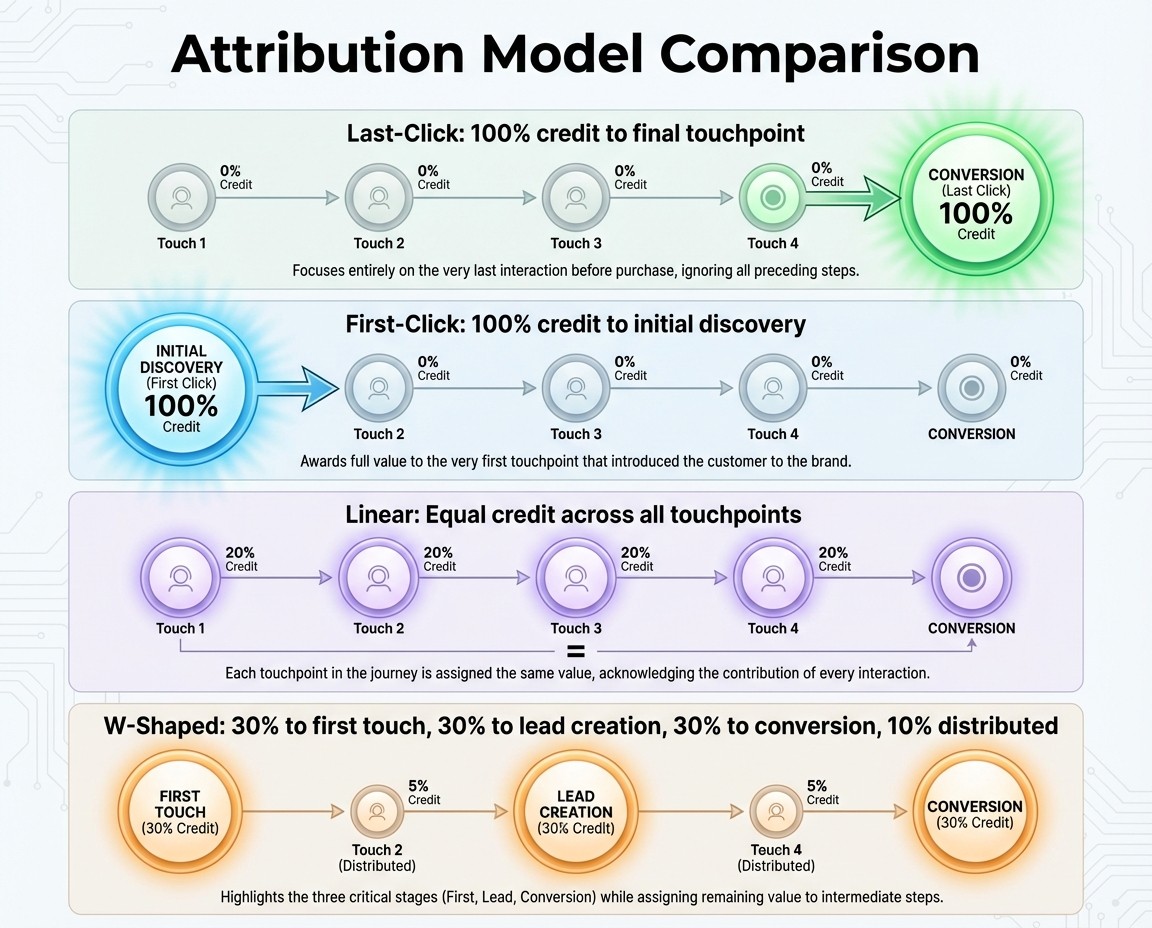
W-shaped attribution offers a balanced approach. It assigns 30% credit each to first touch, lead creation, and conversion touchpoints. The remaining 10% gets distributed among other interactions. This model excels for professional services because it recognizes three critical moments: initial discovery, when prospects demonstrate serious interest, and final conversion.
Data-driven attribution represents the most sophisticated approach. It uses algorithms and machine learning to analyze all touchpoints and assign credit based on actual influence patterns in your specific customer journeys. Current research indicates 29.8% of B2B organizations now use data-driven models. While these models require substantial data volumes and technical setup, they deliver insights that simple rule-based models can't match.
How to Track Attribution Across Long Sales Cycles
Implementation requires technical infrastructure that maintains visibility across months-long consideration periods. The challenge intensifies when prospects interact across devices, clear cookies, or engage both online and offline before conversion. This becomes critical for law firm marketing strategies where tracking must span from initial awareness through to signed engagement letters.
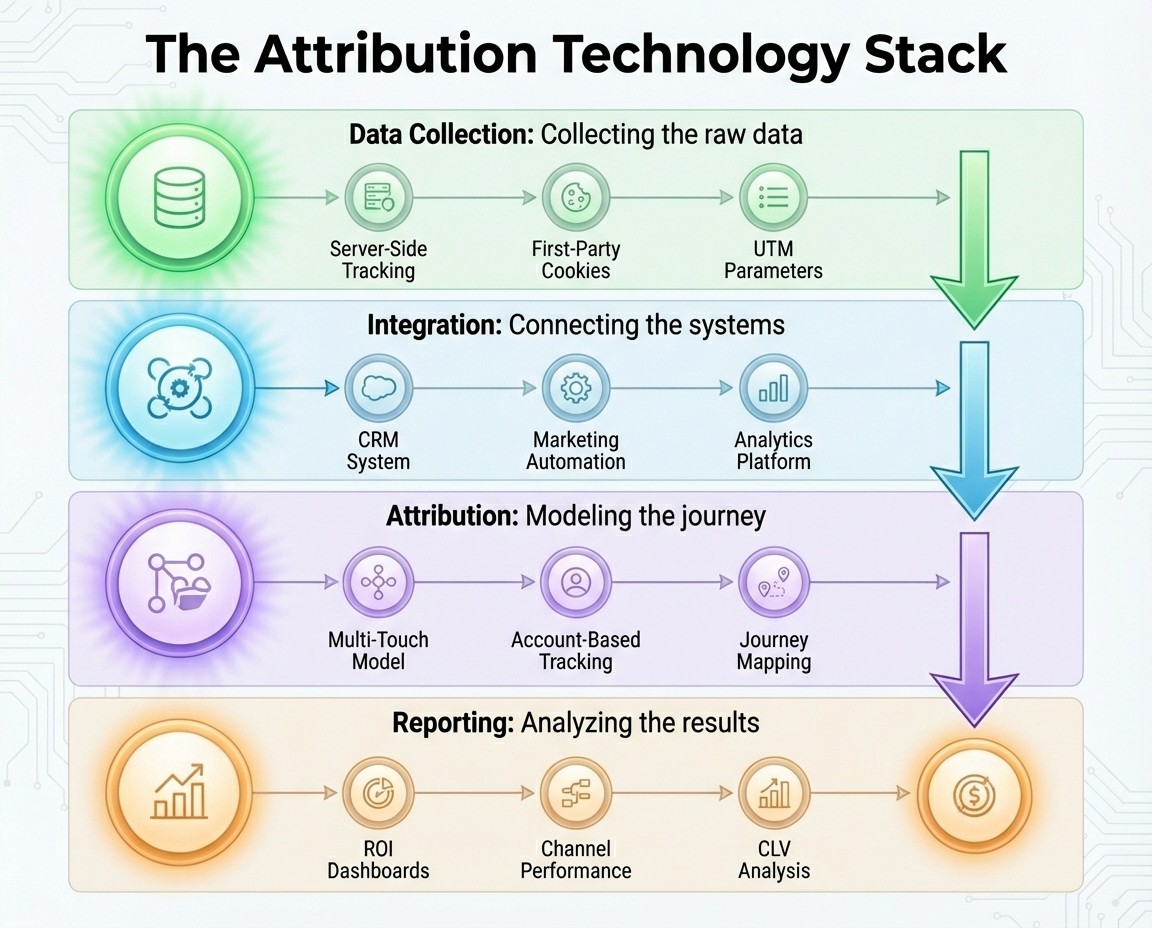
Server-side tracking provides the foundation for reliable long-term attribution. It captures interaction data on your servers rather than relying on browser cookies that expire after 30 to 90 days. When sales cycles run six months but cookies expire in 30 days, you lose the connection between early touchpoints and final conversions. Server-side tracking solves this by matching interactions to persistent visitor IDs in your database.
CRM integration proves essential because client acquisition often involves offline interactions that digital analytics can't capture. When attribution platforms connect with your CRM, they associate early digital touchpoints with subsequent sales meetings and proposal presentations. This integration enables attribution to follow the complete journey from initial website visit through consultation to signed engagement letter. Account-based tracking adds another critical layer. Rather than tracking individuals in isolation, attribution systems must recognize when different people from the same company interact with your marketing, then aggregate these activities to understand the account-level journey.
Leading and Lagging Indicators to Monitor
Effective attribution extends beyond final revenue numbers. It includes predictive indicators that signal future performance, enabling faster strategic adjustment rather than waiting months for revenue data to reveal problems.
Website traffic quality serves as an early predictor of pipeline health. But total visitor counts matter far less than traffic composition. Track visits specifically from target segments: the industries you serve, the company sizes you pursue, the geographic markets you target. Data shows professional services achieve 12.3% conversion from organic search, the highest among all B2B sectors. Content engagement demonstrates consideration-stage progression that typically precedes conversion. When prospects spend time with your thought leadership articles, download service guides, or watch case study videos, they signal growing interest. This often leads to consultation requests weeks or months later. Research indicates blog content influences 56% of B2B mid-funnel decisions.
Lead scoring provides quantitative assessment of prospect qualification based on firmographic data and behavioral signals. Rather than treating all leads equally, sophisticated scoring systems assign points for factors indicating genuine service need: company size, industry alignment, job title seniority, content consumed, and website visit frequency. Pipeline velocity measures how quickly opportunities move through stages from initial contact to engagement. Attribution that tracks pipeline velocity by source channel reveals which marketing activities generate not just volume but momentum. Data shows companies using attribution effectively see 15-30% higher marketing ROI precisely because they optimize based on these predictive signals.
While leading indicators enable proactive optimization, lagging indicators like revenue, client acquisition cost, and retention rates provide the ultimate measure. The challenge lies in connecting these metrics back to specific marketing activities given the extended timelines between touchpoint and transaction.
How Customer Lifetime Value Changes Everything
Most attribution stops at initial client acquisition. That's a mistake. Professional service firms make money through retention, expansion, and referrals. These compound marketing's real business impact. Customer lifetime value shows you the full picture.
Take a law firm where attribution shows a content campaign generated five new clients with $50,000 in initial work. Looks decent. But those clients stay for three years. They each bring four more matters at $40,000 each. Now the campaign's actual value is $850,000. When you factor CLV into attribution, you often find campaigns deliver four to five times more than you first thought.
Retention rates significantly impact ROI calculations. Research demonstrates that increasing customer retention by just 5% can boost profitability by 25% to 95%. When attribution connects marketing activities to client retention, it reveals which campaigns attract clients who stay longer. An accounting firm might discover that clients acquired through thought leadership content show 40% higher retention than those from paid advertising. Referral generation represents another dimension of value that simple attribution misses. Attribution systems that track referral sources back to original acquisition channels reveal which marketing activities attract clients who become champions. Expansion revenue through additional services significantly boosts CLV in professional services. When attribution tracks not just initial acquisition but subsequent cross-selling success, marketing teams gain visibility into which campaigns attract clients with broader service needs.
Conclusion
Here's the reality. Long sales cycles make attribution hard. Multiple stakeholders make it harder. Complex customer journeys create real tracking problems. But firms that get attribution right gain serious advantages. They know what works. They spend money based on data, not hunches. They build marketing that drives growth while competitors burn cash on stuff that doesn't deliver. With proper systems tracking your customer journey, the right attribution model, and CLV in the mix, you'll have proof that marketing actually impacts revenue.
Ready to implement data-driven marketing attribution that proves ROI? DesignBff partners with professional service firms to create comprehensive marketing strategies backed by measurable results. Book a free consultation to discuss how we can help you demonstrate clear attribution between your marketing activities and revenue outcomes.
Frequently Asked Questions
Q1: What is the best attribution model for professional services with long sales cycles?
W-shaped or data-driven attribution models work best. W-shaped assigns 30% credit each to first touch, lead creation, and conversion while distributing remaining credit among supporting interactions. Data-driven attribution uses algorithms to analyze actual influence patterns. Current research shows 29.8% of B2B organizations now use data-driven models because they deliver superior insights for complex strategies.
Q2: How do you track attribution across a 6-12 month sales cycle?
Tracking requires server-side tracking that captures interaction data on your servers rather than browser cookies that expire in 30 to 90 days, CRM integration that connects digital touchpoints with offline activities, and account-based tracking that aggregates activities from multiple stakeholders. This infrastructure maintains data integrity across months, ensuring early touchpoints receive appropriate credit when engagements close quarters later.
Q3: What's the difference between leading and lagging indicators?
Leading indicators predict future revenue through metrics like qualified traffic, content engagement, lead scoring, and pipeline velocity. Lagging indicators measure actual outcomes through revenue, client acquisition cost, retention rates, and customer lifetime value. Professional service marketers need both. Leading indicators enable proactive optimization while lagging indicators provide accountability for business results.
Q4: How does customer lifetime value affect marketing ROI calculations?
Customer lifetime value transforms attribution from measuring initial transaction value to calculating total relationship value including retention, expansion revenue, and referrals. Marketing campaigns that generate clients with higher CLV deliver superior ROI even if initial acquisition costs appear higher. Attribution incorporating CLV often reveals marketing delivers four to five times higher returns than initial transaction analysis suggests.
Q5: What tools are needed to implement multi-touch attribution?
Implementation requires analytics platforms with attribution modeling capabilities like Google Analytics 4, CRM systems that track the complete sales process, marketing automation platforms that capture email and content engagement, and server-side tracking infrastructure that maintains visitor identity across extended periods. Statistics show 86% of B2B practitioners indicate marketing measurement is a growing priority, driving investment in sophisticated attribution technology stacks.