A law firm YouTube channel is one of the highest-return, least-crowded lead generation assets a small firm can build in 2026, and it does not require a production studio.
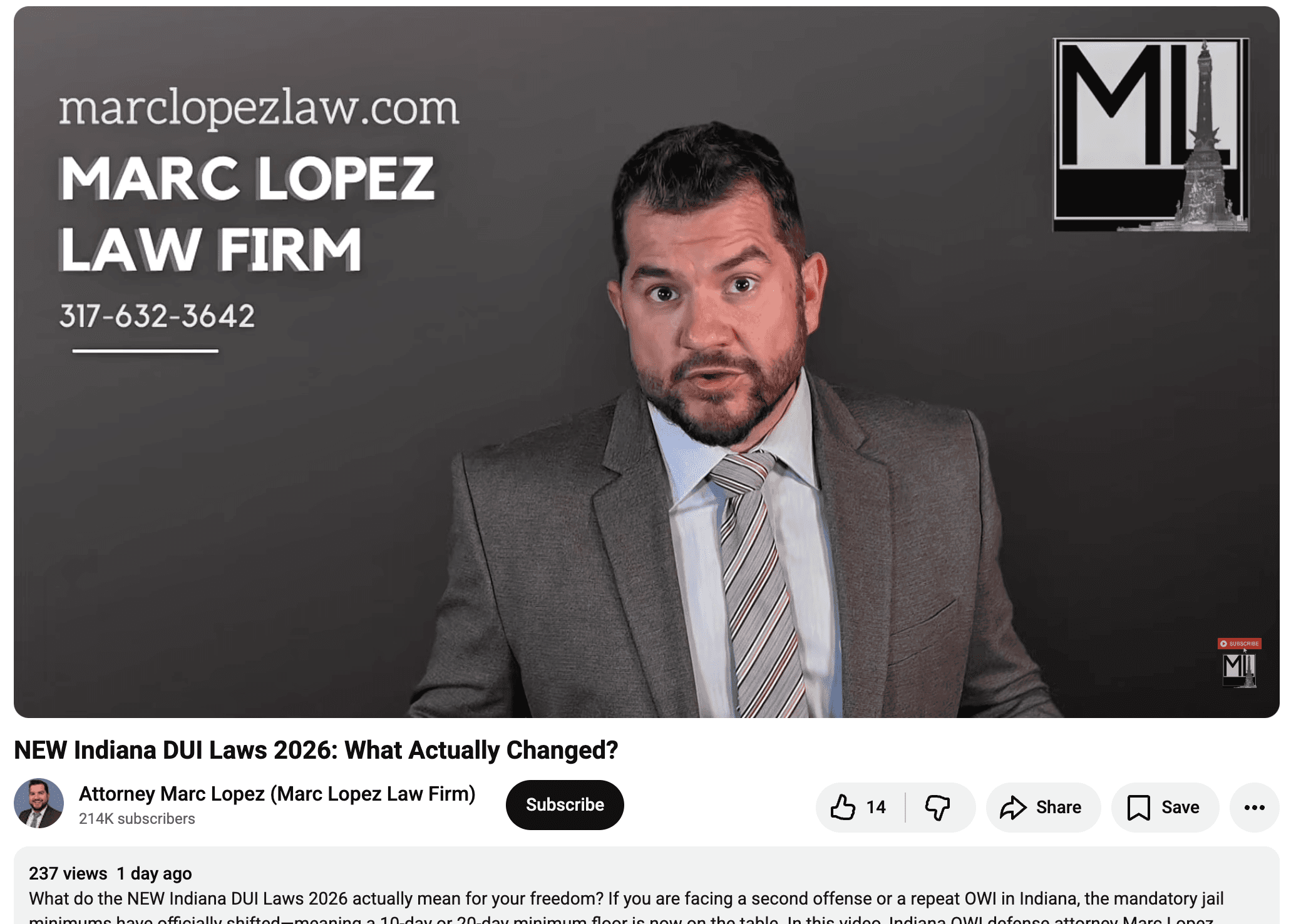
The proof is Marc Lopez Law Firm, an Indianapolis criminal defence practice whose channel has grown to 214,000 subscribers and 1,400 videos using AI-generated thumbnails, stock footage and minimal editing.
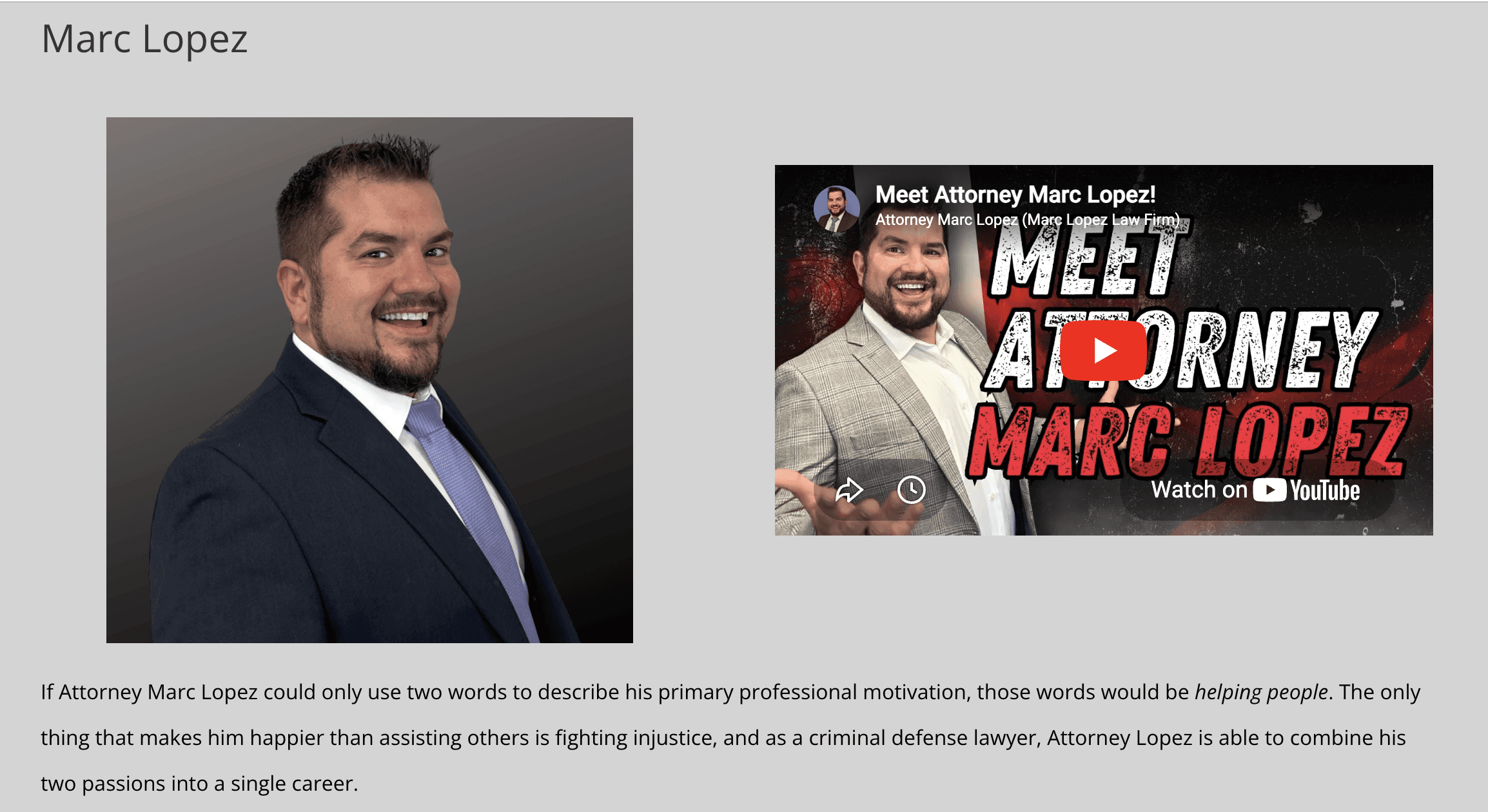
This article breaks down why the channel works, then translates the playbook for Australian firms: organic growth strategy, video optimisation for local audiences, content ideas by practice area, and the ethical rules that govern lawyers publishing client-related video content.
Why Should Your Law Firm Start a YouTube Channel?
Law firms should start a YouTube channel because clients now search for legal answers on video before they search for a lawyer, and very few firms are competing for that attention. Only 24% of law firms use video in their marketing at all, according to My Legal Academy's YouTube marketing guide citing 2020 ABA survey data, which leaves the field open for early movers.
The audience shift is measurable. Some 41% of Gen Z now turn to social media first when searching for information, against 32% who go to Google first, and YouTube has overtaken Google as the primary destination for how-to queries among users under 35, per the same 2025 My Legal Academy research. The commercial upside follows: websites with video content are 53 times more likely to reach Google's first page, and landing pages with embedded video convert 80% better. For a small firm competing against larger marketing budgets, video is a rare social media channel marketing tactic where effort beats spend.
Case Study: How Did Marc Lopez Law Firm Reach 214K Subscribers?
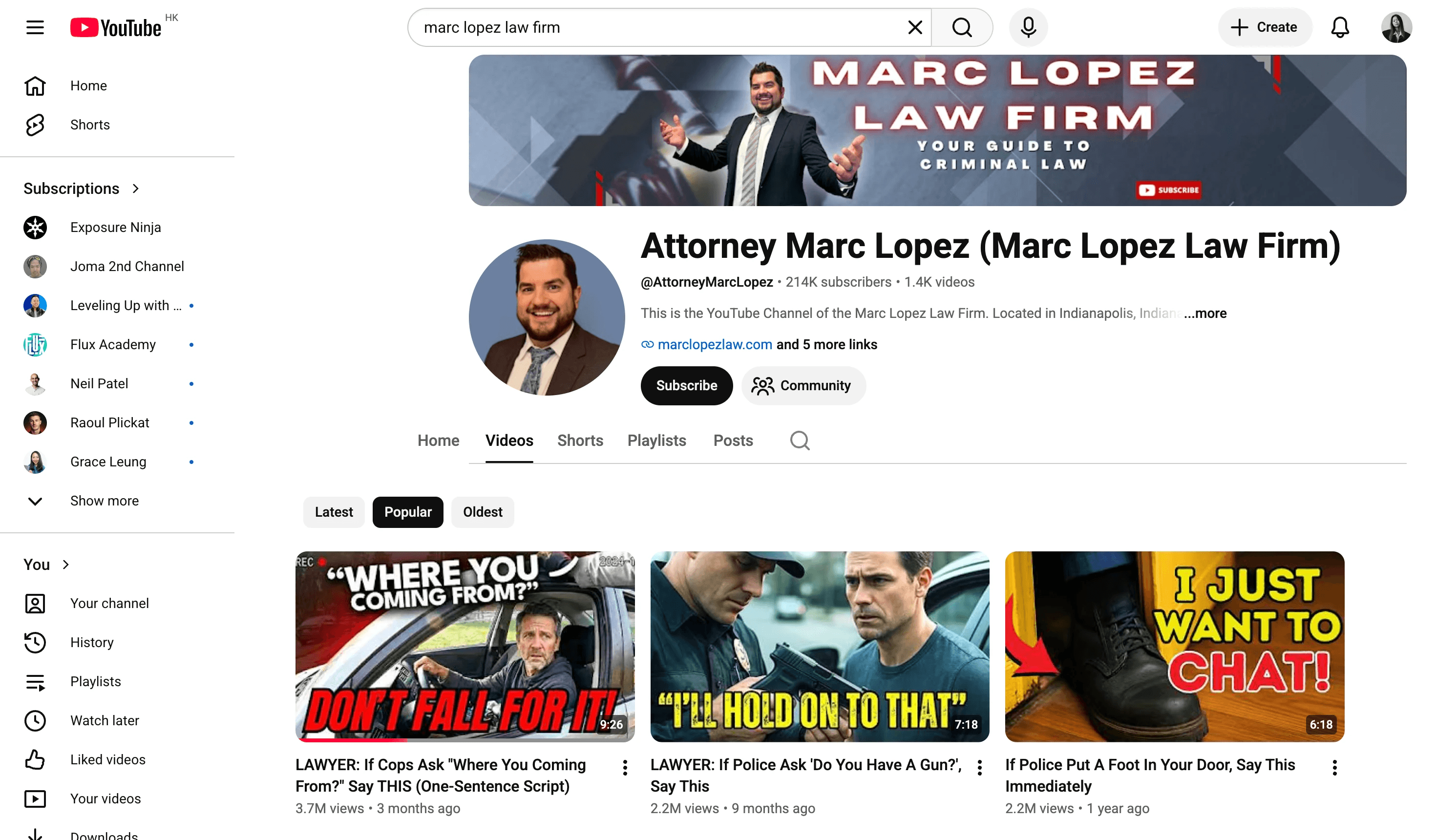
Marc Lopez Law Firm reached 214,000 subscribers by publishing consistently for 7 years, answering 1 common client question per video in plain English, and prioritising volume over production polish. The channel launched around 2019 at roughly 1 video per month, scaled to about 80 videos in its second year, and has never stopped posting since.
Look closely at the channel and the production choices are deliberately cheap. Thumbnails are largely AI-generated, backgrounds are plain slide-style images, stock footage fills the b-roll, and the editing is basic. What carries every video is the delivery: Lopez presents naturally and with real emotion, never visibly reading a script, and explains Indiana law in everyday language built around scenarios the public actually faces, such as what to say when police knock on your door. Most videos run under 10 minutes and cover exactly 1 topic. A handful blew up to over 3 million views, while many still sit at 2-digit or 3-digit view counts, and the firm publishes regardless.
The channel's authority now feeds the firm's website. Semrush Organic Research data from June 2026 shows marclopezlaw.com ranking for 9,800 organic keywords and drawing an estimated 8,200 monthly visits, organic traffic that would cost around US$55,100 per month to buy through Google Ads. The site holds position 1 for plain-English queries like "cops at my door", "trick questions cops ask" and "legal alcohol limit Indiana", the same questions the videos answer. The lesson for a firm of any size:
consistency beats performance anxiety, because the algorithm rewards channels that keep publishing
content relevance beats production quality, and AI tools make high volume affordable
hyper-local focus wins, since every video targets Indiana law where the firm practises
1 question per video turns the channel into a searchable legal help library
plain language reaches potential clients that legal jargon filters out
What Strategies Grow a Law Firm YouTube Audience Organically?
Organic growth comes from a fixed publishing cadence, a searchable library structure, playlists, Shorts and a 24/7 conversion path. Weekly publishing is the growth standard, fortnightly maintains momentum, and monthly is the minimum floor below which algorithmic momentum decays. Practice Proof's 2026 Australian guide is blunt on this point: a firm showing up weekly with a smartphone and a lavalier microphone will outperform one producing studio-quality content sporadically. Expect limited visibility in months 1 to 3 and compounding growth from month 6 onwards.
Structure matters as much as cadence. Group videos into practice-area playlists named with searchable geographic phrases, such as "Family Law Questions – NSW" rather than "Legal Insights", because playlists extend session time, a signal the algorithm weights heavily. Repurpose each long-form video into 2 or 3 Shorts that link back to the full version, so Shorts drive discovery while long-form converts viewers into consultations. Then give every video an after-hours conversion path: a booking link above the fold in the description and a verbal call to action at roughly 80% through the video, where retention data shows viewers are still watching. This mirrors the approach in our guide to law firm video marketing strategies that win clients.
How Do You Optimise YouTube Videos for an Australian Audience?
Optimising for Australian viewers means using the exact plain-English phrases clients search, anchored to a state or jurisdiction. Long-tail titles like "What Happens at a First Family Court Mention in NSW?" outperform generic phrases like "family law advice" for both discoverability and conversion, because legal rights differ by state and viewers want locally applicable answers. Front-load the primary keyword and keep titles under 60 characters, since YouTube truncates anything longer in search results.
Descriptions and captions are the most wasted assets on law firm channels. Put a keyword-rich summary in the first 125 characters, place the booking link before the "Show more" fold, add timestamps to any video over 3 minutes, and finish with a general-information disclaimer. Upload accurate captions rather than relying on auto-generation, because 69% of mobile viewers watch with the sound off and YouTube indexes caption text as ranking signals, per rankings.io's 2025 analysis. These are the same question-led principles behind law firm SEO and AEO in AI search, applied to video.

Which Legal Content Ideas Work Best for Law Firm Channels?
The best-performing legal content answers 1 real client question per video in under 10 minutes, exactly as the Marc Lopez channel does. Start with the 10 to 15 questions clients ask before engaging your firm, pulled from intake forms, consultation notes and Google reviews, and give each its own jurisdiction-specific video.
From there, map formats to intent. FAQ answers of 90 seconds to 4 minutes reach high-intent prospects with an active legal problem. Process explainers of 5 to 10 minutes, such as "How are assets split after separation in Australia?" or "What happens at settlement?", serve people researching what comes next. Myth-busting videos and law-change updates capture earlier-stage viewers, for example "Redundancy vs dismissal: what are your rights?" or a short explainer whenever the Fair Work Commission changes a rule. Recurring series like "Ask a Lawyer" or a "State Spotlight" covering the same topic across NSW, VIC and QLD reduce ideation pressure while multiplying search coverage. If a weekly camera commitment feels heavy, our content strategy for time-poor lawyers shows how to batch it.

What Are the Ethical Rules for Australian Lawyers on YouTube?
Australian solicitors publishing video content are bound by the confidentiality, advertising and fair-trial rules of the Australian Solicitors' Conduct Rules, and the duties apply to every title, thumbnail and description, not just the video itself. Rule 9 of the ASCR prohibits disclosing any information confidential to a client, and the Victorian Legal Services Board's guidance confirms the duty continues after the retainer ends, so a case referenced years later is still covered. Any client story, testimonial or outcome needs written consent before production begins, a script approved by the client, the consent retained on file, and a published video that stays within the approved scope.
Advertising rules bite harder on video than most firms expect. Under ASCR Rule 36, outcome language like "we win", superlatives like "best family lawyer in Sydney", and the word "specialist" without current accreditation all create breach risk, even in a thumbnail. Rule 28 adds contempt exposure for commentary on current proceedings, and the Law Society of NSW warns that replying to viewer comments with specific guidance can create an accidental solicitor-client relationship. Every video should carry a general-information disclaimer on screen and in the description, and comment replies should direct viewers to book a consultation. Handled properly, none of this prevents a compliant channel from becoming a serious lead source, as we found in what actually works for small family law firm lead generation.
Conclusion
The Marc Lopez case proves that a law firm YouTube channel is a compounding asset built on consistency, plain language and hyper-local focus rather than production budget: 7 years of never missing a post turned cheap thumbnails and stock footage into 214,000 subscribers and an estimated US$55,100 per month in equivalent organic traffic value. Australian firms can replicate the model with a smartphone, a $115 to $290 equipment kit, a weekly or fortnightly cadence, and a compliance workflow that builds ASCR obligations into every upload. If you want a channel plan mapped to your practice areas and state, request a marketing audit from DesignBff and we will show you where YouTube video fits in your firm's marketing strategy.
Frequently Asked Questions
How much does it cost to start a law firm YouTube channel?
A law firm can start a YouTube channel for roughly $115 to $290 AUD using an existing smartphone, a tripod and a lavalier microphone. Professional production of $2,000 to $8,000 per video is only worth considering for evergreen cornerstone assets like a website hero video. For weekly FAQ content, in-house production is more sustainable and often more authentic, and the Marc Lopez case shows AI thumbnails and stock footage are no barrier to reaching 214,000 subscribers.
How long does it take for a law firm YouTube channel to generate leads?
Expect the first meaningful leads within 6 to 12 months of consistent publishing. Months 1 to 3 typically show limited search visibility while the channel builds authority, with compounding growth from month 6 onwards as each new video benefits from the library already published. Firms that publish weekly reach this compounding phase fastest, while dropping below monthly uploads stalls algorithmic momentum. The channel keeps generating leads from old videos years after upload.
Can Australian lawyers post client case studies on YouTube?
Yes, but only with express written client consent under Rule 9.2 of the Australian Solicitors' Conduct Rules. The firm should obtain signed consent before production specifying what may be disclosed, give the client a draft script to approve, keep the consent on file, and ensure the published video matches the approved scope. A verbal yes is insufficient, and the confidentiality duty continues after the retainer ends, so even old matters need consent before appearing in video content.
What should lawyers not say in YouTube videos?
Lawyers should avoid outcome guarantees, superlatives and unaccredited specialist claims, because every video, title and thumbnail counts as advertising under ASCR Rule 36. Phrases like "we always win", "best criminal lawyer in Melbourne" or "employment law specialist" without current law society accreditation all create breach risk. Lawyers should also avoid commenting on current proceedings, which risks Rule 28 and contempt exposure, and avoid giving specific advice in video comments, which can create an accidental solicitor-client relationship.
How often should a law firm post on YouTube?
Weekly publishing is the growth standard for a law firm YouTube channel. Fortnightly uploads maintain momentum for teams with limited capacity, while monthly is the minimum viable floor before algorithmic momentum decays. Consistency matters more than polish: a firm publishing useful smartphone-shot videos every week will outgrow one posting studio-quality content sporadically. Marc Lopez Law Firm scaled from 1 video per month to around 80 videos per year and has never stopped posting in 7 years.