
AI search has fundamentally rewritten the rules for how law firms attract clients online. As of early 2026, AI Overviews now appear in 60% of all Google searches, and for legal queries specifically, that figure rises to 77.67% — the highest trigger rate of any industry.
Zero-click searches now account for approximately 69% of all queries, and firms that relied on traditional keyword rankings have seen a median 42% drop in search impressions since September 2025.

Yet the firms being cited inside AI-generated answers are seeing 35% more organic clicks and 41% more time on site compared to those that are not. The strategic implication is clear: the firms that win in this new landscape are not those that rank for the most keywords, but those that become the source AI systems choose to cite.
Why Is AI Search Changing the Game for Law Firms?
The traditional client acquisition funnel of Search, then Click, then Website, then Contact Form, then Phone Call is being compressed into a single moment. When a prospective client asks an AI-powered search platform a legal question, the AI synthesises an answer on the spot, often including the name of a recommended firm. Gartner projects that traditional search engine volume will drop by 25% in 2026 as users migrate to AI-powered answers. Leading AI search platforms were collectively handling billions of queries per day by late 2025, having doubled their active user base in just nine months. For law firms accustomed to competing for position one on Google, this shift demands a completely different strategic orientation.
The stakes are asymmetric. A firm cited in an AI Overview converts at significantly higher rates because that visitor has already consumed the AI-generated answer and arrived with pre-qualified trust in the cited source. Research supporting this post found that a firm receiving 2,000 AI-referred visitors can outperform a firm receiving 10,000 from traditional search, because the intent and readiness to act is categorically higher. Traffic volume is no longer the right metric. Citation authority is. To understand how DesignBff approaches this strategic shift for professional service firms, the methodology starts with building citation authority from the ground up.
What Is the Difference Between SEO, AEO, and GEO for Law Firms?
Law firms now need to operate across three complementary disciplines simultaneously, not just the one that defined the past decade. Understanding what each does and how they interact is the foundation of any viable digital strategy in 2026.
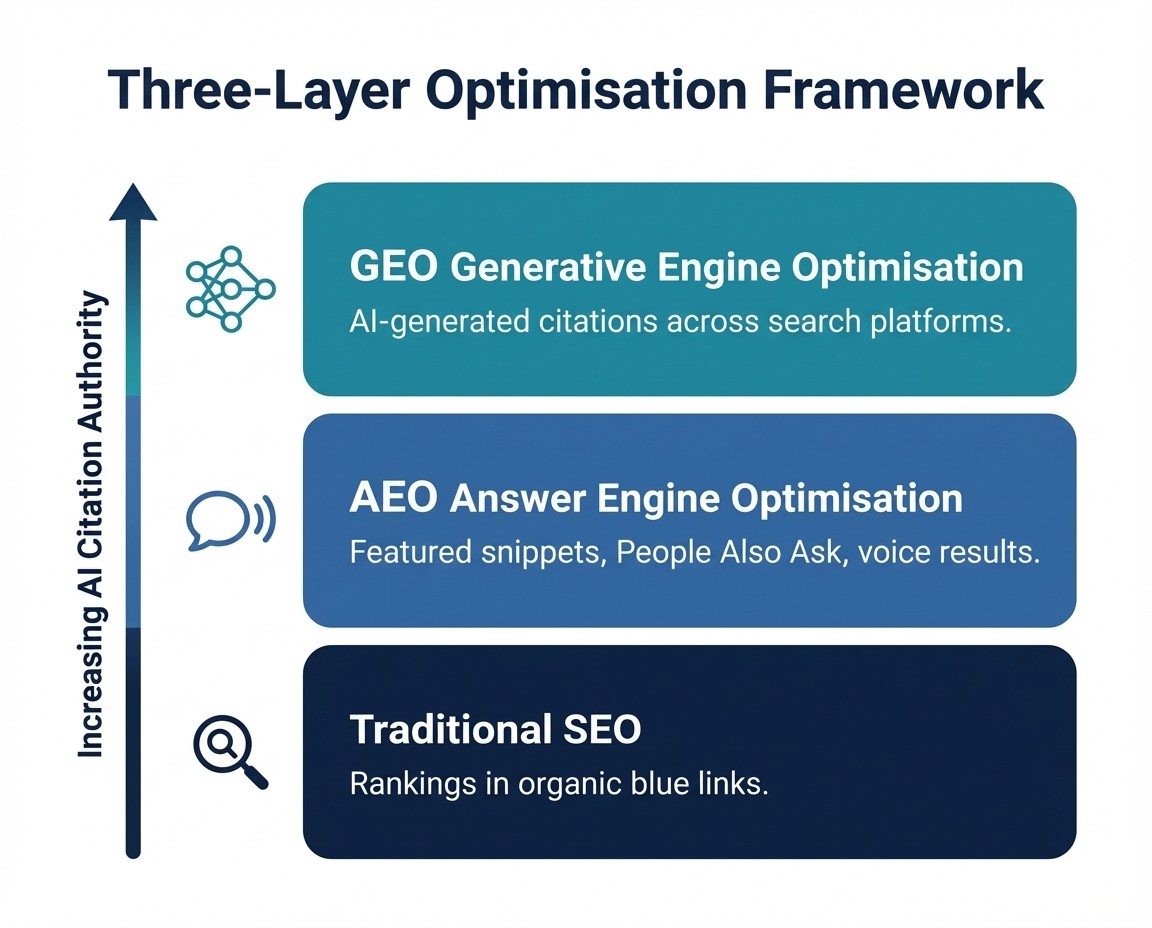
The Three-Layer Optimisation Framework Explained
Traditional SEO remains the technical bedrock: ensuring your site loads quickly, is built on crawlable architecture, earns authoritative backlinks, and produces content structured around relevant keywords. Without solid SEO foundations, the layers above cannot function. However, as a standalone strategy, it is no longer sufficient because traditional organic results are being pushed down or replaced by AI-generated summaries. The question firms are now asking is not just "is SEO dead?" but rather: what role does it play alongside the newer disciplines that govern AI visibility?
Answer Engine Optimisation (AEO) targets the extraction layer above traditional rankings: featured snippets, People Also Ask boxes, voice search results, and the concise answer capsules that AI systems pull directly from web pages. AEO is primarily a content formatting discipline, requiring that every practice area page and blog post leads with a direct, standalone answer before expanding into supporting detail. Generative Engine Optimisation (GEO), including optimisation for platforms powered by Google Gemini and similar AI engines, operates at the authority layer: ensuring that AI systems across multiple platforms have sufficient signals to identify your firm as a credible, citable source. GEO is built through deep topical authority, expert attribution, structured data, and consistent presence across the platforms and directories that feed AI training data. When people compare AEO vs SEO, the honest answer is that neither replaces the other. All three layers must work together.
How Should Law Firms Restructure Their Content for AI Visibility?
Answer-First Content: What Does It Look Like in Practice?
The most common mistake law firm websites make is burying the answer to a client's question in the third or fourth paragraph after a lengthy preamble. AI systems extract information from the first portion of your content disproportionately. Research from Growth Memo published in February 2026 found that 44.2% of all AI citations come from the first 30% of a piece of text. For law firms, this means every practice area page must open with a direct, jurisdiction-specific answer in two to three sentences, then expand into eligibility, process, timelines, costs, and outcomes. The opening is not a marketing opportunity. It is an answer capsule that AI systems either extract or ignore.
Leading firms have moved away from publishing thin, keyword-targeted content at high volume and towards monthly or quarterly deep-authority pieces that cover a topic comprehensively. Each piece should include real, anonymised case examples that demonstrate genuine experience, cite specific statutes or case law, use question-based subheadings that mirror how people actually query AI assistants, and be authored by a named, licensed practitioner whose credentials are verifiable. This combination of depth, attribution, and specificity is what AI systems use to distinguish authoritative content from generic legal information. The question many firms are weighing, namely whether a law firm should use AI for content creation, has a nuanced answer: AI tools can assist with research and structure, but every piece must carry a human expert author whose credentials can be independently verified, or it risks being deprioritised by AI citation systems.
Why Topic Clusters Drive AI Citation Authority
Generative AI engines process legal queries through a mechanism sometimes called Query Fan-Out, where a single question triggers multiple sub-queries that are assembled into a coherent answer. Firms that build topic clusters earn consistent inclusion across those sub-queries. The structure is straightforward: one pillar page per core practice area, such as Employment Law, supported by multiple subtopic pages addressing specific variants like Unfair Dismissal, Constructive Dismissal, or Settlement Agreements. Each page should link tightly to the others, creating a content ecosystem that signals comprehensive authority. For a deeper look at how this approach applies to your firm's online presence, the complete 2026 guide for law firm websites covers the structural requirements that underpin AI-ready content architecture.
Does Schema Markup Really Matter for Law Firm SEO in 2026?
Yes, and it is no longer optional. Google has confirmed that large language models now use structured data to ground AI-generated answers, and proper schema implementation can increase click-through rates by 35%. Schema markup acts as a machine-readable translation layer between your website content and AI systems, helping them understand precisely who you are, what services you offer, and why your content is trustworthy. Without it, even excellent content can be misclassified or overlooked entirely. A well-structured site architecture that supports schema is also foundational to AI search visibility, and your website's UX will make or break your AI search visibility in 2026 in ways that go far beyond page speed alone.
The essential schema types for law firms are: LegalService Schema as the foundation for practice area visibility, preferred over the now-deprecated Attorney schema; Person Schema for individual attorney profiles that support E-E-A-T signals; Organization Schema for firm-level authority and knowledge panel eligibility; FAQPage Schema to make Q&A content eligible for featured snippets and AI extraction; Article Schema to signal authorship, publication date, and topic relevance; and LocalBusiness Schema to reinforce geographic relevance for near-me searches. Implementing all six across your site constitutes the technical infrastructure that makes every piece of content machine-readable to AI, and it is the single highest-leverage technical action a law firm can take in 2026.
How Does E-E-A-T Affect a Law Firm's AI Search Visibility?
E-E-A-T, which stands for Experience, Expertise, Authoritativeness, and Trustworthiness, is no longer just a content quality signal for Google's human reviewers. It is the primary filter AI systems use to decide whether to cite a source. AI systems actively cross-reference claims against external databases, verify credentials, and deprioritise or ignore content by anonymous or generalist authors. Every piece of legal content must carry a named, licensed solicitor or lawyer as author, a detailed bio establishing their specific expertise in the topic covered, clear credentials including bar admissions and specialisation areas, and links to verifiable external profiles such as Law Society registries, leading legal directories, and LinkedIn. Maintaining a strong, active presence on LinkedIn is itself a credibility signal that AI systems increasingly factor into author authority assessments, and there are proven strategies for building client relationships before they need you through LinkedIn that serve dual purposes for both business development and AI citation eligibility.
Third-party authority signals amplify this internal E-E-A-T work. Maintaining active, optimised profiles on peer-validated directories such as Best Lawyers and Chambers, contributing expertise to established legal publications, and actively managing client reviews all serve as trust signals for AI systems. SE Ranking research from November 2025 found that domains with profiles on trusted review platforms have a 3x higher probability of being cited by AI platforms as a source compared to those without. Reviews and directory listings are not just reputation management tools. They are AI citation infrastructure.
Should Law Firms Optimise Beyond Google Alone?
Absolutely. Google remains the dominant platform but it is no longer the only one that matters for client acquisition. Leading AI search platforms were processing billions of queries daily by late 2025 and growing their share of legal information searches rapidly. Critically, only 13.7% of citations overlap between different Google AI surfaces, which means being cited in one does not guarantee visibility in another, let alone in other AI platforms. Dedicated Gemini AEO service and optimisation has become a distinct strategic workstream for firms that want visibility across the full spectrum of AI-powered search.
The practical implication is that law firms must pursue visibility across the platforms and directories that feed AI training data: professional legal directories, industry associations, high-authority publications, and public legal resources. Monthly manual testing across major AI platforms using practice-area prompts will reveal where your firm appears and where competitors are being cited instead. This multi-platform visibility strategy is central to the law firm marketing approach DesignBff builds for firms that want durable client acquisition across all channels, not just the ones that dominated in 2022.
How Do You Measure Success in an AI-First Search World?
The metrics that defined law firm SEO success over the past decade are increasingly misleading. Total traffic, keyword rankings, and click-through rates all decline even when your AI citation frequency, which is the true measure of visibility, is rising. Firms need a new measurement framework built around the outcomes that reflect actual business impact in the AI search era.
The core metrics to track are: AI Citation Frequency, measuring how often AI systems reference your firm when answering practice-area questions; Share of Voice in AI Summaries, measuring the proportion of AI answers for your topics that cite your firm versus competitors; Answer Inclusion Rate, tracking how often your content appears in AI-generated answer panels and featured snippets; Cost per Conversion, replacing cost per click as the true measure of acquisition efficiency; and Branded Search Volume, since genuine AI visibility creates brand familiarity that surfaces as increasing branded query volume over time. Tools including Google Search Console, Ahrefs, Semrush, and manual prompt testing across AI platforms all contribute to this picture. If you would like a baseline assessment of where your firm currently sits across these dimensions, you can request a marketing audit from DesignBff to get a clear starting point.
Be the Answer, Not Just a Result
The decline in organic traffic from AI search is not a crisis for law firms. It is a market correction that separates firms producing genuinely authoritative, well-structured content from those that relied on keyword volume and position gaming. Firms that invest now in answer-first content, comprehensive schema markup, named expert attribution, topic cluster architecture, and multi-platform citation authority will find that fewer visitors can mean more clients, because every arrival is already pre-qualified and pre-trusting. The strategic imperative has shifted from ranking for questions to being the answer that AI systems confidently cite, and the window for establishing that citation authority before patterns solidify is open now. To find out where your firm currently stands, explore DesignBff's law firm marketing services or request a free marketing audit to see exactly where your competitors are being cited and you are not.
Frequently Asked Questions
What is AEO and why does it matter for law firms?
Answer Engine Optimisation (AEO) is the practice of structuring website content so that AI-driven platforms, including Google's featured snippets, voice assistants, and AI Overviews, can extract and present your firm's content as a direct answer to a user's question. For law firms, AEO matters because prospective clients increasingly receive synthesised answers from AI before clicking any link. Firms whose content is structured to be extracted become the recommended source, generating higher-intent leads than traditional search traffic. AEO is the discipline that bridges traditional SEO with AI citation visibility.
What is the difference between AEO vs SEO for law firms?
SEO focuses on helping your website rank in traditional organic search results through technical performance, backlinks, and keyword relevance. AEO focuses on structuring your content so AI systems can extract and present it as a direct answer, without the user needing to click through at all. For law firms, SEO builds the technical foundation while AEO and GEO build citation authority. The distinction matters because a firm can rank in position one for a keyword and still be invisible if an AI-generated overview answers the query above it.
How does AI search affect lead generation for law firms?
AI search compresses the client decision journey. Rather than clicking through multiple websites, prospective clients receive an AI-generated summary that often recommends a specific firm by name. Firms cited in these summaries benefit from pre-qualified trust: the visitor already considers the cited firm credible before their first contact. According to research underlying this post, AI-referred visitors show 23% lower bounce rates and 41% more time on site than those arriving through traditional organic search, making each visitor significantly more valuable even as total visit numbers may decline.
How do I get my law firm cited in Google AI Overviews?
To earn citations in Google AI Overviews, your content must satisfy three conditions simultaneously. First, it must answer legal questions directly in the opening sentences using an answer-first structure. Second, it must carry strong authorship signals including a named, licensed lawyer as author with verifiable credentials. Third, it must be supported by proper schema markup including LegalService, FAQPage, and Person schema. Additionally, 76.1% of URLs cited in AI Overviews already rank in the top ten of standard Google search results, so solid technical SEO and link authority remain prerequisites for AI citation eligibility.
Should law firms use AI for content creation?
AI tools can legitimately assist with legal content research, structural planning, and drafting efficiency. However, every published piece must carry a named, licensed practitioner as its attributed author, with verifiable credentials and a detailed bio. AI systems actively cross-reference authorship claims and deprioritise content that cannot be traced to a credible human expert. Using AI to generate and publish unattributed or generically attributed content is one of the fastest ways to lose AI citation eligibility. The correct model is AI-assisted drafting with human expert authorship, review, and sign-off on every piece.
What KPIs should law firms track instead of keyword rankings in 2026?
The most meaningful KPIs in an AI-first search environment are: AI Citation Frequency across major AI search platforms; Share of Voice in AI-generated summaries for your core practice areas; Answer Inclusion Rate in featured snippets and People Also Ask panels; Branded Search Volume growth as a proxy for AI-driven brand awareness; Cost per Conversion from visit to signed client rather than cost per click; and Inquiry Quality Score, tracking the conversion rate from first contact to retained matter. Traditional metrics like total impressions and average keyword position are lagging indicators that increasingly obscure the true impact of AI visibility investment.