YouTube is one of the largest search platforms on the planet, and Australian legal consumers are already using it.
Many people research legal issues on YouTube, employment disputes, property settlements, estate planning, before they ever pick up the phone or contact a solicitor.

Some firms ignore this channel entirely. Others run law firm video ads that burn through budget on the wrong format, the wrong audience, or messaging that skirts compliance risk in ways that could land the firm in front of its Law Society.
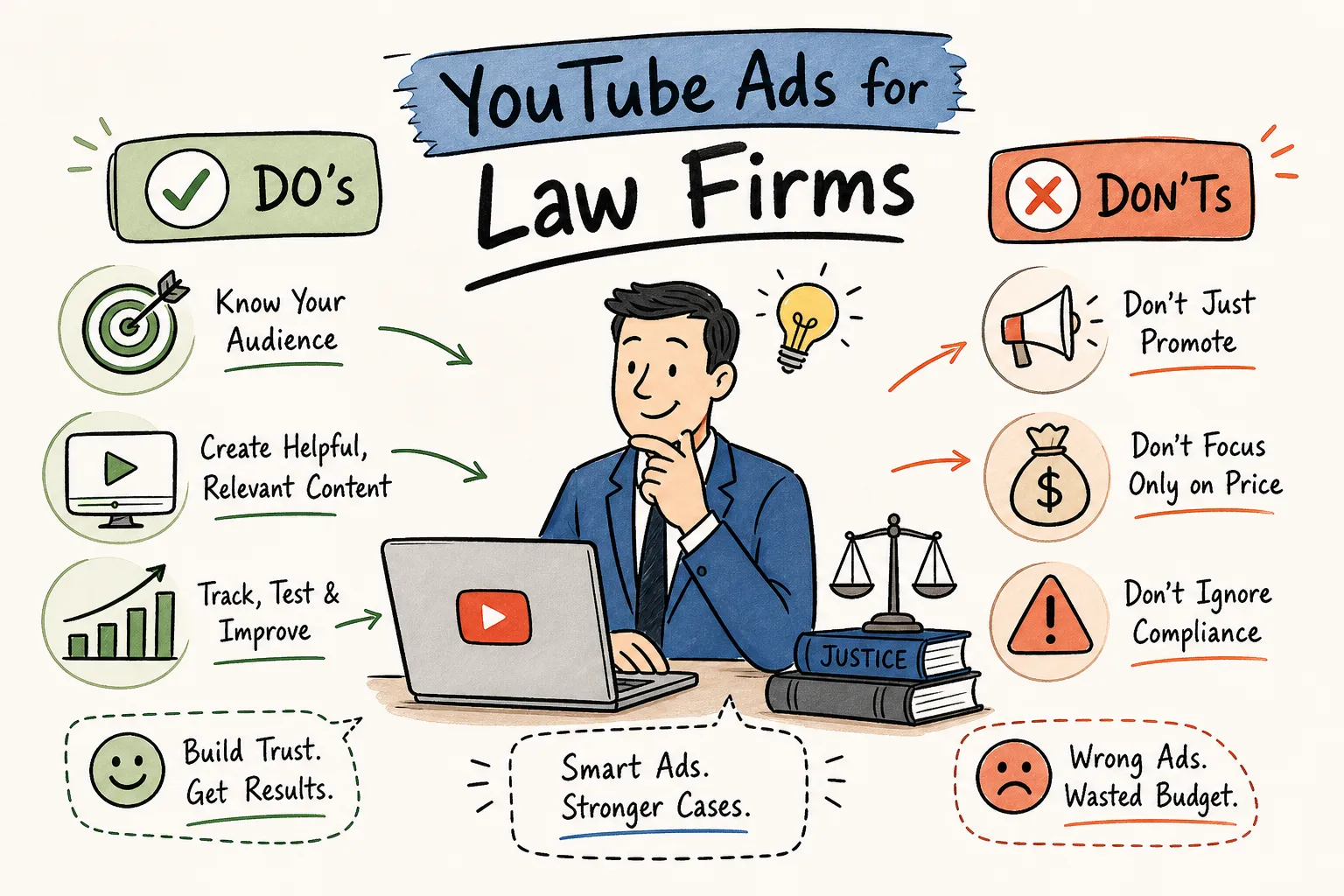
This article breaks down the do's and don'ts of law firm advertising on YouTube, covering ad formats, creative hooks, targeting strategy, Australian compliance obligations, and the KPIs that tell you whether the campaign is generating actual client enquiries. At DesignBff, we build video advertising programmes for professional service firms across APAC, and the mistakes we see repeated are, without exception, familiar ones, and entirely avoidable.
Choosing the right YouTube ad format for your law firm
Skippable in-stream ads are the default format for most law firm YouTube advertising campaigns, and for good reason. You pay only when a viewer watches at least 30 seconds or clicks through, which means the budget goes toward genuinely engaged people rather than passive scrollers. For law firms, these ads work well for awareness and mid-funnel trust-building: a short-to-medium-length video, test 30 to 90 seconds and validate by performance, that introduces the firm, establishes credibility, and ends with a clear next step. The critical rule is to earn the skip by front-loading value in the first five seconds. If your opening is a logo and a tagline, viewers are gone before the message lands.
Non-skippable in-stream ads (up to 15 seconds, though some markets support longer formats, check current Google Ads platform specifications) and bumper ads (6 seconds) serve a different purpose. They work best for retargeting audiences who already visited your website or watched a previous ad, rather than cold audiences. Non-skippable formats used on audiences unfamiliar with your firm are better suited to sequencing and reinforcement than cold outreach; bumper ads function particularly well as a short, punchy reminder of a single benefit or a specific practice area, running alongside a broader skippable campaign to increase message frequency without increasing irritation.
What makes a law firm YouTube ad actually work
The first five seconds of any lawyer commercial on YouTube determine whether the viewer stays or skips. The highest-performing legal video ads open with a question that mirrors the viewer's anxiety ("Have you been injured at work and don't know where to start?"), a surprising statistic, or a confident statement that signals the firm understands the viewer's exact problem. Direct-to-camera delivery from a real lawyer, not a hired actor, adds authenticity that stock footage cannot replicate. In legal services, trust is the first conversion, and audiences are perceptive about whether the person on screen actually knows what they are talking about.
Direct-to-camera, client testimonials, and educational explainers each occupy a distinct position across the funnel. Direct-to-camera works best at the bottom of the funnel: a lawyer speaks plainly about a specific legal issue and offers one clear next step. Client testimonials are most effective in the middle of the funnel, where a real client describes the problem they faced and the outcome the firm delivered. Educational explainers sit at the top: short, focused videos that answer one legal question completely, performing well on YouTube search as both organic content and paid placements. For further practical ideas on video content that converts for law firms, see 10 Law Firm Video Marketing Strategies That Win Clients | DesignBff.
The don't for CTAs is obvious but common: ending the ad with "Contact us" and nothing else. A CTA that converts is specific, low-friction, and tied to a single action. Specific, value-driven CTAs, such as "Book a free 20-minute consultation this week", typically outperform generic prompts. Pair the verbal CTA with a YouTube call-to-action overlay or end screen linking to a dedicated landing page, not your homepage, where the intake form matches the exact legal issue addressed in the ad. When there is a mismatch between what the ad promises and what the landing page delivers, conversion rates typically drop. For guidance on effective lawyer CTAs and overlay best practice, this write-up on lawyer call-to-action best practices is a useful reference.
Creative and messaging mistakes that kill campaigns
The single most common mistake in law firm video ads is trying to appeal to everyone. An ad that mentions family law, commercial disputes, and wills in the same 60 seconds converts no one. Each ad should address one practice area, one audience, and one pain point. Narrower targeting produces better leads, not fewer leads. A boutique family law firm in Melbourne is far better served by a single, specific ad about parenting arrangements than by a general brand reel covering everything the firm does.
Equally dangerous are implied guarantees. Phrases like "we'll get you the compensation you deserve" breach Australian professional conduct rules under the ASCR and the Australian Consumer Law, and they erode trust with sophisticated viewers who know legal outcomes are never certain.
Targeting ads at people who have recently experienced an accident or medical event and using distressing imagery to prompt immediate contact is both ethically problematic and legally risky under Australian advertising standards. The better approach is educational and empowering: show viewers you understand their situation and position the firm as a knowledgeable guide, not an opportunist.
Audience targeting strategies for law firm YouTube advertising
YouTube's audience targeting gives law firms more precise, intent-based targeting than broadcast media such as billboards, combined with the reach needed to build a sustainable pipeline. In-market audiences let you serve your YouTube ads to viewers Google has identified as actively researching legal services, people searching for lawyers, reading legal Q&A sites, or watching related content. Affinity audiences are broader and suit top-of-funnel brand building. For most law firms, the smartest starting point is combining in-market audiences with geographic targeting to a specific city or region, ensuring the ad reaches people within a realistic distance of the office.
Custom segments take this further by building audiences based on specific keywords users recently searched on Google, for example, "how to contest a will in Victoria" or "unfair dismissal claim Sydney." These audiences reflect genuine buyer intent and tend to produce lower cost-per-acquisition figures than broad affinity targeting alone. Retargeting is where law firm YouTube advertising campaigns earn their best return. Viewers who watched more than 50% of a previous ad, visited your website, or engaged with your Google Ads are warm audiences. Serving them a more specific follow-up ad, such as a client testimonial or a direct consultation offer, costs less and converts at a higher rate than cold outreach. Set up a YouTube remarketing list through Google Ads and treat it as a separate campaign with a tighter, more conversion-focused message.
Australian compliance rules no law firm can afford to ignore
Australian law firms running legal video ad campaigns are bound by two overlapping frameworks: the Australian Consumer Law (ACL) and the professional conduct rules set out in the Australian Solicitors' Conduct Rules 2015 (ASCR), specifically Rule 36. Under the ACL, video ads must not be misleading or deceptive, must not make false representations about qualifications or outcomes, and must represent fee arrangements clearly and prominently. Under ASCR Rule 36, touting and unsolicited direct approaches to prospective clients are prohibited, outcome guarantees are expressly forbidden, and specialist expertise claims require formal accreditation to support them. For official guidance on allowable advertising content for regulated practitioners, refer to the AHPRA advertising guidelines.
Every script should be reviewed against both frameworks before production begins, not after. For practical commentary on social media and digital advertising obligations specific to Australian firms, Sprintlaw's overview of legal requirements for social media advertising in Australia is helpful to cross-check your approach.
Personal injury advertising carries a separate compliance layer that varies by state. Queensland imposes the most restrictive regime: under the Personal Injuries Proceedings Act 2002, personal injury advertising is effectively limited to name, contact details, and area of practice. New South Wales removed its blanket ban under the Legal Profession Uniform Law but retains strict conduct obligations, including rules around emotive imagery, testimonial use, and outcome language. Across all states, "no win, no fee" arrangements must be described with precision and clarity, and testimonials for personal injury services face significant restrictions. A national template is not safe: the same ad may be compliant in NSW and prohibited in Queensland. For marketers working with personal injury practices, see also Google Ads for Personal Injury Lawyers: The 2026 Australia Cost Breakdown | DesignBff for considerations when planning paid search and video budgets in this tightly regulated space. Building a state-by-state compliance checklist into your pre-production process, ideally reviewed alongside your professional indemnity insurer, is recommended practice for any APAC legal marketing campaign.
Budgeting and measuring law firm YouTube ad performance
Australian legal YouTube campaigns run on cost-per-view (CPV) pricing. Legal services typically sit at the upper end of the CPV range across verticals. Based on current benchmarks, CPV for legal campaigns generally falls between AUD $0.05 and $0.30 per view depending on targeting parameters and competitive pressure, though figures vary by market and campaign configuration, so treat these as starting references rather than fixed targets. Cost per lead for legal services is significantly higher than general categories: many campaigns fall in the AUD $150 to $400 range once you account for CPV, click-through rates, and landing page conversion efficiency. A sensible starting budget for a law firm testing YouTube ads is AUD $3,000 to $10,000 per month in media spend depending on market and goals, with at least 90 days of data before drawing conclusions. Campaigns that stop after four weeks rarely generate enough conversion data to optimise against, and the algorithm needs at least 50 conversions before smart bidding can work effectively. For the latest industry CPV/CPM/CTR benchmarks, this YouTube ads benchmarks overview is a useful comparator when setting targets.
View count and impressions are not business outcomes. The KPIs that matter for law firm YouTube advertising fall into four categories: view-through rate (what percentage of viewers watch past the skip point), click-through rate on the CTA, lead form submissions from the dedicated landing page, and cost per qualified consultation booked. Set up conversion tracking through Google Ads linked to your YouTube account, and attribute phone calls using a campaign-specific number or call tracking software. Once you have 50 or more conversions in the system, switch to target CPA bidding and let the algorithm optimise toward your actual business goal rather than raw view volume. The shift from CPV optimisation to CPA optimisation is where most legal campaigns find their real efficiency gains.
Getting it right from the start
Running effective law firm advertising on YouTube is not about production budgets or mimicking the dramatic personal injury commercials that dominate international search results. It is about choosing the right format for the right audience, opening with a hook that earns attention in the first five seconds, structuring a CTA that leads somewhere specific, staying within the boundaries of Australian legal advertising law, and tracking the metrics that connect to client acquisition.
Start with one practice area, one audience segment, and one ad format. Measure it properly across 90 days. Then scale what works. The firms that treat law firm advertising on YouTube as a strategic channel rather than a one-off experiment are the ones that build a consistent pipeline of qualified enquiries, not just views.
If your firm wants a compliance-first, conversion-focused approach to legal video advertising built for the Australian and APAC market, we build that kind of integrated infrastructure at DesignBff. From diagnostic audits and strategic blueprints through to ongoing retainer support, we specialise exclusively in law, accounting, and finance firms, and we turn professional expertise into measurable client growth. Learn more about our Law Firm Marketing | DesignBff services.
Frequently Asked Questions
How much does YouTube advertising cost for law firms in Australia?
YouTube advertising for Australian law firms typically costs between AUD $0.05 and $0.30 per view, with cost per lead commonly falling in the AUD $150 to $400 range once landing page conversion is factored in (2026 benchmarks). A sensible testing budget is AUD $3,000 to $10,000 per month in media spend, sustained for at least 90 days. Legal services sit at the upper end of CPV ranges because competition for legal intent audiences is high, so treat these figures as starting references rather than fixed targets.
What is the best YouTube ad format for law firms?
Skippable in-stream ads are the best starting format for most law firm YouTube campaigns. You pay only when a viewer watches at least 30 seconds or clicks through, so budget flows to engaged viewers rather than passive scrollers. They suit awareness and mid-funnel trust building with 30 to 90 second videos that front-load value in the first 5 seconds. Non-skippable ads and 6 second bumpers work best as retargeting tools for people who have already visited your website or watched a previous ad, not for cold audiences.
Can law firms advertise on YouTube in Australia?
Yes, law firms can advertise on YouTube in Australia, provided every ad complies with the Australian Consumer Law and Rule 36 of the Australian Solicitors' Conduct Rules 2015. Ads must not be misleading or deceptive, must not guarantee outcomes, and specialist expertise claims require formal accreditation. Personal injury advertising carries additional state-based restrictions: Queensland limits it to name, contact details, and area of practice under the Personal Injuries Proceedings Act 2002, while NSW retains strict conduct obligations. Review every script against both frameworks before production begins.
How long should a law firm YouTube ad be?
Most law firm YouTube ads should run 30 to 90 seconds in skippable in-stream format, then be adjusted based on performance data. The first 5 seconds matter most: viewers decide whether to skip before your message lands, so open with a question that mirrors their legal problem rather than a logo and tagline. Shorter formats have a place too. 6 second bumpers work well for reinforcing a single benefit to warm audiences, and 15 second non-skippable ads suit retargeting sequences rather than first contact.
How do I measure whether my law firm's YouTube ads are working?
Measure law firm YouTube ads by view-through rate, click-through rate on the CTA, lead form submissions from a dedicated landing page, and cost per qualified consultation booked, not raw views or impressions. Set up conversion tracking through Google Ads, attribute phone calls with a campaign-specific number or call tracking software, and give the campaign at least 90 days before drawing conclusions. Once you have 50 or more conversions, switch to target CPA bidding so the algorithm optimises toward enquiries rather than view volume.