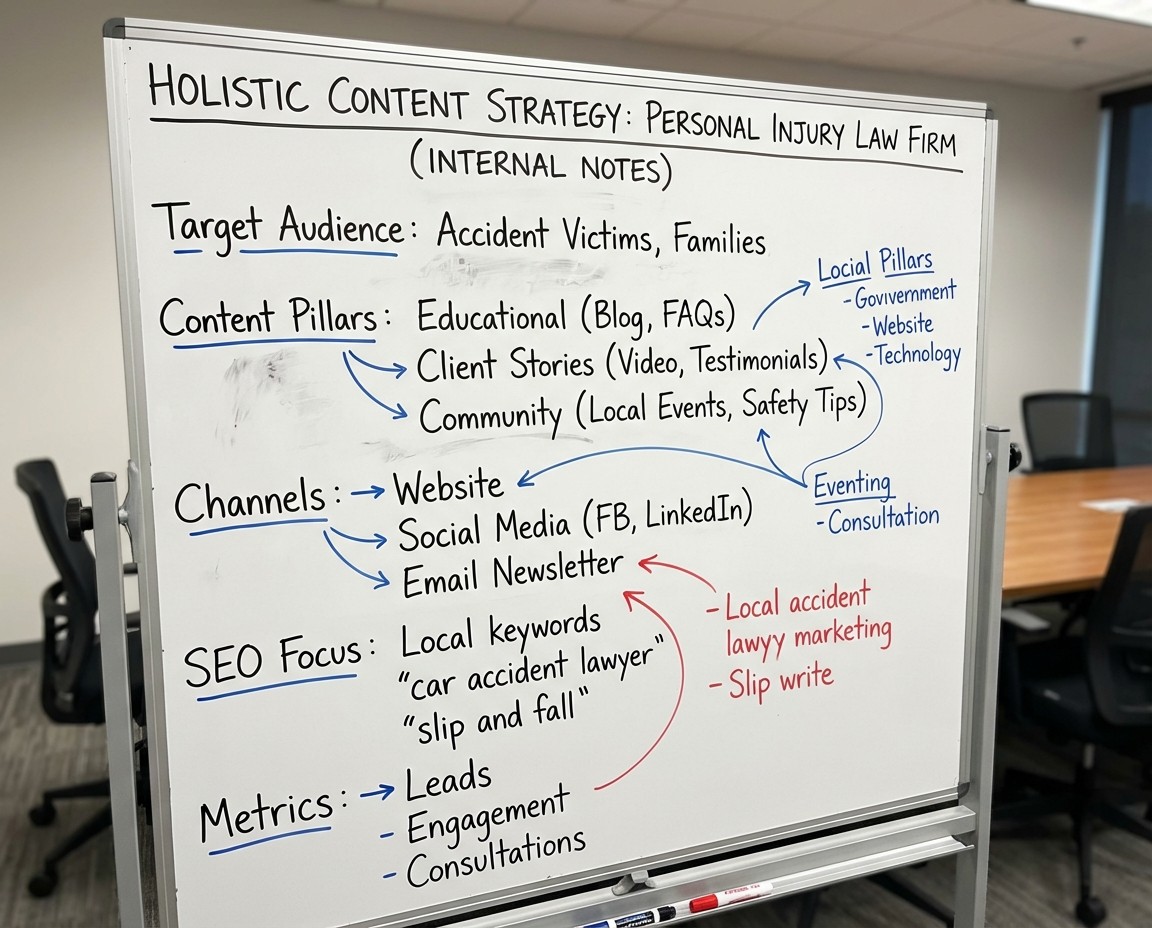
What Are Effective Content Marketing Strategies for Personal Injury Lawyers?

Mar 22, 2026

Discover proven content marketing strategies for personal injury law firms in Australia that build authority, attract qualified leads, and grow your practice sustainably.

What Are Effective Content Marketing Strategies for Personal Injury Lawyers?

Mar 22, 2026

Discover proven content marketing strategies for personal injury law firms in Australia that build authority, attract qualified leads, and grow your practice sustainably.

Effective content marketing for personal injury lawyers means publishing the right information, in the right format, at the exact moment an injury victim is searching for answers.

When executed consistently, it builds compounding organic authority that generates qualified leads long after a single ad campaign has gone dark.

For Australian PI firms operating in one of the most competitive keyword markets in legal services, a structured content strategy is no longer optional — it is the difference between steady case flow and chasing paid traffic at unsustainable cost.

Why Is Content Marketing Essential for Personal Injury Law Firms?

Content marketing is essential for personal injury law firms because potential clients are in acute distress and searching for trustworthy guidance before they ever pick up the phone. Educational, empathetic content positions a firm as the reliable authority at the moment it matters most, building the trust that converts a searcher into a signed client.

The demand for this kind of trust-building content is backed by hard numbers. Over 51% of all content engagement originates from organic search, and personal injury remains one of the most contested keyword spaces in the legal sector. According to research compiled by legal marketing analysts at Andava, 74% of companies that invest in content marketing report increased lead generation, and approximately 47% of prospective clients consume multiple pieces of content before engaging a service provider.

For PI firms, this means a single blog post or video is rarely enough, the firms winning new cases organically are publishing consistently and across multiple formats. Unlike pay-per-click campaigns, where a single keyword like "car accident lawyer" can cost upwards of AUD $150 per click, well-ranked organic content continues generating enquiries at no additional cost. For small to mid-sized PI firms managing tight marketing budgets, this compounding return is the most defensible growth strategy available. For firms exploring where to begin, DesignBff's dedicated law firm marketing services outline how this foundation is built in the context of the Australian professional services market.

How Does a High-Performing PI Content Funnel Work?

A high-performing personal injury content funnel maps content to each stage of the client decision journey: awareness-stage content educates injury victims about their situation; consideration-stage content answers whether they have a case; decision-stage content positions the firm as the right choice. Each piece must lead with empathy, because most injury victims are reacting to a crisis rather than calmly shopping for a lawyer.

Blogging: The Foundation of Your Lead Generation Strategy

Blog content remains the highest-leverage format in any PI firm's content program. The posts that generate the most qualified enquiries are those written to mirror exactly how injury victims search, in plain language, immediately after an incident. According to FWD Lawyer Marketing, high-intent blog posts targeting queries such as "Do I have a personal injury case?" or "How much is my car accident claim worth?" attract users who are in the active decision phase, making them far more likely to convert into consultations than general informational traffic.

The practical approach is to publish a minimum of two to four targeted posts per month, each built around a specific long-tail keyword with local modifiers, referencing cities, suburbs, highways, or local courts relevant to your jurisdiction. These posts should link through to dedicated practice area landing pages for car accidents, slip and fall claims, medical malpractice, and workers' compensation, creating a topical cluster that signals deep authority to Google. Understanding exactly who you are trying to reach matters as much as what you publish; identifying your ideal client profile shapes the topics, tone, and local focus that make blog content resonate with the right audience.

Does Your Content Meet Google's E-E-A-T Standards?

Google evaluates all legal content against its E-E-A-T framework, which stands for Experience, Expertise, Authoritativeness, and Trustworthiness. Because personal injury content falls under Google's "Your Money or Your Life" classification, it is subject to heightened scrutiny, meaning anonymous, generic legal articles can actively harm a firm's organic visibility. Meeting E-E-A-T standards requires every article to be attributed to a named, credentialed attorney with a professional biography, bar admission details, and a headshot. Content should reference real-world case experience, link to authoritative sources such as state statutes and court decisions, and present transparent information about the firm's attorneys and outcomes.

These same signals are now determining whether a firm's content is cited in AI-generated search responses from tools like Google's AI Overviews, ChatGPT, and Perplexity. As Practice Proof's 2026 law firm marketing benchmarks note, Answer Engine Optimisation (AEO) is now an active frontier for Australian law firms, with questions like "who is the best personal injury lawyer in [city]" increasingly being answered by AI models drawing from E-E-A-T-rich content. For firms seeking to build this foundation strategically, reviewing DesignBff's approach to marketing personal injury law firms outlines how these authority signals are embedded into content from the start.

How Should Personal Injury Lawyers Use Video Content?

Video content is among the fastest-growing and most persuasive formats available to PI firms, precisely because it bridges the gap between written authority and genuine human connection. According to Andava's legal marketing research, 91% of businesses now use video to engage their audiences, and for personal injury law, where a client is trusting a firm with an often life-altering claim, seeing and hearing the lawyers who will represent them is a powerful conversion catalyst.

The most effective video formats for PI firms include attorney introduction videos that humanise the team, FAQ videos addressing the questions most frequently raised in intake consultations, and explainer videos that walk viewers through what to expect during the claims process. Short-form video on platforms like Instagram Reels and YouTube Shorts is effective for quick legal tips and driving traffic to longer content, while long-form video hosted on YouTube or embedded on practice area pages is better suited to in-depth explanations and storytelling.

A single recording session can be repurposed into multiple formats, short clips for social, a full-length video for the website, and transcribed text as a blog post, making video one of the most efficient content investments a PI firm can make. The key is to show authenticity: as legal marketing analysts at Aguiar Injury Lawyers noted, unscripted and genuine team content on social media consistently outperforms polished commercial-style video in both reach and audience trust.

Why Does Local SEO Content Matter for PI Firms in Australia?

Personal injury law in Australia is inherently local, every state and territory has its own limitation periods, court procedures, and insurance frameworks. Content that speaks to this geographic specificity does double duty: it signals genuine local relevance to Google's algorithms and reassures potential clients that the firm knows their jurisdiction intimately. Practically, this means creating dedicated landing pages for each suburb or city the firm serves, writing blog content that references specific local roads, hospitals, and accident statistics, and maintaining an optimised Google Business Profile with consistent name, address, and phone data.

As Ostenpowers' guide to digital marketing for Australian law firms highlights, the majority of Australians begin their search for legal representation on Google, and local search results, particularly the "map pack", are frequently the first point of contact between a firm and a potential client. A well-structured and professionally designed website underpins all of this local content work; firms with slow, outdated, or poorly structured sites lose the organic visibility their content earns. For firms at this stage, commissioning a marketing agency with specific experience in personal injury law firm growth is a meaningful accelerator in establishing local authority faster than in-house efforts typically allow.

How Do Client Testimonials and Case Studies Convert Leads?

Client testimonials and case studies are the most persuasive conversion assets a PI firm can deploy, because they provide exactly the social proof that injury victims instinctively seek before committing to legal representation. A person facing a workers' compensation claim or a complex road accident case does not want generic assurances, they want evidence that a firm has achieved meaningful outcomes for someone in a comparable situation.

Written testimonials placed on practice area pages and the homepage establish baseline credibility, while video testimonials are substantially more persuasive, combining the social proof of a written review with the trust signals of a real person speaking on camera. Detailed case studies, describing the nature of the claim, the legal approach taken, and the settlement achieved, while protecting the client's identifying information, function as both a trust-building asset and a demonstration of the firm's strategic capability.

Third-party platforms including Google Reviews and Avvo extend this social proof off-site, where it cannot be dismissed as self-promotional. According to LawRank's 2025 personal injury marketing guide, consistently publishing and showcasing client outcomes is one of the most reliable ways to differentiate a firm in a saturated local market, because it shifts the conversation from what a firm claims to what it has actually delivered.

Should Personal Injury Law Firms Use Email Marketing and Lead Magnets?

Email marketing and lead magnets serve a function that SEO and paid ads cannot: they keep a firm present and useful during the often extended gap between a prospect's first enquiry and their decision to hire. For PI firms, leads can take weeks or months to convert, particularly when a client is still receiving medical treatment or weighing their options.

A structured email nurture sequence, beginning with an acknowledgement email on the day of enquiry, followed by three to five educational emails covering topics such as how insurance companies assess claims, what to expect during a personal injury investigation, and how contingency fees work, maintains trust without pressure. Lead magnets such as a "Post-Accident Checklist" or a downloadable guide titled "What to Do After a Car Accident in [State]" are particularly effective at capturing middle-of-funnel prospects who are researching but not yet ready to call.

All email campaigns must comply with Australia's Spam Act 2003 and Privacy Act 1988, requiring documented opt-in consent and a clear unsubscribe mechanism. According to Spotlight Branding's 2024 legal marketing survey, only 28% of law firms currently send email newsletters for lead nurturing — meaning firms that implement this channel well are still accessing an undercrowded advantage. For a comprehensive framework on how to structure this channel from the ground up, DesignBff's complete guide to law firm email marketing for Australia in 2026 covers the strategy, compliance requirements, and nurture sequences specific to the local market.

How Do You Measure Content Marketing ROI for a PI Firm?

Measuring content marketing ROI for a personal injury firm means tracking the metrics that connect content activity directly to signed cases, not just traffic or page views. The most important indicators are organic search traffic growth, keyword rankings for target PI terms, lead conversion rate from content-driven pages, cost per lead from organic versus paid channels, and ultimately the number of cases signed from organic enquiries. Tools including Google Analytics, Google Search Console, SEMrush, and a well-configured CRM are the practical infrastructure for this measurement. The benchmark set by one Australian PI firm working with a specialist content agency is illustrative of what sustained execution can achieve: a documented campaign generated 183% more leads from the same marketing spend, resulting in 800% more new clients at nearly 89% lower cost per client.

As SeoProfy's 2026 legal marketing statistics confirm, organic search drives as much as 66% of call conversions in the legal industry, making it the channel most directly tied to revenue for firms that invest consistently. For a full breakdown of the specific data points that matter most for professional service firms, DesignBff's guide to the 10 marketing metrics every professional service firm must track provides an actionable measurement framework built for firms of this size and type.

Conclusion

Content marketing is the most durable growth lever available to personal injury law firms, and the firms winning the most cases from organic channels are those that treat it as an ongoing discipline rather than a one-time project. From E-E-A-T-optimised blog content and video that builds genuine human trust, to local SEO pages that capture jurisdiction-specific searches and email nurture sequences that convert slow-moving leads, every element of a well-built PI content strategy compounds in value over time. The Australian personal injury market is competitive, and the gap between firms investing intelligently in content and those still relying solely on paid ads is widening every quarter.

Ready to Build a Content Strategy That Brings in Better Cases?

DesignBff works exclusively with professional service firms to design and execute content marketing programs that generate real case enquiries, not just traffic. Each month, we open our free marketing audit to just five personal injury firms so we can give each firm the strategic attention it deserves.

If you want a clear picture of where your content stands today and a prioritised roadmap for sustainable lead generation, request your free marketing audit here before the month's spots are filled.

Frequently Asked Questions

What is content marketing for personal injury lawyers?

Content marketing for personal injury lawyers is the practice of creating and distributing educational, empathetic, and SEO-optimised content, including blog posts, videos, case studies, and email campaigns, to attract injury victims to a firm's website, build trust, and convert them into signed clients. Unlike paid advertising, content marketing generates compounding organic traffic over time, making it a cost-effective and sustainable strategy for PI firms of all sizes.

How long does it take for content marketing to generate leads for a PI firm?

Content marketing typically begins generating measurable organic leads within three to six months of consistent publishing, with more significant results building from month six to twelve. SEO investments are generally considered to break even at around the 14-month mark, with organic traffic compounding at approximately 21% annually thereafter. Firms that pair blog content with local SEO, video, and email nurture sequences typically see faster lead conversion than those relying on blog content alone.

What types of blog content work best for personal injury law firms?

The blog content that generates the most qualified leads for PI firms targets high-intent queries — questions that injury victims type immediately after an accident, such as "how long do I have to file a personal injury claim in NSW?" or "what is my car accident claim worth in Australia?" These posts should be written in plain language, attributed to a named attorney, and optimised for local geographic modifiers. Consistency matters more than volume: two to four well-researched posts per month outperforms irregular bursts of content.

Does Google's E-E-A-T framework affect personal injury law firm content?

Yes, E-E-A-T (Experience, Expertise, Authoritativeness, Trustworthiness) has a direct and significant effect on how Google ranks personal injury content. Because legal content falls under Google's "Your Money or Your Life" category, anonymous or generic articles are actively disadvantaged in search rankings. Every piece of content published by a PI firm should carry an attorney byline with credentials, link to authoritative sources, and reference real case experience. These same signals also influence whether a firm's content is cited in AI-generated search responses.

How much should a personal injury law firm spend on content marketing in Australia?

Mid-sized personal injury law firms in Australia typically invest between AUD $2,000 and $10,000 per month on content marketing, depending on the competitiveness of their target market and the range of content formats they are producing. However, budget alone does not determine outcomes. Firms that work with a specialist marketing agency for personal injury law firms and invest in a well-structured strategy combining SEO-optimised blogging, video production, local content, and email nurture consistently achieve a lower cost per signed case than those spending the same budget on paid search alone.

Effective content marketing for personal injury lawyers means publishing the right information, in the right format, at the exact moment an injury victim is searching for answers.

When executed consistently, it builds compounding organic authority that generates qualified leads long after a single ad campaign has gone dark.

For Australian PI firms operating in one of the most competitive keyword markets in legal services, a structured content strategy is no longer optional — it is the difference between steady case flow and chasing paid traffic at unsustainable cost.

Why Is Content Marketing Essential for Personal Injury Law Firms?

Content marketing is essential for personal injury law firms because potential clients are in acute distress and searching for trustworthy guidance before they ever pick up the phone. Educational, empathetic content positions a firm as the reliable authority at the moment it matters most, building the trust that converts a searcher into a signed client.

The demand for this kind of trust-building content is backed by hard numbers. Over 51% of all content engagement originates from organic search, and personal injury remains one of the most contested keyword spaces in the legal sector. According to research compiled by legal marketing analysts at Andava, 74% of companies that invest in content marketing report increased lead generation, and approximately 47% of prospective clients consume multiple pieces of content before engaging a service provider.

For PI firms, this means a single blog post or video is rarely enough, the firms winning new cases organically are publishing consistently and across multiple formats. Unlike pay-per-click campaigns, where a single keyword like "car accident lawyer" can cost upwards of AUD $150 per click, well-ranked organic content continues generating enquiries at no additional cost. For small to mid-sized PI firms managing tight marketing budgets, this compounding return is the most defensible growth strategy available. For firms exploring where to begin, DesignBff's dedicated law firm marketing services outline how this foundation is built in the context of the Australian professional services market.

How Does a High-Performing PI Content Funnel Work?

A high-performing personal injury content funnel maps content to each stage of the client decision journey: awareness-stage content educates injury victims about their situation; consideration-stage content answers whether they have a case; decision-stage content positions the firm as the right choice. Each piece must lead with empathy, because most injury victims are reacting to a crisis rather than calmly shopping for a lawyer.

Blogging: The Foundation of Your Lead Generation Strategy

Blog content remains the highest-leverage format in any PI firm's content program. The posts that generate the most qualified enquiries are those written to mirror exactly how injury victims search, in plain language, immediately after an incident. According to FWD Lawyer Marketing, high-intent blog posts targeting queries such as "Do I have a personal injury case?" or "How much is my car accident claim worth?" attract users who are in the active decision phase, making them far more likely to convert into consultations than general informational traffic.

The practical approach is to publish a minimum of two to four targeted posts per month, each built around a specific long-tail keyword with local modifiers, referencing cities, suburbs, highways, or local courts relevant to your jurisdiction. These posts should link through to dedicated practice area landing pages for car accidents, slip and fall claims, medical malpractice, and workers' compensation, creating a topical cluster that signals deep authority to Google. Understanding exactly who you are trying to reach matters as much as what you publish; identifying your ideal client profile shapes the topics, tone, and local focus that make blog content resonate with the right audience.

Does Your Content Meet Google's E-E-A-T Standards?

Google evaluates all legal content against its E-E-A-T framework, which stands for Experience, Expertise, Authoritativeness, and Trustworthiness. Because personal injury content falls under Google's "Your Money or Your Life" classification, it is subject to heightened scrutiny, meaning anonymous, generic legal articles can actively harm a firm's organic visibility. Meeting E-E-A-T standards requires every article to be attributed to a named, credentialed attorney with a professional biography, bar admission details, and a headshot. Content should reference real-world case experience, link to authoritative sources such as state statutes and court decisions, and present transparent information about the firm's attorneys and outcomes.

These same signals are now determining whether a firm's content is cited in AI-generated search responses from tools like Google's AI Overviews, ChatGPT, and Perplexity. As Practice Proof's 2026 law firm marketing benchmarks note, Answer Engine Optimisation (AEO) is now an active frontier for Australian law firms, with questions like "who is the best personal injury lawyer in [city]" increasingly being answered by AI models drawing from E-E-A-T-rich content. For firms seeking to build this foundation strategically, reviewing DesignBff's approach to marketing personal injury law firms outlines how these authority signals are embedded into content from the start.

How Should Personal Injury Lawyers Use Video Content?

Video content is among the fastest-growing and most persuasive formats available to PI firms, precisely because it bridges the gap between written authority and genuine human connection. According to Andava's legal marketing research, 91% of businesses now use video to engage their audiences, and for personal injury law, where a client is trusting a firm with an often life-altering claim, seeing and hearing the lawyers who will represent them is a powerful conversion catalyst.

The most effective video formats for PI firms include attorney introduction videos that humanise the team, FAQ videos addressing the questions most frequently raised in intake consultations, and explainer videos that walk viewers through what to expect during the claims process. Short-form video on platforms like Instagram Reels and YouTube Shorts is effective for quick legal tips and driving traffic to longer content, while long-form video hosted on YouTube or embedded on practice area pages is better suited to in-depth explanations and storytelling.

A single recording session can be repurposed into multiple formats, short clips for social, a full-length video for the website, and transcribed text as a blog post, making video one of the most efficient content investments a PI firm can make. The key is to show authenticity: as legal marketing analysts at Aguiar Injury Lawyers noted, unscripted and genuine team content on social media consistently outperforms polished commercial-style video in both reach and audience trust.

Why Does Local SEO Content Matter for PI Firms in Australia?

Personal injury law in Australia is inherently local, every state and territory has its own limitation periods, court procedures, and insurance frameworks. Content that speaks to this geographic specificity does double duty: it signals genuine local relevance to Google's algorithms and reassures potential clients that the firm knows their jurisdiction intimately. Practically, this means creating dedicated landing pages for each suburb or city the firm serves, writing blog content that references specific local roads, hospitals, and accident statistics, and maintaining an optimised Google Business Profile with consistent name, address, and phone data.

As Ostenpowers' guide to digital marketing for Australian law firms highlights, the majority of Australians begin their search for legal representation on Google, and local search results, particularly the "map pack", are frequently the first point of contact between a firm and a potential client. A well-structured and professionally designed website underpins all of this local content work; firms with slow, outdated, or poorly structured sites lose the organic visibility their content earns. For firms at this stage, commissioning a marketing agency with specific experience in personal injury law firm growth is a meaningful accelerator in establishing local authority faster than in-house efforts typically allow.

How Do Client Testimonials and Case Studies Convert Leads?

Client testimonials and case studies are the most persuasive conversion assets a PI firm can deploy, because they provide exactly the social proof that injury victims instinctively seek before committing to legal representation. A person facing a workers' compensation claim or a complex road accident case does not want generic assurances, they want evidence that a firm has achieved meaningful outcomes for someone in a comparable situation.

Written testimonials placed on practice area pages and the homepage establish baseline credibility, while video testimonials are substantially more persuasive, combining the social proof of a written review with the trust signals of a real person speaking on camera. Detailed case studies, describing the nature of the claim, the legal approach taken, and the settlement achieved, while protecting the client's identifying information, function as both a trust-building asset and a demonstration of the firm's strategic capability.

Third-party platforms including Google Reviews and Avvo extend this social proof off-site, where it cannot be dismissed as self-promotional. According to LawRank's 2025 personal injury marketing guide, consistently publishing and showcasing client outcomes is one of the most reliable ways to differentiate a firm in a saturated local market, because it shifts the conversation from what a firm claims to what it has actually delivered.

Should Personal Injury Law Firms Use Email Marketing and Lead Magnets?

Email marketing and lead magnets serve a function that SEO and paid ads cannot: they keep a firm present and useful during the often extended gap between a prospect's first enquiry and their decision to hire. For PI firms, leads can take weeks or months to convert, particularly when a client is still receiving medical treatment or weighing their options.

A structured email nurture sequence, beginning with an acknowledgement email on the day of enquiry, followed by three to five educational emails covering topics such as how insurance companies assess claims, what to expect during a personal injury investigation, and how contingency fees work, maintains trust without pressure. Lead magnets such as a "Post-Accident Checklist" or a downloadable guide titled "What to Do After a Car Accident in [State]" are particularly effective at capturing middle-of-funnel prospects who are researching but not yet ready to call.

All email campaigns must comply with Australia's Spam Act 2003 and Privacy Act 1988, requiring documented opt-in consent and a clear unsubscribe mechanism. According to Spotlight Branding's 2024 legal marketing survey, only 28% of law firms currently send email newsletters for lead nurturing — meaning firms that implement this channel well are still accessing an undercrowded advantage. For a comprehensive framework on how to structure this channel from the ground up, DesignBff's complete guide to law firm email marketing for Australia in 2026 covers the strategy, compliance requirements, and nurture sequences specific to the local market.

How Do You Measure Content Marketing ROI for a PI Firm?

Measuring content marketing ROI for a personal injury firm means tracking the metrics that connect content activity directly to signed cases, not just traffic or page views. The most important indicators are organic search traffic growth, keyword rankings for target PI terms, lead conversion rate from content-driven pages, cost per lead from organic versus paid channels, and ultimately the number of cases signed from organic enquiries. Tools including Google Analytics, Google Search Console, SEMrush, and a well-configured CRM are the practical infrastructure for this measurement. The benchmark set by one Australian PI firm working with a specialist content agency is illustrative of what sustained execution can achieve: a documented campaign generated 183% more leads from the same marketing spend, resulting in 800% more new clients at nearly 89% lower cost per client.

As SeoProfy's 2026 legal marketing statistics confirm, organic search drives as much as 66% of call conversions in the legal industry, making it the channel most directly tied to revenue for firms that invest consistently. For a full breakdown of the specific data points that matter most for professional service firms, DesignBff's guide to the 10 marketing metrics every professional service firm must track provides an actionable measurement framework built for firms of this size and type.

Conclusion

Content marketing is the most durable growth lever available to personal injury law firms, and the firms winning the most cases from organic channels are those that treat it as an ongoing discipline rather than a one-time project. From E-E-A-T-optimised blog content and video that builds genuine human trust, to local SEO pages that capture jurisdiction-specific searches and email nurture sequences that convert slow-moving leads, every element of a well-built PI content strategy compounds in value over time. The Australian personal injury market is competitive, and the gap between firms investing intelligently in content and those still relying solely on paid ads is widening every quarter.

Ready to Build a Content Strategy That Brings in Better Cases?

DesignBff works exclusively with professional service firms to design and execute content marketing programs that generate real case enquiries, not just traffic. Each month, we open our free marketing audit to just five personal injury firms so we can give each firm the strategic attention it deserves.

If you want a clear picture of where your content stands today and a prioritised roadmap for sustainable lead generation, request your free marketing audit here before the month's spots are filled.

Frequently Asked Questions

What is content marketing for personal injury lawyers?

Content marketing for personal injury lawyers is the practice of creating and distributing educational, empathetic, and SEO-optimised content, including blog posts, videos, case studies, and email campaigns, to attract injury victims to a firm's website, build trust, and convert them into signed clients. Unlike paid advertising, content marketing generates compounding organic traffic over time, making it a cost-effective and sustainable strategy for PI firms of all sizes.

How long does it take for content marketing to generate leads for a PI firm?

Content marketing typically begins generating measurable organic leads within three to six months of consistent publishing, with more significant results building from month six to twelve. SEO investments are generally considered to break even at around the 14-month mark, with organic traffic compounding at approximately 21% annually thereafter. Firms that pair blog content with local SEO, video, and email nurture sequences typically see faster lead conversion than those relying on blog content alone.

What types of blog content work best for personal injury law firms?

The blog content that generates the most qualified leads for PI firms targets high-intent queries — questions that injury victims type immediately after an accident, such as "how long do I have to file a personal injury claim in NSW?" or "what is my car accident claim worth in Australia?" These posts should be written in plain language, attributed to a named attorney, and optimised for local geographic modifiers. Consistency matters more than volume: two to four well-researched posts per month outperforms irregular bursts of content.

Does Google's E-E-A-T framework affect personal injury law firm content?

Yes, E-E-A-T (Experience, Expertise, Authoritativeness, Trustworthiness) has a direct and significant effect on how Google ranks personal injury content. Because legal content falls under Google's "Your Money or Your Life" category, anonymous or generic articles are actively disadvantaged in search rankings. Every piece of content published by a PI firm should carry an attorney byline with credentials, link to authoritative sources, and reference real case experience. These same signals also influence whether a firm's content is cited in AI-generated search responses.

How much should a personal injury law firm spend on content marketing in Australia?

Mid-sized personal injury law firms in Australia typically invest between AUD $2,000 and $10,000 per month on content marketing, depending on the competitiveness of their target market and the range of content formats they are producing. However, budget alone does not determine outcomes. Firms that work with a specialist marketing agency for personal injury law firms and invest in a well-structured strategy combining SEO-optimised blogging, video production, local content, and email nurture consistently achieve a lower cost per signed case than those spending the same budget on paid search alone.

Let’s tackle your marketing challenge and show you the roadmap to success.

Extreme close-up black and white photograph of a human eye

Let’s tackle your marketing challenge and show you the roadmap to success.

Extreme close-up black and white photograph of a human eye

Let’s tackle your marketing challenge and show you the roadmap to success.

Extreme close-up black and white photograph of a human eye

Day Job