
Launch a Singapore M&A Practice and Win High-Value Clients

Jun 9, 2026

An M&A practice marketing strategy for Singapore law firms to build pipeline, win referrals, and close high-value mandates faster in 2026 and beyond.

Launch a Singapore M&A Practice and Win High-Value Clients

Jun 9, 2026

An M&A practice marketing strategy for Singapore law firms to build pipeline, win referrals, and close high-value mandates faster in 2026 and beyond.

Launching an M&A practice at a small Singapore commercial law firm needs a minimum 12-month marketing and business development plan, not a one-off campaign.

The sequence is simple: build credentials, activate referrers, earn directory credibility, then convert relationships into mandates. Done in order, it turns a new partner's expertise into a visible, profitable practice.

Why is launching an M&A practice harder than it looks in 2026?

It is hard because M&A mandates are won through trust built over many months, not through quick advertising. Singapore now rewards fewer, larger, more complex deals. A new partner brings deal instinct, but rarely the marketing system that turns that expertise into a practice clients can find and choose.

The market actually favours firms that prepare. Asia-Pacific M&A deal values rose 10% in 2025 even as volumes stayed soft, according to PwC's 2026 global M&A outlook.

Singapore was a regional bright spot. Deal value climbed 18% over the year, per BCG's 2026 M&A outlook. Capital is concentrating into bigger, strategic transactions that need specialist counsel.

That cuts both ways for a boutique. Outbound Singapore M&A had earlier slid to a nine-year low near USD 14.7 billion, a 24% drop, as documented in Chambers' Corporate M&A 2025 Singapore guide.

Quiet markets are exactly when relationships compound. Firms that build now capture a larger share when activity returns. And teams with a documented plan are 313% more likely to report success, per CoSchedule's research.

What does a 12-month M&A go-to-market plan look like?

It runs across four phases: Foundation (months one to three), Activation (four to six), Acceleration (seven to nine), and Conversion (ten to twelve). Each phase has one job. Skipping ahead is the most common reason a new practice stalls before its first qualified pitch.

The roadmap below maps the whole year at a glance.
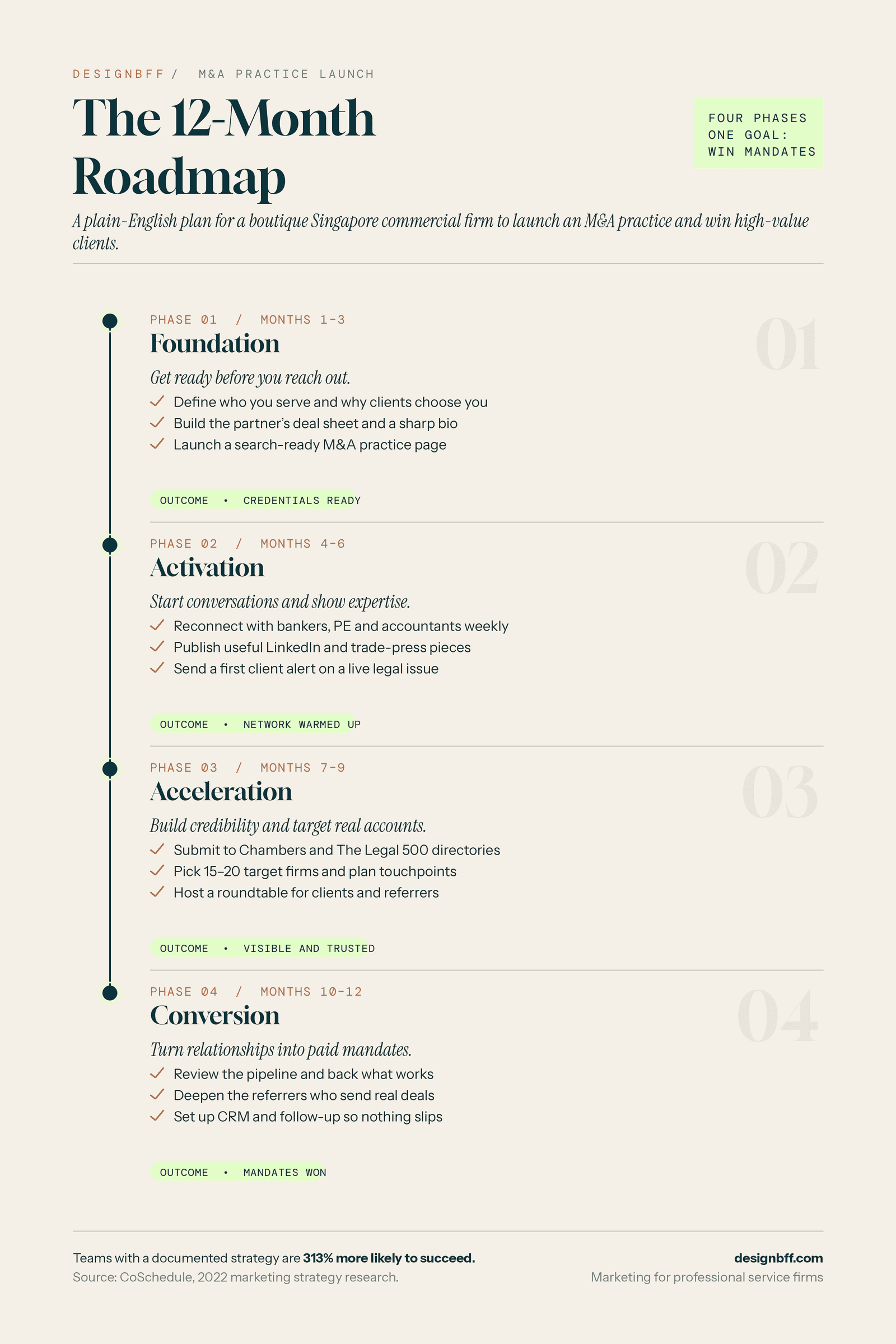

The 12-month M&A practice launch roadmap showing four phases: Foundation, Activation, Acceleration and Conversion

The 12-month roadmap at a glance: Foundation, Activation, Acceleration, then Conversion.

Phase 1: How do you build the foundation before any outreach?

You make the firm presentation-ready before reaching out. There is no value in outreach while the partner's profile, deal sheet, and practice page are still unfinished.

Picture the partner's first month. Instead of chasing leads, they sit with you to map every past deal, every banker and accountant they know, and the sectors where they consistently win.

That work becomes positioning. Rather than "we do M&A", you claim a specific lane, such as cross-border deals for ASEAN-facing real estate and healthcare clients. Sharp positioning is a branding strategy decision that shapes everything after it.

The new practice page should also rank for searches like "M&A legal counsel Singapore". That is where a deliberate SEO and AEO build pays off, since legal organic visibility usually takes six to eighteen months to mature.

Phase 2: How do you activate referrals and thought leadership?

You turn quiet expertise into conversations. In months four to six the partner reconnects with referrers each week while the firm begins publishing useful, non-promotional content.

Referrals are not a nice-to-have in this market. In disputes and investigations work, 60% to 70% of revenue can depend on referred matters, and referrals also drive M&A instructions, according to the Legal Benchmarking Group.

Imagine a coffee with a former banking contact that surfaces a client planning a divestment in eight months. That single conversation, logged and nurtured, can become next year's mandate.

Content gives a reason to stay in touch between deals. A LinkedIn rhythm, a quarterly regulatory alert, and one contributed trade-press article keep the partner visible, which is what a structured content marketing engine is built to deliver.

Phase 3: How do you accelerate with directories and events?

You build third-party credibility and start targeting real companies. Directories and a flagship event move the practice from "new" to "trusted" in the eyes of in-house counsel.

Chambers Asia-Pacific and The Legal 500 are the references general counsel consult when choosing outside counsel. An early listing, even at a lower band, is a strong trust signal for a young practice.

Now picture a breakfast roundtable for twenty guests on a live regulatory topic. A general counsel from a target company meets the partner over coffee, not over a cold pitch.

Alongside the event, you pick 15 to 20 target firms and plan a few meaningful touchpoints for each. Directory submissions, awards, and events all sit inside a coordinated PR and events programme that builds credibility and pipeline at the same time.

Phase 4: How do you convert relationships into mandates?

You turn warm relationships into paid work. By month ten you know which channels produce, so you back what works and quietly drop what does not.

This is where boutiques lose momentum. Research shows 80% of people are willing to refer, yet only about 30% actually do, a gap most firms never close, per Spotlight Branding.

Think of an enquiry that once died in an inbox. With a simple system it is logged, followed up on time, and nurtured until the client is ready to instruct.

A disciplined client engagement system tracks each account, automates the right follow-up, and protects relationship memory even when a partner moves on.

Why do referrals and follow-up decide whether the practice survives?

Because corporate clients are won over months and years, and one dropped thread can cost a mandate worth more than a whole year of marketing. Relationship intelligence is the practice's most valuable asset, and it fades fast without a system.

The firms that win treat business development as a discipline, not an afterthought between billable hours. They log meetings, score accounts, and reciprocate value to referrers consistently.

Pairing that rigour with new tooling compounds the edge, a theme we explore in turning law firm AI pilots into client value stories. For a boutique facing larger rivals, systematic patience is the difference between a loud launch that fades and a durable book of high-value clients.

How can a marketing partner speed up the launch?

A marketing partner acts as your external head of growth, bridging the partner's deal expertise and a small in-house team. At a mid-sized firm, one specialist who owns the whole plan is high-leverage, not a luxury.

That is the model DesignBff is built around for law firm marketing across Singapore and APAC.

We connect positioning, search visibility, content, directories, events, and client engagement into one sequenced plan tied to a clear revenue goal, then implement it beside your partner.

Conclusion

Launching an M&A practice as a boutique Singapore firm is winnable, but only with a sequenced 12-month plan that builds credentials before outreach, activates referrers with genuine thought leadership, earns directory credibility, and converts relationships through a disciplined client engagement system, all while the market rewards firms positioned for fewer, larger deals.

If you are launching a new M&A practice and want a clear roadmap, book a free consultation with DesignBff to discuss the go-to-market strategy for your boutique law firm to close more high-value M&A clients and build a bigger portfolio to grow the business, or request a free marketing audit to see your 90-day quick wins first.


Frequently Asked Questions

How do you launch an M&A practice at a small law firm?

Launch an M&A practice with a 12-month plan across 4 phases. First, build the foundation: positioning, the partner's deal sheet, and an SEO-ready practice page. Second, activate referrers and publish thought leadership. Third, accelerate with directory submissions and account targeting. Fourth, convert pipeline into mandates through disciplined follow-up. The sequence matters because credentials must be presentation-ready before outreach begins, and corporate mandates are won through trust built steadily over months rather than quick advertising.

How long does it take a law firm to win M&A clients?

Winning M&A clients typically takes several months to two years from first contact, because corporate buyers select counsel through trust rather than fast purchases. Referral relationships seeded in months four to six of a launch often produce mandates in months ten to twenty-four. Organic search visibility for specialist legal terms also takes six to eighteen months to mature. The practical implication is to start relationships and content early, measure progress in stages, and manage leadership expectations on realistic timelines.

What marketing channels work best for an M&A law practice?

The best channels match how corporate buyers research counsel: a sharp positioning and practice page, SEO and AEO visibility, partner thought leadership on LinkedIn and in trade press, legal directory rankings like Chambers and The Legal 500, firm-hosted roundtables, and a structured referral network. Account-based marketing against specific target companies layers on top. The right mix depends on the firm's stage, market, and goal, which is why a diagnosed channel playbook outperforms scattered tactics.

Why are legal directory rankings important for a new practice?

Legal directory rankings matter because Chambers Asia-Pacific and The Legal 500 are among the most authoritative signals general counsel consult when choosing outside counsel. For a new M&A practice, even a lower-band listing is a credible trust signal that improves win rates in pitches and referral conversations. Submissions require compiling significant matters, gathering client referees, and writing a clear practice narrative against each guide's template. Because submission windows are annual and competitive, preparation should begin months ahead of the deadline.

Should a boutique law firm hire a marketing agency or build in-house?

A boutique law firm usually benefits from an external marketing partner over a full in-house build, because launching a practice needs a broad, senior skill set that is expensive to hire and underused once the launch matures. An external head of growth connects positioning, visibility, content, events, and client engagement around one commercial goal, then implements alongside the partner. The right partner diagnoses the firm's growth constraint and builds a sequenced plan, rather than selling disconnected tactics or hourly deliverables.


Launching an M&A practice at a small Singapore commercial law firm needs a minimum 12-month marketing and business development plan, not a one-off campaign.

The sequence is simple: build credentials, activate referrers, earn directory credibility, then convert relationships into mandates. Done in order, it turns a new partner's expertise into a visible, profitable practice.

Why is launching an M&A practice harder than it looks in 2026?

It is hard because M&A mandates are won through trust built over many months, not through quick advertising. Singapore now rewards fewer, larger, more complex deals. A new partner brings deal instinct, but rarely the marketing system that turns that expertise into a practice clients can find and choose.

The market actually favours firms that prepare. Asia-Pacific M&A deal values rose 10% in 2025 even as volumes stayed soft, according to PwC's 2026 global M&A outlook.

Singapore was a regional bright spot. Deal value climbed 18% over the year, per BCG's 2026 M&A outlook. Capital is concentrating into bigger, strategic transactions that need specialist counsel.

That cuts both ways for a boutique. Outbound Singapore M&A had earlier slid to a nine-year low near USD 14.7 billion, a 24% drop, as documented in Chambers' Corporate M&A 2025 Singapore guide.

Quiet markets are exactly when relationships compound. Firms that build now capture a larger share when activity returns. And teams with a documented plan are 313% more likely to report success, per CoSchedule's research.

What does a 12-month M&A go-to-market plan look like?

It runs across four phases: Foundation (months one to three), Activation (four to six), Acceleration (seven to nine), and Conversion (ten to twelve). Each phase has one job. Skipping ahead is the most common reason a new practice stalls before its first qualified pitch.

The roadmap below maps the whole year at a glance.


The 12-month M&A practice launch roadmap showing four phases: Foundation, Activation, Acceleration and Conversion

The 12-month roadmap at a glance: Foundation, Activation, Acceleration, then Conversion.

Phase 1: How do you build the foundation before any outreach?

You make the firm presentation-ready before reaching out. There is no value in outreach while the partner's profile, deal sheet, and practice page are still unfinished.

Picture the partner's first month. Instead of chasing leads, they sit with you to map every past deal, every banker and accountant they know, and the sectors where they consistently win.

That work becomes positioning. Rather than "we do M&A", you claim a specific lane, such as cross-border deals for ASEAN-facing real estate and healthcare clients. Sharp positioning is a branding strategy decision that shapes everything after it.

The new practice page should also rank for searches like "M&A legal counsel Singapore". That is where a deliberate SEO and AEO build pays off, since legal organic visibility usually takes six to eighteen months to mature.

Phase 2: How do you activate referrals and thought leadership?

You turn quiet expertise into conversations. In months four to six the partner reconnects with referrers each week while the firm begins publishing useful, non-promotional content.

Referrals are not a nice-to-have in this market. In disputes and investigations work, 60% to 70% of revenue can depend on referred matters, and referrals also drive M&A instructions, according to the Legal Benchmarking Group.

Imagine a coffee with a former banking contact that surfaces a client planning a divestment in eight months. That single conversation, logged and nurtured, can become next year's mandate.

Content gives a reason to stay in touch between deals. A LinkedIn rhythm, a quarterly regulatory alert, and one contributed trade-press article keep the partner visible, which is what a structured content marketing engine is built to deliver.

Phase 3: How do you accelerate with directories and events?

You build third-party credibility and start targeting real companies. Directories and a flagship event move the practice from "new" to "trusted" in the eyes of in-house counsel.

Chambers Asia-Pacific and The Legal 500 are the references general counsel consult when choosing outside counsel. An early listing, even at a lower band, is a strong trust signal for a young practice.

Now picture a breakfast roundtable for twenty guests on a live regulatory topic. A general counsel from a target company meets the partner over coffee, not over a cold pitch.

Alongside the event, you pick 15 to 20 target firms and plan a few meaningful touchpoints for each. Directory submissions, awards, and events all sit inside a coordinated PR and events programme that builds credibility and pipeline at the same time.

Phase 4: How do you convert relationships into mandates?

You turn warm relationships into paid work. By month ten you know which channels produce, so you back what works and quietly drop what does not.

This is where boutiques lose momentum. Research shows 80% of people are willing to refer, yet only about 30% actually do, a gap most firms never close, per Spotlight Branding.

Think of an enquiry that once died in an inbox. With a simple system it is logged, followed up on time, and nurtured until the client is ready to instruct.

A disciplined client engagement system tracks each account, automates the right follow-up, and protects relationship memory even when a partner moves on.

Why do referrals and follow-up decide whether the practice survives?

Because corporate clients are won over months and years, and one dropped thread can cost a mandate worth more than a whole year of marketing. Relationship intelligence is the practice's most valuable asset, and it fades fast without a system.

The firms that win treat business development as a discipline, not an afterthought between billable hours. They log meetings, score accounts, and reciprocate value to referrers consistently.

Pairing that rigour with new tooling compounds the edge, a theme we explore in turning law firm AI pilots into client value stories. For a boutique facing larger rivals, systematic patience is the difference between a loud launch that fades and a durable book of high-value clients.

How can a marketing partner speed up the launch?

A marketing partner acts as your external head of growth, bridging the partner's deal expertise and a small in-house team. At a mid-sized firm, one specialist who owns the whole plan is high-leverage, not a luxury.

That is the model DesignBff is built around for law firm marketing across Singapore and APAC.

We connect positioning, search visibility, content, directories, events, and client engagement into one sequenced plan tied to a clear revenue goal, then implement it beside your partner.

Conclusion

Launching an M&A practice as a boutique Singapore firm is winnable, but only with a sequenced 12-month plan that builds credentials before outreach, activates referrers with genuine thought leadership, earns directory credibility, and converts relationships through a disciplined client engagement system, all while the market rewards firms positioned for fewer, larger deals.

If you are launching a new M&A practice and want a clear roadmap, book a free consultation with DesignBff to discuss the go-to-market strategy for your boutique law firm to close more high-value M&A clients and build a bigger portfolio to grow the business, or request a free marketing audit to see your 90-day quick wins first.


Frequently Asked Questions

How do you launch an M&A practice at a small law firm?

Launch an M&A practice with a 12-month plan across 4 phases. First, build the foundation: positioning, the partner's deal sheet, and an SEO-ready practice page. Second, activate referrers and publish thought leadership. Third, accelerate with directory submissions and account targeting. Fourth, convert pipeline into mandates through disciplined follow-up. The sequence matters because credentials must be presentation-ready before outreach begins, and corporate mandates are won through trust built steadily over months rather than quick advertising.

How long does it take a law firm to win M&A clients?

Winning M&A clients typically takes several months to two years from first contact, because corporate buyers select counsel through trust rather than fast purchases. Referral relationships seeded in months four to six of a launch often produce mandates in months ten to twenty-four. Organic search visibility for specialist legal terms also takes six to eighteen months to mature. The practical implication is to start relationships and content early, measure progress in stages, and manage leadership expectations on realistic timelines.

What marketing channels work best for an M&A law practice?

The best channels match how corporate buyers research counsel: a sharp positioning and practice page, SEO and AEO visibility, partner thought leadership on LinkedIn and in trade press, legal directory rankings like Chambers and The Legal 500, firm-hosted roundtables, and a structured referral network. Account-based marketing against specific target companies layers on top. The right mix depends on the firm's stage, market, and goal, which is why a diagnosed channel playbook outperforms scattered tactics.

Why are legal directory rankings important for a new practice?

Legal directory rankings matter because Chambers Asia-Pacific and The Legal 500 are among the most authoritative signals general counsel consult when choosing outside counsel. For a new M&A practice, even a lower-band listing is a credible trust signal that improves win rates in pitches and referral conversations. Submissions require compiling significant matters, gathering client referees, and writing a clear practice narrative against each guide's template. Because submission windows are annual and competitive, preparation should begin months ahead of the deadline.

Should a boutique law firm hire a marketing agency or build in-house?

A boutique law firm usually benefits from an external marketing partner over a full in-house build, because launching a practice needs a broad, senior skill set that is expensive to hire and underused once the launch matures. An external head of growth connects positioning, visibility, content, events, and client engagement around one commercial goal, then implements alongside the partner. The right partner diagnoses the firm's growth constraint and builds a sequenced plan, rather than selling disconnected tactics or hourly deliverables.


Let’s tackle your marketing challenge and show you the roadmap to success.

Extreme close-up black and white photograph of a human eye

Let’s tackle your marketing challenge and show you the roadmap to success.

Extreme close-up black and white photograph of a human eye

Let’s tackle your marketing challenge and show you the roadmap to success.

Extreme close-up black and white photograph of a human eye

Day Job